Please do not adjust margins
Green Chemistry
DOI: 10.1039/C6GC01979J
ARTICLE
Journal Name
0.53 mm ID, 40 μm film) column using Ar as a carrier followed by a The research leading to these results has received funding from the
methanator and a Flame Ionization Detector (FID) was employed University of Trieste (project FRA2015), INSTM, the Seventh
for the detection of the volatile organic compounds.
Framework Programme [FP7/2007- 2013] under grant agreement
n° 310651 (SACS project). Dr. A. Aneggi and prof. A. Trovarelli
After the photocatalytic tests, the liquid phases were separated
from the catalyst by filtration on a 0.45 µm PVDF Millipore
membrane and subsequently analysed by GC/MS to detect the by-
products accumulated. For a semi-quantitative analysis, 1-butanol
(
University of Udine, Italy) are kindly acknowledged for access to
XRD facility.
and 1-esanol were used as internal standard in the liquid phases Notes and references
recovered from ethanol and glycerol tests, respectively.
‡ Footnotes relating to the main text should appear here. These
might include comments relevant to but not central to the
Quantum efficiency (QE) was calculated with equation:
QE = 2∙mol H / absorbed photons
matter under discussion, limited experimental and spectral data,
and crystallographic data.
§
§§
etc.
2
irradiating the sample with a 4 W Hg Penray.
1
2
N. Armaroli and V. Balzani, ChemSusChem, 2011, 4, 21.
S. Zinoviev, F. Müller-Langer, P. Das, N. Bertero, P.
Fornasiero, M. Kaltschmittꢀ, G. Centiꢀ and S. Miertus,
ChemSusChem, 2010, 3, 1106.
Conclusions
Development of new nanostructured catalysts for the sustainable
3
4
Y. Shiraishi, Y. Sugano, S. Tanaka and T. Hirai, Angew. Chem.
Int. Ed., 2010, 49, 1656.
production of H
2
has become one of the most fertile fields of
molecule in
M. Cargnello, T. Montini, S. Y. Smolin, J. B. Priebe, J. J.
Delgado Jaèn, V. V. T. Doan-Nguyen, I. S. McKay, J. A.
Schwalbe, M. M. Pohl, T. R. Gordon, Y. Lu, J. B. Baxter, A.
Brückner, P. Fornasiero and C. B. Murray, Proc. Natl. Acad.
Sci. U.S.A., 2016, 113, 3966.
research in catalysis, given the central position of the H
2
industry and energy-related applications. Our approach is based on
the recognition that functional multicomponent materials are
2
leveraged to the H production with unmatched efficiency, provided
5
K. Liu, C. Song and V. Subramani, Hydrogen and Syngas
Production and Purification Technologies, Wiley, Hoboken,
2010.
A. Fujishima and K. Honda, Nature, 1972, 238, 37.
V. Balzani, A. Credi and M. Venturi, ChemSusChem, 2008, 1,
that each component is appropriately endowed with the required
characteristics for the specific role. Here, we have engineered and
accurately interlaced three nanoscale elements, namely i)
functionalised MWCNTs, ii) functionalised (3-5 nm) Pd nanoparticles
6
7
2
6.
H. B. Gray, Nature Chem., 1, 7.
and iii) crystalline TiO
catalyst is able to drive the light-induced (both UV and solar
simulated irradiation) H evolution from biomass-derived alcohols
2
in a precise hierarchical order. The hybrid
8
9
N. S. Lewis and D. G. Nocera, Proc. Natl Acad. Sci. USA, 2006,
103, 15729.
2
(
ethanol and glycerol) with production rates which are amongst the 10 K. Jun, Y. S. Lee, T. Buonassisi and J. M. Jacobson, Angew.
Chem. Int. Ed., 2012, 51, 423.
best reported for carbon-supported catalysts, with highest activity
-
2
11 A. Gallo, T. Montini, M. Marelli, A. Minguzzi, V. Gombac, R.
Psaro, P. Fornasiero and V. Dal Santo, ChemSusChem, 2012,
5, 1800.
(
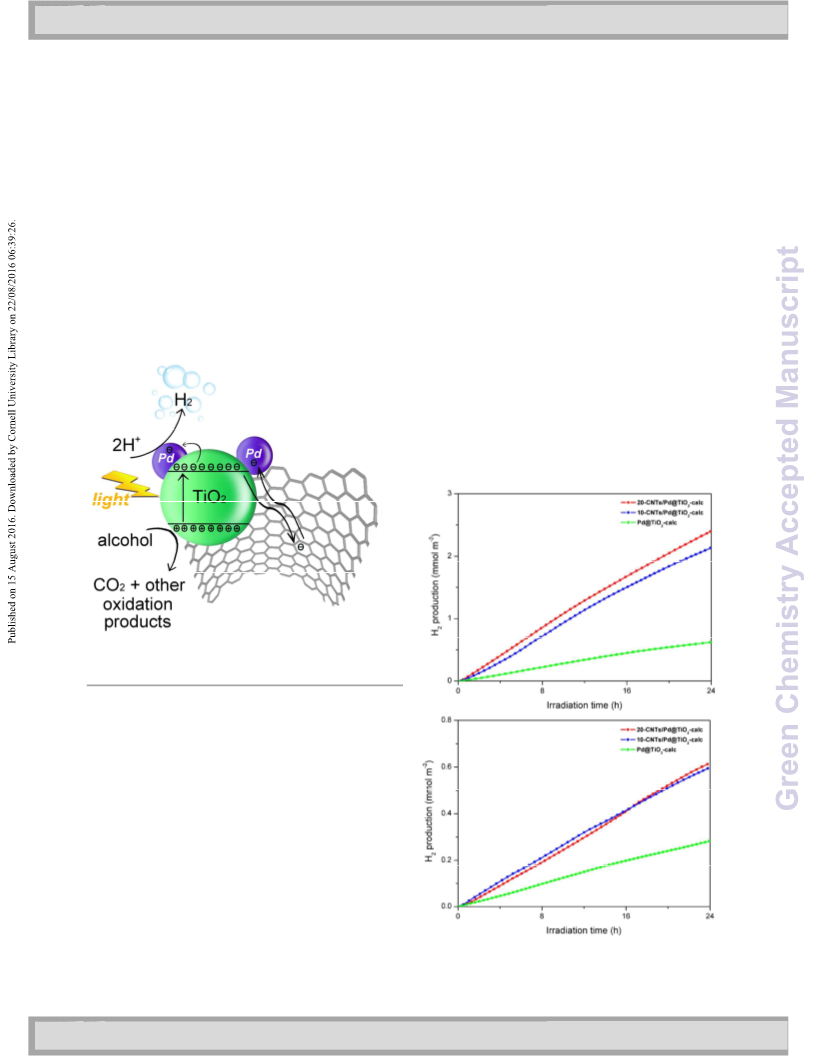
under UV) setting at 2.4 mmol mcat after 24 hours (rate per gram:
-1
-1
2
5
mmol
g
h ). By comparing with the state-of-the-art
photocatalysts, the definite step forward arises from several 12 D. Barreca, G. Carraro, V. Gombac, A. Gasparotto, C.
Maccato, P. Fornasiero and E. Tondello, Adv. Funct. Mater.,
advantages, such : 1) the use of lower-powered irradiation lamps, 2)
2
3 K. Shimura and H. Yoshida, Energy Environ. Sci., 2011, 4,
011, 21, 2611.
the use of Pd in lieu of the intrinsically more active, but more costly,
Pt, 3) the replacement of generally used methanol as sacrificial
electron donor with alcohols of higher value. All these advantages
are realized without compromising the H2 productivity. The
outstanding performance of the catalysts critically depends on the
developed synthetic protocols, allowing a uniform and tight
interfacing of the three components, which can therefore work in
perfect synergy. The catalysts also exhibit excellent stability over at
least 24 h. Last, in the wider view, the anatomy of the synthetic
photocatalyst to unveil the corresponding structure/reactivity
relationships is expected to provide the key guidelines to evolve a
new generation of carbon supported catalysts for artificial water
splitting.
1
1
1
2467.
4 X. Chen, S. Shen, L. Guo and S. S. Mao, Chem. Rev., 2010,
10, 6503.
1
5 S. Zinoviev, F. Müller-Langer, P. Das, N. Bertero, P.
Fornasiero, M. Kaltschmitt, G. Centi and S. Miertus,
ChemSusChem, 2010, 3, 1106.
6 T. Montini, M. Monai, A. Beltram, I. Romero-Ocaña and P.
Fornasiero, Mater. Sci. Semicond. Process., 2016, 42, 122.
7 A. V. Puga, Coord. Chem. Rev., 2016, 315, 1.
1
1
1
8 M. Cargnello, A. Gasparotto, V. Gombac, T. Montini, D.
Barreca and Paolo Fornasiero, Eur. J. Inorg. Chem., 2011, 28
309.
9 O. Carp, C. L. Huisman and A. Reller, Prog. Solid State Chem.,
004, 32, 33.
0 A. Primo, A. Corma and H. Garcia, Phys. Chem. Chem. Phys.,
011, 13, 886.
1 T. Montini, V. Gombac, L. Sordelli, J. J. Delgado, X. Chen, G.
Adami and P. Fornasiero, ChemCatChem, 2011, , 574.
,
4
1
2
2
2
2
2
3
Acknowledgements
2 A. V. Korzhak, N. I. Ermokhina, A. L. Stroyuk, V. K.
Bukhtiyarov, A. E. Raevskaya, V. I. Litvin, S. Ya. Kuchmiy, V. G.
1
0 | J. Name., 2012, 00, 1-3
This journal is © The Royal Society of Chemistry 20xx
Please do not adjust margins

 Beltram