
Photochemical and Photobiological Sciences p. 863 - 870 (2019)
Update date:2022-08-28
Topics:
 Salazar-Beltrán, Daniel
Hinojosa-Reyes, Laura
Maya-Alejandro, Fernando
Turnes-Palomino, Gemma
Palomino-Cabello, Carlos
Hernández-Ramírez, Aracely
Guzmán-Mar, Jorge Luis
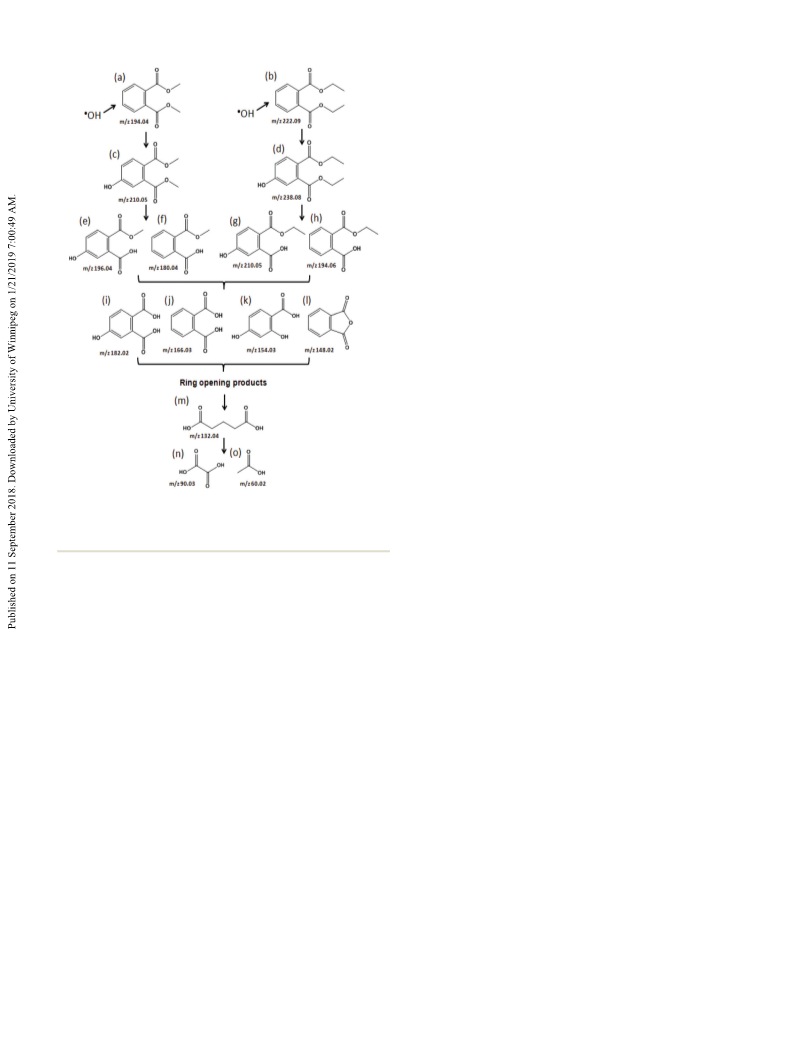
A fully automated on-line system for monitoring the TiO2-based photocatalytic degradation of dimethyl phthalate (DMP) and diethyl phthalate (DEP) using sequential injection analysis (SIA) coupled to liquid chromatography (LC) with UV detection was proposed. The effects of the type of catalyst (sol-gel, Degussa P25 and Hombikat), the amount of catalyst (0.5, 1.0 and 1.5 g L-1), and the solution pH (4, 7 and 10) were evaluated through a three-level fractional factorial design (FFD) to verify the influence of the factors on the response variable (degradation efficiency, %). As a result of FFD evaluation, the main factor that influences the process is the type of catalyst. Degradation percentages close to 100% under UV-vis radiation were reached using the two commercial TiO2 materials, which present mixed phases (anatase/rutile), Degussa P25 (82%/18%) and Hombikat (76%/24%). 60% degradation was obtained using the laboratory-made pure anatase crystalline TiO2 phase. The pH and amount of catalyst showed minimum significant effect on the degradation efficiencies of DMP and DEP. Greater degradation efficiency was achieved using Degussa P25 at pH 10 with 1.5 g L-1 catalyst dosage. Under these conditions, complete degradation and 92% mineralization were achieved after 300 min of reaction. Additionally, a drastic decrease in the concentration of BOD5 and COD was observed, which results in significant enhancement of their biodegradability obtaining a BOD5/COD index of 0.66 after the photocatalytic treatment. The main intermediate products found were dimethyl 4-hydroxyphthalate, 4-hydroxy-diethyl phthalate, phthalic acid and phthalic anhydride indicating that the photocatalytic degradation pathway involved the hydrolysis reaction of the aliphatic chain and hydroxylation of the aromatic ring, obtaining products with lower toxicity than the initial molecules.
View More



Contact:+86-134-5286-9121
Address:Add: Wing Tuck Commercial Centre, 177-183 Wing Lok Street, Hong Kong,
Contact:
Address:
Hangzhou Donglou Bio-nutrient Co., Ltd.
Contact:+86-571-82225795,13967112289
Address:Louta Town, Xiaoshan,Hangzhou,Zhejiang
Ningbo Tide Imp. & Exp. Co., Ltd.
Contact:+86-571-8993 7933; +86-571-8993 6453
Address:7/F Anno Domini Building, Tower South, 8 Qiu Shi Road,Hangzhou,China.
Shanghai Dianyang Industry Co.,ltd
Contact:+86 21 6492 4669
Address:Chejing RD, Songjiang District, Shanghai, China
Doi:10.1007/BF00956231
(1984)Doi:10.1039/j19680000869
(1968)Doi:10.1016/j.ica.2018.08.034
(2018)Doi:10.1016/S0277-5387(00)83512-3
(1986)Doi:10.1016/S0040-4039(00)74267-5
(1991)Doi:10.1021/jo501640d
(2014)
