
Organometallics p. 2430 - 2443 (1994)
Update date:2022-08-18
Topics:
 Lambert, Joseph B.
Zhang, Shizhong
Ciro, Sol M.
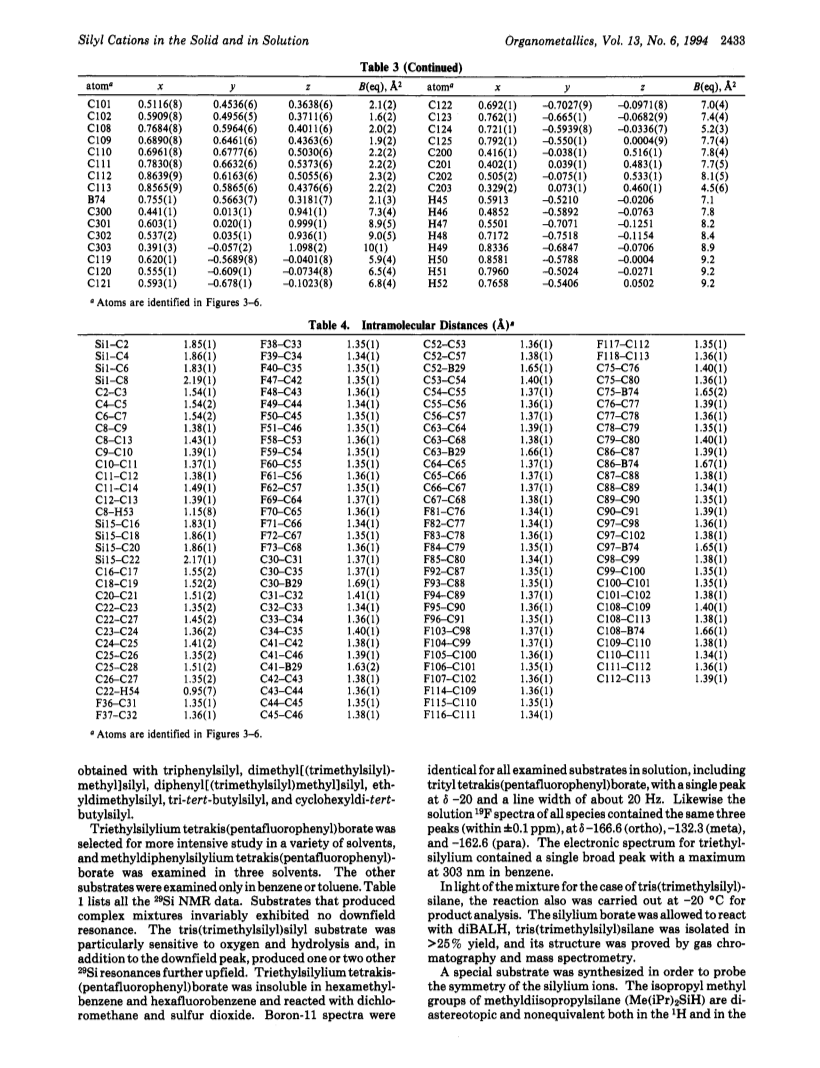
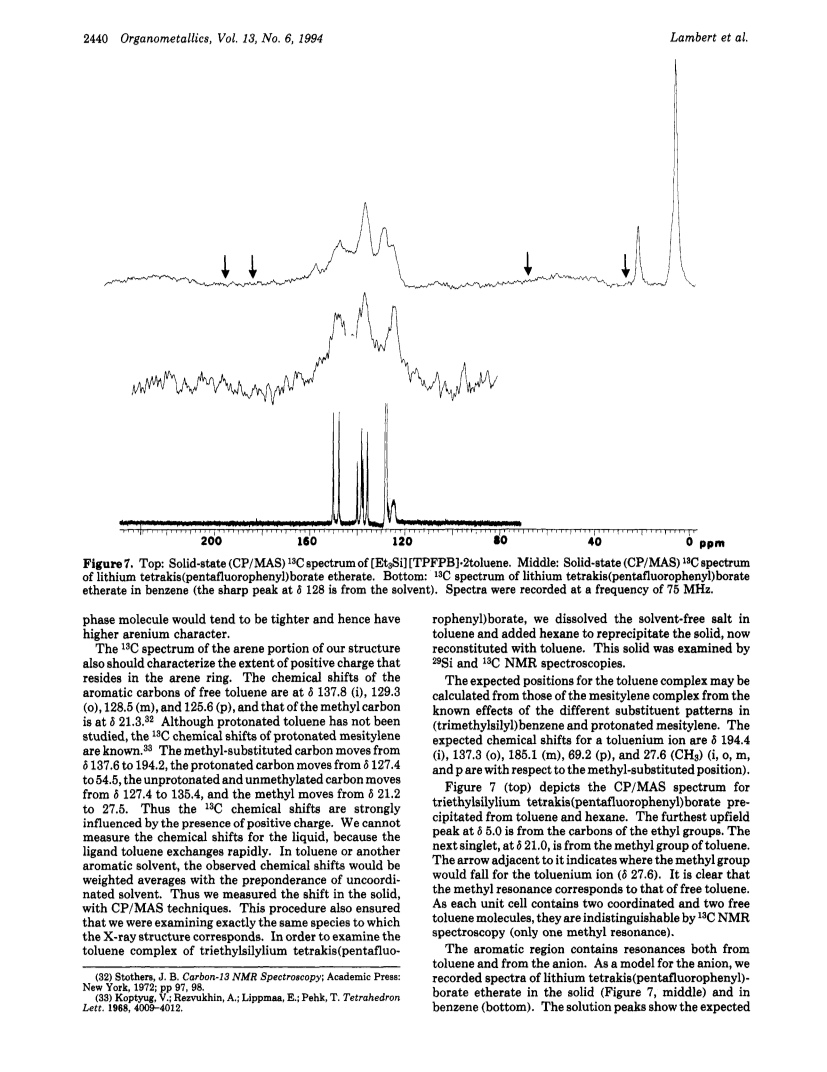
Reaction of silanes with triphenylmethyl tetrakis(pentafluorophenyl)borate (TPFPB) with excess silane as solvent yields a white solid that may be examined directly or dissolved for experiments in solution. The NMR properties of the material in a variety of solvents indicate that the anion is free and unperturbed by the presence of the silicon species. The 29Si chemical shift is highly dependent on the nucleophilicity of the solvent, with large downfield shifts (compared with the analogous silane, Δδ) in the order acetonitrile, sulfolane, toluene, benzene. The largest Δδ values for alkyl substituents in the arene solvents are ca. 100 ppm, far short of the expectation for a fully trigonal silylium ion. For tris(trimethylsilyl)silylium tetrakis-(pentafluorophenyl)borate, Δδ is 228.5 ppm, much closer to the trigonal ideal. The 29Si shifts of the solid, which had never been exposed to a solvent, are almost identical to those in benzene solution. For the case of methyldiisopropylsilane, with diastereotopic methyl groups, conversion to the TPFPB salt resulted in homotopic protons and carbons in a variety of solvents, which require a dynamic process between bound and unbound silyl species with a barrier of no more than about 13 kcal mol-1. The X-ray crystallographic structure of triethylsilylium tetrakis-(pentafluorophenyl)borate recrystallized from hexane/toluene contains silicon in a distorted pyramid with normal coordination to the methylene carbons (1.85 A?) and an experimentally unprecedented distant coordination to toluene (2.18 A?). This Si-C distance to the para position of toluene is equivalent to a bond order of 0.28 according to the Pauling equation. The coordinated toluene is planar and essentially unaltered by the interaction with silicon, in contrast to the crystal structures of known arenium ions (σ complexes). The solid state 13C spectrum indicates little transfer of positive charge to toluene. Thus the arenium ion model is rejected by experiment. The ions are best termed silyl cations with weak η1 π coordination to toluene.






Chongqing Yawei Fine Chemical Co.,Ltd
Contact:0086-23-62849407
Address:Ziyou village, Nanquan town, Banan district, Chongqing China
Nanjing Chemzam Pharmtech Co., Ltd.
Contact:+86-25-86462165,+86-13915979898
Address:C5-1,6 Maiyue Road,Maigaoqiao,Nanjing,Jiangsu,China
website:http://www.lonwinchem.com
Contact:Tel: 86-21-59858395
Address:No#966,Huaxu Road,Shanghai 201702,P.R.China
Shenzhen JYMed Technology Co.,Ltd.
website:http://www.jymedtech.com
Contact:+86-755-26612112
Address:1#8,9/F, Biomedicine innovation Industrial Park, No.14, Jinhui Road, Pingshan Sistrict, Shenzhen, China
Dayang Chem (Hangzhou) Co.,Ltd.
website:http://www.dycnchem.com
Contact:+86-571-88938639
Address:9/F, Unit 2 Changdi Torch Building, 259# WenSan Road, Xihu District, Hangzhou City 310012, P.R.China
Doi:10.1021/acs.jnatprod.6b00321
(2016)Doi:10.1021/jo01039a503
(1963)Doi:10.1002/cber.19721050635
(1972)Doi:10.1039/c3cc45476b
(2013)Doi:10.1002/anie.201603921
(2016)Doi:10.1246/bcsj.58.3383
(1985)
