Angewandte
Chemie
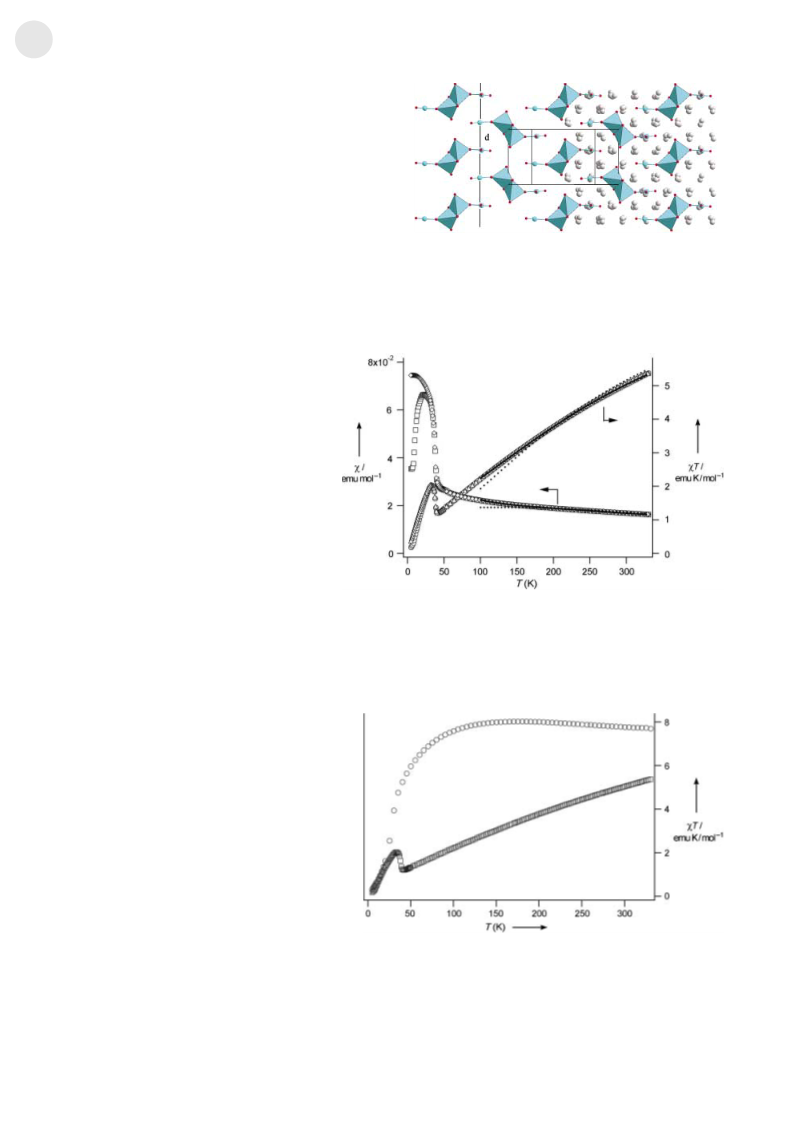
in which S1 = S4 = 3/2 and S2 = S3 = 2, and the Co3+–Co3+
interaction is neglected (J = spin coupling constant). A
least-squares fit of cT calculated on the basis of Equation (2)
and the van Vleck equation[15] with g = 2.0 (g = g-factor) for
all the ions to the data between 330 K and 100 K yields 2J =
ꢀ70 cmꢀ1 and the broken line in Figure 3. The full line
corresponds to a fit with the g values as additional fit
parameters: g1 = g4 = 1.71, g2 = g3 = 2.15 and 2J = ꢀ81 cmꢀ1.
Considering the very approximate character of our model the
fits are surprisingly good. Anisotropy, which is expected to be
important for both Co2+ and Co3+ in distorted triangular and
Td coordination, respectively, does not significantly affect the
magnetic properties above 100 K.
Cobalt oxide was prepared by heating Co(C2O4)·2H2O (Alfa,
Reagent Grade) in a stream of oxygen at 3758C for 24h. Precursors
(NaN3, NaNO3 and Co3O4) were mixed in the required ratio
according to Equation (1), ground in a ball mill, pressed in pellets
under 105 N, dried under vacuum (10ꢀ3 mbar) at 1508C for 12 h, and
placed under argon in a tightly closed steel container provided with a
silver inlay.[4b] In a flow of dry argon the following temperature
treatment was applied: 25!2608C (100 Khꢀ1); 260!3808C
(5 Khꢀ1); 380–5008C (20 Khꢀ1) followed by subsequent annealing
for 50 h at 5008C. The obtained black powder is very sensitive to air
and moisture and all following manipulation were performed in an
inert atmosphere of purified argon.
Single crystals were grown by subsequent annealing of the as-
prepared powder at 5008C for 2000 h in silver crucibles, which were
sealed in glass ampoules under dry argon.
The dominant antiferromagnetic Co2+–Co3+ interaction
with 2J = ꢀ81 cmꢀ1 is due to the superexchange through the
oxygen ion. The Co3+ lies approximately in the triangular
plane of the Co2+ coordination, and the Co2+-O-Co3+ angle is
1248. The planar Co2+ coordination forces two unpaired
electrons into the coordination plane. They will have signifi-
cant overlap with oxygen 2s and 2p orbitals. On the Co3+ side
all the t2 orbitals are singly occupied in tetrahedral coordina-
tion. As a result of the overlap with the oxygen orbitals some
spin density will be transferred also from Co3+ to oxygen. The
situation thus bears some resemblance with dihydroxo-
bridged Cu2+ dimers, in which the relevant orbital interactions
occur in the Cu2+-O-Cu2+ plane.[16] In these, the sign and the
magnitude of J is a function of the angle at the bridging
oxygen, and for an angle of 1248 it is strongly antiferromag-
netic. The interaction between the central Co3+ ions is much
weaker, and we attribute this mainly to the much smaller
Co3+-O-Co3+ angle of 928, which leads to a cancellation of
Magnetic measurements were performed on a SQUID-Magneto-
meter (MPMS 5.5, Quantum Design) between 2 and 330 K in a
magnetic field up to 5 T.
Received: March 27, 2003 [Z51506]
Keywords: cobalt · crystal structure · magnetic properties ·
.
mixed-valent compounds · oxo ligands
[1] N. Cavadini, C. Rüegg, A. Furrer, H. U. Güdel, K. Krämer, H.
Mutka, P. Vorderwisch, Phys. Rev. B 2002, 65, 132415.
[2] G. Blumberg, P. Littlewood, A. Gozar, B. S. Dennis, N.
Motoyama, H. Eisaki, S. Uchida, Science 2002, 297, 584.
[3] A. Caneschi, D. Gatteschi, R. Sessoli, A. L. Barra, L. C. Brunel,
M. Guillot, J. Am. Chem. Soc. 1991, 113, 5873.
[4] a) D. Trinschek, M. Jansen, Angew. Chem. 1999, 111, 234;
Angew. Chem. Int. Ed. 1999, 38, 133; b) M. Sofin, E. M. Peters,
M. Jansen, Z. Anorg. Allg. Chem. 2002, 628, 2691.
[5] Crystal data: monoclinic, C2/c (No. 15), Z = 4, a = 14.9061(4),
b = 8,1008(2), c = 11.4233(3) , b = 104.6102(9)8, Mr = 625.62,
1 = 3.11, Single crystal X-ray structure determination: intensities
were measured at 293 K with graphite-monochromatized MoKa
radiation (l = 0.71069 ) on a Bruker AXS Diffraktometer with
APEX Smart CCD; 3510 independent reflections (13458 total
measured) were analysed by direct method. The refinement by
full-matrix least squares gave final values R1(all) = 0.0294,
Rw(all) = 0.0689. Further details on the crystal structure inves-
tigations may be obtained from the Fachinformationszentrum
Karlsruhe, 76344 Eggenstein-Leopoldshafen, Germany (fax:
(+ 49)7247-808-666; e-mail: crysdata@fiz-karlsruhe.de), on
quoting the depository number CSD-413025.
[6] W. Burow, R. Hoppe, Z. Anorg. Allg. Chem. 1979, 459, 79; M. G.
Barker, G. A. Fairhall, J. Chem. Res. Synop. 1979, 371; W. Burow,
R. Hoppe, Z. Anorg. Allg. Chem. 1980, 467, 158; F. Bernhardt, R.
Hoppe, Z. Anorg. Allg. Chem. 1993, 619, 1807; R. Hoppe, J. Birx,
Z. Anorg. Allg. Chem. 1988, 557, 171; J. Birx, R. Hoppe, Z.
Anorg. Allg. Chem. 1990, 591, 67; J. Birx, R. Hoppe, Z. Anorg.
Allg. Chem. 1990, 588, 7; F. Bernhardt, R. Hoppe, Z. Anorg. Allg.
Chem. 1994, 620, 586.
ferro and antiferromagnetic contributions to J within Co3+
ꢀ
3+
ꢀ
O/O Co plane. This view is supported by comparison with
Na6Co2O6 where for a virtually identical geometry there is no
manifestation of magnetic interactions down to about 100 K.
At 50 K in Na10Co4O10 we thus have two strongly AF
coupled Co2+–Co3+ dimers, each with a S = 1/2 ground state.
The coupling between these dimers is weak and cannot be
quantified because of the onset of the ferromagnetic order at
38 K. This cooperative effect results from intercluster inter-
actions. An inspection of the crystal structure (Figure 2)
reveals unusually short Co2+–Co2+ distances of d = 4.1
along the b axis between neighboring clusters, which may act
as interaction pathways. From the small value of the ordered
moment M = 0.13 mB per Co4 at 10 K the order is more likely
canted antiferromagnetic rather than ferromagnetic.
In conclusion, the unusual new structure of the title
compound is accompanied by unusual magnetic properties.
We can clearly determine a hierarchy of exchange effects. A
strong antiferromagnetic intracluster exchange interaction
between Co2+ and Co3+ ions dominates the high T magnetic
behavior. Below 38 K cooperative effects become important.
As a consequence, the intracluster Co3+–Co3+ coupling and
the intercluster interactions cannot be separated.
[7] M. Jansen, R. Hoppe, Z. Anorg. Allg. Chem. 1975, 417, 31.
[8] C. Delmas, C. Fouassier, P. Hagenmuller, J. Solid State Chem.
1975, 13, 165.
[9] W. Burow, R. Hoppe, Naturwissenschaften 1980, 67, 192.
[10] J. Birx, R. Hoppe, Z. Anorg. Allg. Chem. 1991, 597, 19.
[11] L. C. Baker, T. P. McCutchean, J. Am. Chem. Soc. 1956, 78, 4503.
[12] R. D. Shannon, Acta Crystallogr. Sect. A 1976, 32, 751.
[13] A. Möller, Chem. Mater. 1998, 10, 3196.
[14] M. Sofin, E. M. Peters, M. Jansen, unpublished results.
[15] R. L. Carlin, Magnetochemistry, Springer, New York, 1986.
[16] O. Kahn, Molecular Magnetism, VCH Publishers, New York,
1993, p. 160.
Experimental Section
Starting materials for the preparation of Na10Co4O10 were NaN3
(Sigma, 99.5%), NaNO3 (Aldrich, 99%) and activated Co3O4.
Angew. Chem. Int. Ed. 2003, 42, 3527 –3529
ꢀ 2003 Wiley-VCH Verlag GmbH & Co. KGaA, Weinheim
3529

 Sofin, Mikhail