Thermoanalytical and NMR investigation of NaBH
4
Á2H
2
O thermolysis process
This process might correspond to reaction 1. Then con-
version reaction (reaction 2) proceeds with an oxoderiva-
tive and sodium metaborate formation. The process
duration is 15 min.
a crystalline NaBH4Á2H2O proceeds like hydrolysis in
solutions.
4. Catalytic thermolysis proceeds as an exothermic process
in the temperature range 40–90 °C, i.e., at much lower
temperatures than non-catalytic thermolysis. Change of
mass (* 23%) indicates an increase in the proportion of
hydrogen in the thermolysis products compared to non-
catalytic process, where the change in mass is about
45%. Consequently, the catalytic thermolysis decreases
the by-products of hydroxyborohydrides.
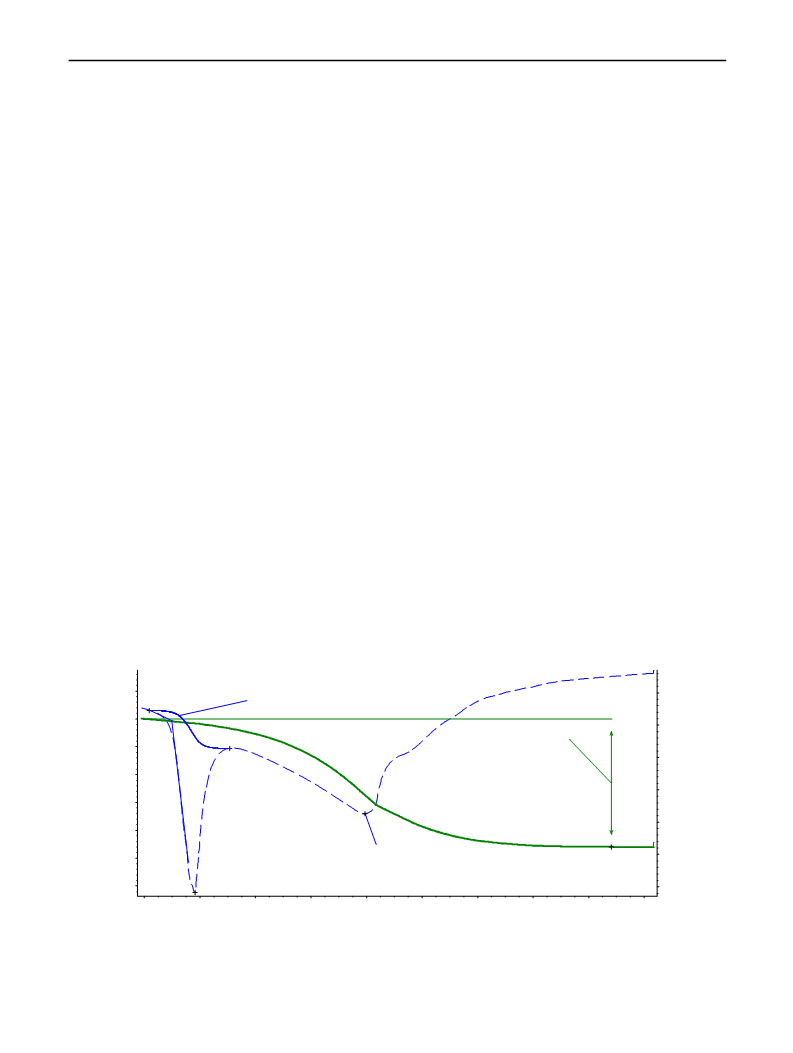
The situation is dramatically different in the presence of
a solid catalyst (Fig. 10).
The entire process duration is 4 min at the same tem-
perature. Both curves have inflection points in 1 min after
the process starts. This indicates the increasing impact of
the second stage of the process. This might be due to the
increasing rate of the sodium metaborate hydrate forma-
tion. Two minutes after the process starts, it transforms into
a solid phase. Thus, the liquid-phase formation defines the
process behavior in case of the catalytic thermolysis also. It
should be noted that thermolysis process does not occur at
temperatures below 35 °C and under external pressure of
water steam C 7 mm Hg even in the presence of a solid
catalyst.
5. Kinetic calculations showed that the non-catalytic
process proceeds as two successive stages. The
catalytic process had statistically two significant par-
allel processes. The values of the kinetic parameters in
a catalytic process were substantially more, i.e.,
thermolysis speed increases as increasing temperature
becomes much stronger.
Thus, the characteristic feature of thermolysis
NaBH4Á2H2O is formation of the hydroxyborohydrides in
case of non-catalytic process as well in the presence of a
solid catalyst.
Acknowledgements This work was supported by the RFBR under
Grant No. 15-03-0750.
References
Calculations of the thermolysis NaBH Á2H O for iso-
4
2
therm characterizes only the conditions of thermoanalytical
experiments. But the joint solution of the kinetic, heat and
mass transfer equations will take into account the scale
factor.
1
. Schlesinger HI, Brown HC, Finholt AE, Gilbreath JR, Hoekstra
H, Hyde RK. Sodium borohydride, its hydrolysis and its use as a
reduction agent and in the generation of hydrogen. J Am Chem
Soc. 1953;75:215–9.
2
3
. Orimo SI, Nakamori Y, Eliseo JR, Zuttel A, Jensen CM. Complex
hydrides for hydrogen storage. Chem Rev. 2007;107(10):4111–32.
. Amendola SC, Sharp-Goldman SL, Janjua MS, Spencer NC,
Kelly MT, Petillo PJ, Binder M. A safe, portable, hydrogen gas
generator using aqueous borohydride solution and Ru catalyst. Int
J Hydrog Energy. 2000;25(10):969–75.
. Marrero-Alfonso EY, Beaird AM, Davis TA, Matthews MA.
Hydrogen generation from chemical hydrides. Ind Eng Chem
Res. 2009;48:3703–12.
Conclusions
1
.
According to DSC measurements, the enthalpy of the
endothermic effect in the temperature range of
4
-
1
3
0–40 °C was 19 ± 2 kJ mol . This effect is caused
by the peritectic reaction, which resulted in a suspen-
sion of anhydrous sodium borohydride in a saturated
solution.
5. Beaird AM, Davis TA, Matthews MA. Deliquescence in the
hydrolysis of sodium borohydride by water vapor. Ind Eng Chem
Res. 2010;49:4596–9.
6
. Yongsheng Wei Ru, Wang Liyuan Meng, Wang Yan, Li Guode,
Xin Shigang, Zhao Xinsheng, Zhang Ke. Hydrogen generation
Thus, the thermolysis of NaBH Á2H O proceeds at a
4
2
from alkaline NaBH
catalyst supported on carbon cloth. Int J Hydrog Energy.
017;42(15):9945–51.
7. Li Qiming, Li Fang, Zhao Shiduo, Xia Xin. Hydrogen generation
from hydrolysis of NaBH based on high stable NiB/NiFe
catalyst. Int J Hydrog Energy. 2017;42(7):3971–80.
4
solution using a dandelion-like Co–Mo–B
significant rate at temperatures above 36.4 °C (i.e., at the
peritectic transition temperature) in both cases: either with
or without solid catalyst. The change in mass during non-
catalytic thermolysis is observed in the temperature range
2
4
2 4
O
4
0–150 °C.
8
. Simagina VI, Komova OV, Ozerova AM, Netskina OV, Odegova
GV, Kellerman DG, Bulavchenko OA, Ishchenko AV. Cobalt
oxide catalyst for hydrolysis of sodium borohydride and ammonia
borane. Appl Catal A. 2011;394:86–92.
2
.
NaBH4Á2H2O heating in air to a temperature of
5
3
50 °C leads to intense exothermic effects at
00–490 °C. The appearance of these effects is due
9. Malceva NN, Khain VC. Sodium borohydride. Moscow: Nauka;
985 (in Russian).
0. Filinchuk Y, Hagemann H. Structure and properties of NaBH4-
O and NaBH . Eur J Inorg Chem. 2008;20:3127–33.
1
to the oxidation of hydroxycomplexes borohydride
1
1
anion as the partial hydrolysis products.
2
H
2
4
1
1
3
.
At 70 °C, in NMR B spectra, a group of multiplets
three quartets were recorded, which indicates the
possibility of formation of a hydroxyborohydride anion
1. Marrero-Alfonso EY, Gray JR, Davis TA, Matthews MA. Mini-
mizing water utilization in hydrolysis of sodium borohydride: the
role of sodium metaborates hydrates. Int J Hydrog Energy.
2007;32:4723–30.
-
-
BH OH or (BH ) OH . Consequently, thermolysis of
3 3 2
123

 Arkhangelskii