Journal of the American Chemical Society
Article
with BArF − anion (ArF = 3,5-bis(trifluoromethyl)phenyl),
processes relevant to methanol carbonylation,3,25−27 and
some reports point to methanolysis while others propose C−
I reductive elimination to produce acetyl iodide as an
intermediate.3,25−27,36,37
4
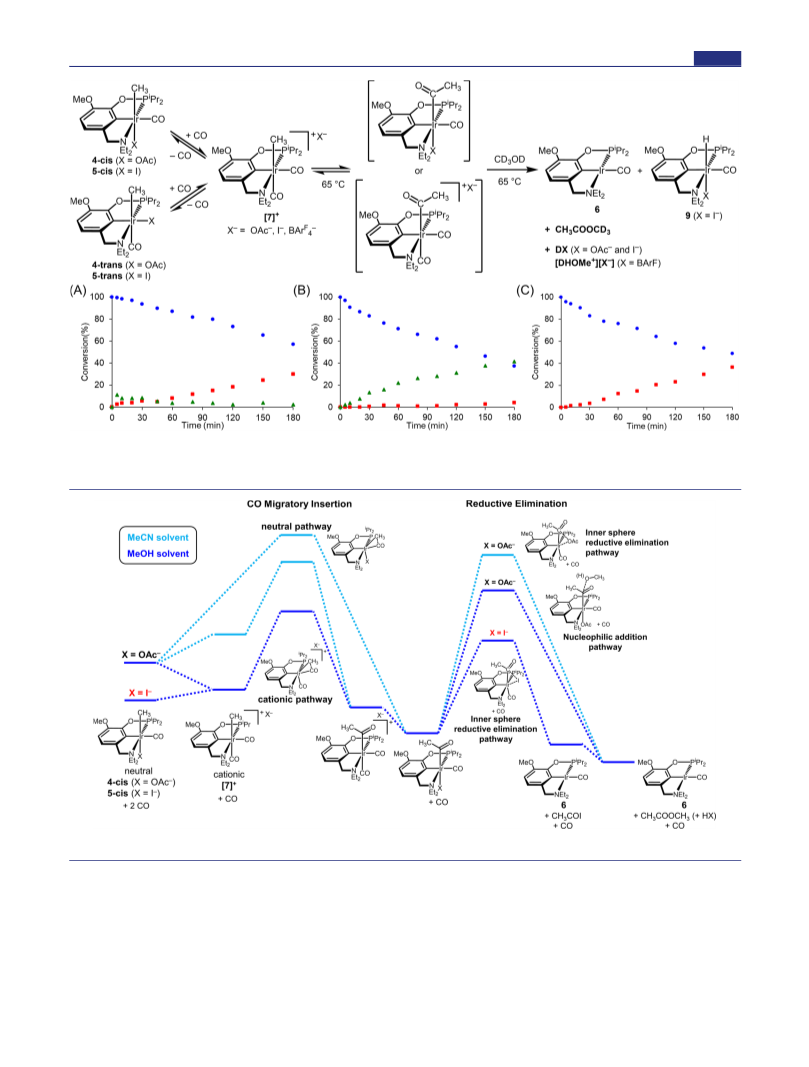
[(MeO‑EtNCOP)Ir(CH3)(CO)2][BArF ] ([7][BArF ]), was
4
synthesized from the reaction of 4-cis with NaBArF 4 under a
4
CO atmosphere (Scheme 4). CD2Cl2 solutions of [7][BArF ]
4
The reactivity of iodide species 5-cis was examined under
CO to compare with the previously described reactivity of
acetate complex 4-cis. Because of poor solubility of 5-cis in
CD3OD, 5-cis was dissolved in a mixture of 90% CD3OD and
10% 1,2-dichloroethane (DCE) and charged with 1 atm of
CO. At ambient temperature, relatively little iodide dissocia-
tion was observed. After 24 h the mixture comprised unreacted
5-cis, the isomer where the CO is trans to methyl
Scheme 4. Generation of Acetyl via Cationic Species
Formation
(
MeO‑EtNCOP)Ir(CH3)(I)(CO) (5-trans), and ∼40% yield of
[7]+. This contrasts the behavior of 4-cis, which generated
70% yield of [7]+ after only 5 h (vide supra), indicating that
iodide dissociation is less favorable than acetate dissociation in
methanol solvent. Heating this mixture for 3 h at 65 °C led to
∼40% conversion to two iridium carbonyl products, 6 and
iridium(III) hydridoiodide species (MeO‑EtNCOP)Ir(H)(CO)-
1
(I) (9), identified by a hydride resonance in the H NMR
spectrum (δ −16.64, d, JPH = 19.4 Hz), in an ∼1:8 ratio. The
formation of hydridoiodide 9 is similar to our previous study of
a crown-ether-containing iodide complex22 but contrasts the
reactivity of 4-cis to produce only iridium(I) carbonyl 6. This
raises the possibility that one role of iodide is to shift
speciation away from iridium(I) carbonyl, which could have
important implications in catalysis. For example, hydride
complexes are proposed to be responsible for catalyzing the
undesired water-gas shift reaction as a side-reaction during the
Cativa process.1,3,26,38
To better compare the influence of acetate and iodide
ligands on acetyl formation, the kinetics of CO insertion of
iodide (5-cis) and acetate (4-cis) complexes were studied. The
kinetics were first compared in CD3OD/DCE (8:2) solution,
since 5-cis is insoluble in pure methanol (Table 1). Samples
display a methyl resonance at δ −8.57 (d, JPC = 6.8 Hz) in 1H
NMR spectra and two carbonyl resonances at δ 171.54 (s) and
167.41 (d, JPC = 5.4 Hz) in 13C NMR spectra. The CO
stretching frequencies of [7][BArF ] observed by IR spectros-
4
copy (νCO = 2105, 2064 cm−1) are higher energy than those of
4-cis (2023 cm−1) and 5-cis (2015 cm−1), confirming that the
carbonyl ligands are more electrophilic in [7]+.
The cationic species [7][BArF ] underwent CO insertion in
4
acetonitrile, as predicted.23 Thermolysis of [7][BArF ] in
4
CD3CN at 80 °C under 1 atm of CO for 10 h resulted in
∼60% yield of a new species (31P{1H} NMR δ 141.61) with a
diagnostic acetyl peak (1H NMR δ 1.82, s) indicative of
[(MeO‑EtNCOP)Ir(COCH3)(CO)2][BArF ] ([8][BArF ]). Un-
Table 1. Half-Lives (t1/2, min) for Conversion of 4-cis, 5-cis,
4
4
a
and [7][BArF ] under 1 atm of CO in Methanol
fortunately, we were unable to isolate [8][BArF ] because
4
4
removal of the CO atmosphere resulted in reversion to
half-life for conversion (min)
[7][BArF ] (Scheme 4).
4
b
b
solvent
5-cis
4-cis
[7][BArF ]
4
The combined results are consistent with acetyl formation
requiring acetate dissociation to reach a cationic intermediate
capable of CO migratory insertion. Accordingly, only 25%
conversion of [7][BArF ] to [8][BArF ] was observed in the
CD3OD/DCE (8:2)
CD3OD/DCE (9:1)
CD3OD only
250(10)
120(10)
72
140(30)
120
c
270
c
−
69
95
4
4
a
1
Reactions were heated at 65 °C and monitored by H and 31P{1H}
presence of (mostly insoluble) LiOAc in CD3CN under 1 atm
of CO over 50 h at 80 °C. Complete inhibition of migratory
insertion is observed in the presence of tetrabutylammonium
acetate, with immediate formation of 4-cis and 4-trans and no
NMR (25 °C); based on standard deviation of two trials in CD3OD/
DCE (8:2), the expected uncertainty for other conditions is 10%.
Half-life (t1/2) is the time to 50% conversion based on an exponential
fit of the decaying signal for the Ir−methyl complex (first ∼35%
detectable [8][BArF ]. Whereas these data show that acetate
b
4
binds strongly to iridium in acetonitrile (acetate dissociation is
unfavorable), acetate dissociation to produce cationic iridium
species is much more facile in methanol. In fact, [7][OAc]
formed in situ in methanol under CO has almost identical
gated 31P{1H} NMR integrals for each methyl species disappearing
was summed to a single integral and plotted to obtain a weighted
c
average half-life. 5-cis is insoluble in MeOH only.
spectral features to [7][BArF ] in methanol. Formation of the
4
cationic dicarbonyl complex enables rapid migratory insertion.
Comparing Acetate and Iodide Ligands in CO
Insertion and Methyl Acetate Formation. Little is
known about how migratory insertion and organic acetyl
liberation will change based on the presence of iodide or
acetate ligands, but differences in reactivity in these later steps
of the proposed catalytic cycle could be important in iodide-
free carbonylation processes. In fact, there is relatively little
mechanistic information about any reductive elimination
containing 16 mM Ir were prepared in the glovebox, charged
with 1 atm of CO, and heated at 65 °C. The reaction progress
1
was followed by H and 31P{1H} NMR spectroscopy. Because
the Ir iodide and acetate complexes establish an equilibrium
mixture of cis/trans isomers and the dicarbonyl cation [7]+
under CO in MeOH, the total amount of methyl species was
used to evaluate the half-life under pseudo-first-order
G
J. Am. Chem. Soc. XXXX, XXX, XXX−XXX

 Yoo, Changho