Angewandte
Communications
Chemie
Bioinorganic Chemistry
Switchover of the Mechanism between Electron Transfer and
Hydrogen-Atom Transfer for a Protonated Manganese(IV)–Oxo
Complex by Changing Only the Reaction Temperature
Jieun Jung, Surin Kim, Yong-Min Lee, Wonwoo Nam,* and Shunichi Fukuzumi*
Abstract: Hydroxylation of mesitylene by
a
nonheme
step HAT mechanism implies that the hydrogen-atom trans-
fer reaction occurs without a transient intermediate when an
electron and a proton are transferred at the same time. In
contrast, the sequential pathway involves mechanistically
distinct ET and PT steps. In particular, there has been a long-
standing ambiguity as to the mechanistic borderline where
a HAT pathway is changed to a rate-determining ET pathway
IV
2+
manganese(IV)–oxo complex, [(N4Py)Mn (O)] (1), pro-
ceeds via one-step hydrogen-atom transfer (HAT) with a large
deuterium kinetic isotope effect (KIE) of 3.2(3) at 293 K. In
contrast, the same reaction with
manganese(IV)-oxo complex, [(N4Py)Mn (O)] -(HOTf)
a triflic acid-bound
IV
2+
2
(2), proceeds via electron transfer (ET) with no KIE at
[10–13]
2
93 K. Interestingly, when the reaction temperature is lowered
followed by a PT pathway or vice versa.
A more general
to less than 263 K in the reaction of 2, however, the mechanism
changes again from ET to HAT with a large KIE of 2.9(3).
Such a switchover of the reaction mechanism from ET to HAT
is shown to occur by changing only temperature in the
boundary region between ET and HAT pathways when the
driving force of ET from toluene derivatives to 2 is around
À0.5 eV. The present results provide a valuable and general
guide to predict a switchover of the reaction mechanism from
ET to the others, including HAT.
question is whether the rate-determining ET and the other
pathways are distinguishable and competing reactions, or
whether the mechanism is continuously changed between the
[14–19]
two extremes.
Such a general question has never been
clarified previously.
In ET reactions, the DS value is generally close to zero
owing to the structureless transition state.
°
[20–22]
In contrast,
°
HAT affords a largely negative DS value because of the
[
1]
highly structured transition state. Large differences in the
°
°
DH and DS values between ET and HAT reactions may
result in the change of the reaction mechanism depending on
temperature, particularly in the borderline region between
the two pathways. However, there has been no report on the
switchover of the mechanism between ET and HATreactions
by changing only reaction temperature.
H
ydrogen-atom transfer from hydrogen donors (RH) to
hydrogen acceptors is one of the most important and
fundamental reactions that have attracted much attention
not only in organic chemistry but also in inorganic chemis-
[1–7]
try.
There are three reaction mechanisms proposed in
hydrogen transfer, such as electron transfer (ET) followed by
proton transfer (PT), one-step hydrogen-atom transfer
We herein report for the first time that the reaction
mechanism in the hydroxylation of 1,3,5-trimethylbenzene
(mesitylene) by a triflic acid-bound manganese(IV)–oxo
[1a,8–12]
(
HAT), and PT followed by ET (Scheme 1).
The one-
IV
2+
complex, [(N4Py)Mn (O)] -(HOTf) (N4Py = N,N-bis(2-
2
[23,24]
pyridylmethyl)-N-bis(2-pyridyl)methylamine),
changes
from a sequential rate-determining ET pathway (followed
by an PT pathway) to an HAT pathway, both of which are
clearly distinguishable, only by lowering temperature. Such
a switchover of the mechanism has been confirmed by
a drastic change of the deuterium kinetic isotope effect
(
KIE) from 1.0(1) at 293 K to 2.9(3) at temperatures lower
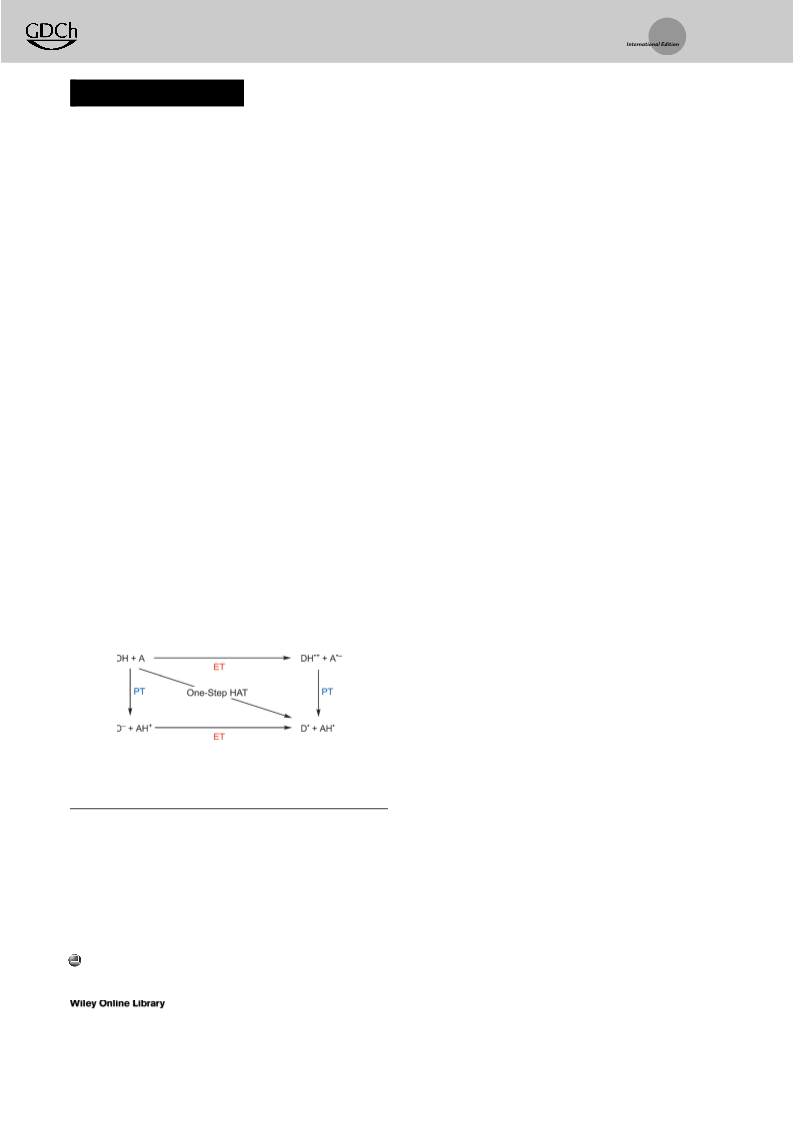
Scheme 1. Possible reaction mechanisms in hydrogen-atom transfer
reaction.
than 263 K when mesitylene and [D ]mesitylene were used as
substrates. The ET driving force dependence of the rate
constants in the hydroxylation of toluene derivatives by
12
IV
2+
[
(N4Py)Mn (O)] -(HOTf) was examined to reveal the
2
[
*] Dr. J. Jung, S. Kim, Dr. Y.-M. Lee, Prof. Dr. W. Nam,
Prof. Dr. S. Fukuzumi
Department of Chemistry and Nano Science
Ewha Womans University, Seoul 03760 (Korea)
E-mail: wwnam@ewha.ac.kr
conditions, where switchover of the mechanism between ET
and HAT can occur only by varying reaction temperature.
IV
2+
The manganese(IV)–oxo complexes, [(N4Py)Mn (O)]
IV
2+
(
1) and [(N4Py)Mn (O)] -(HOTf) (2), were generated and
2
[23,24]
characterized spectroscopically as reported previously.
Prof. Dr. S. Fukuzumi
Mesitylene was hydroxylated by 1 in CF CH OH/CH CN
3
2
3
Faculty of Science and Engineering, ALCA
SENTAN Japan Science and Technology Agency (JST)
Meijo University, Nagoya, Aichi 468-0073 (Japan)
E-mail: fukuzumi@chem.eng.osaka-u.ac.jp
(
v/v = 1:1) to yield 3,5-dimethylbenzyl alcohol and [(N4Py)M-
III 3+
n ] [Eq. (1)].
The yield of 3,5-dimethylbenzyl alcohol was determined
to be 42(4)% with a small amount of 3,5-dimethylbenzalde-
hyde (3.9(8)%; Supporting Information, Table S1). It was
7
450
ꢀ 2016 Wiley-VCH Verlag GmbH & Co. KGaA, Weinheim
Angew. Chem. Int. Ed. 2016, 55, 7450 –7454

 Jung, Jieun