Tetrahedron
Letters
Tetrahedron Letters 45 (2004) 5643–5644
2-Pivalamido-3H-pyrimidin-4-one derivatives: convenient
pivalamide hydrolysis using Fe(NO3)3 in MeOH
V. Bavetsias,* E. A. Henderson and E. McDonald
Cancer Research UK Centre for Cancer Therapeutics at The Institute of Cancer Research, Chemistry Department,
Cancer Research UK Laboratory, 15 Cotswold Road, Sutton, Surrey SM2 5NG, UK
Received 21 April 2004; revised 14 May 2004; accepted 21 May 2004
Available online 11 June 2004
Abstract—A simple methodology for pivalamide (trimethylacetamide, pivaloylamino) hydrolysis has been discovered using
Fe(NO3)3 in MeOH at room temperature. The pivalamido group of 2-pivalamido-3H-pyrimidin-4-ones or fused 2-pivalamido-3H-
pyrimidin-4-ones such as 2-pivalamido-3H-quinazolin-4-ones and 2-pivalamido-3H-pteridines have been hydrolysed under these
conditions to afford the corresponding amine.
Ó 2004 Elsevier Ltd. All rights reserved.
The need for protection of amines in organic synthesis is
well documented and there are many groups available to
achieve this.1 An amine protecting group, which has
often been used during the synthesis of 2-amino-3H-
pyrimidin-4-ones and fused 2-amino-3H-pyrimidin-4-
ones such as 2-amino-3H-quinazolin-4-one or 2-amino-
3H-pteridine derivatives, is the pivaloyl group. Our
experience working with 3H-quinazolin-4-one deriva-
tives indicated that the pivaloyl group brings the addi-
tional benefit, over other groups such as acetyl, of
making these compounds more soluble in organic sol-
vents and therefore easier to handle.
4-amino-3-hydroxypyridines from their pivalamido
counterparts.5
Alkaline conditions were also utilised for pivalamide
hydrolysis. For example, Jones et al. used 0.04 N
NaOH at 50 °C (18 h) to prepare 2-aminoquinazoline-
based inhibitors of thymidylate synthase from the
corresponding pivalamide derivatives.6 There have
also been reports by a number of researchers describing
the hydrolysis of 2-pivalamidoquinazolines or pter-
idines under mild conditions by utilising NH3 in
MeOH.7;8
A pivalamide is stable to both mild acidic or basic
environments. Usually its hydrolysis requires forceful
acidic or basic conditions, although there are limited
examples of successful hydrolysis using milder condi-
tions. For example, the removal of the pivaloyl group of
a series of 2-pivaloylaminopterin cycloadducts required
the use of 1 N HCl at 70–80 °C.2 Krajsovszky et al. used
20% H2SO4 for the hydrolysis of pivalamide deriva-
tives.3 Strongly acidic conditions (concentrated HCl in
EtOH, heating at reflux for 5 h) were also employed by
Akama et al. for pivalamide hydrolysis that led to the
preparation of 2-aminoflavone derivatives.4 Chu-Moyer
et al. utilised 3 N HCl at 90 °C for 18 h to obtain
In connection with work aimed at the synthesis of novel
anticancer agents we found that some 2-pivalamido-3H-
quinazolin-4-one derivatives upon treatment with
Fe(NO3)3Æ9H2O in MeOH gave the corresponding 2-
amino-3H-quinazolin-4-one in good yield. This finding
was further investigated using the 3H-quinazolin-4-one
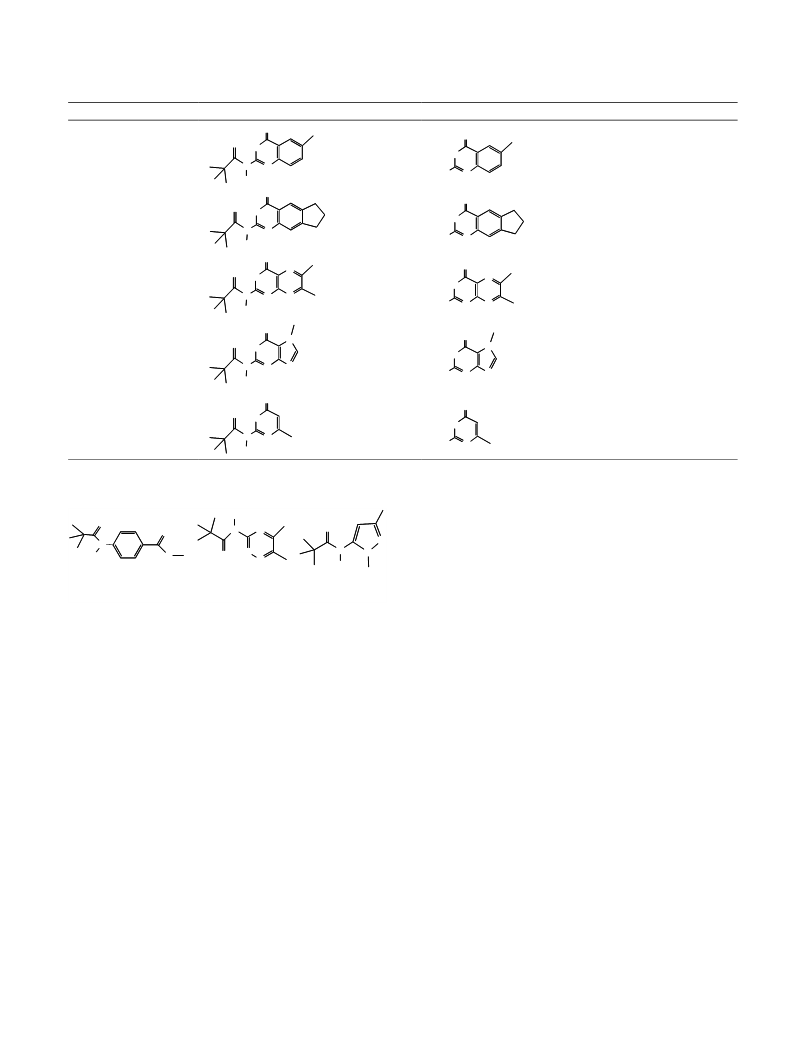
1 (Table 1, entry 1) as a model compound, and it was
established that the pivaloyl group could be removed by
using 0.2 equiv of Fe(NO3)3Æ9H2O in MeOH at room
temperature for 24 h. Removal of the MeOH under
reduced pressure, trituration of the residue with EtOH,
and finally collection of the product by filtration gave 1
in 72% yield.9 The scope of the reaction was further
explored and it was found that pivalamide analogues of
2-amino-3H-quinazolin-4-ones (entry 2), 2-aminopter-
idine (entry 3), 7-methylguanine (entry 4) and 2-amino-
3H-pyrimidin-4-one (entry 5), could also be hydrolysed
under these conditions.
Keywords: 2-Pivalamido-3H-pyrimidin-4-ones; Hydrolysis; Fe(NO3)3.
* Corresponding author. Fax: +44-0-20-87707899; e-mail: vassilios.
0040-4039/$ - see front matter Ó 2004 Elsevier Ltd. All rights reserved.
doi:10.1016/j.tetlet.2004.05.123

 Bavetsias