Communication
The catalytic role of explicit water (H2O) molecules in lower-
ing the barrier of atmospherically important hydrogen atom
transfer (HAT)-based reactions is well-documented.[16] However,
there are other species that can catalyze the HAT reactions in
atmosphere. In fact, it is now increasingly becomingly clear
that organic acids, which are present in significant amounts in
the Earth’s atmosphere,[17–19] can catalyze such reactions much
more efficiently.[20–25] For example, the role of acid catalysis in
influencing the energetics of various atmospheric processes
such as sulfuric acid (H2SO4) forming hydrolysis of SO3,[20,21] hy-
drolysis of ketene,[23] and tautomerization of the Criegee inter-
mediate[24,25] has been recently reported. In the Venusian at-
mosphere, the inorganic acid, H2SO4 is expected to be present
in appreciable amounts[26] and may play a role in CO2 activa-
tion.
further refined using the coupled-cluster single and double
substitution method with a perturbative treatment of triple ex-
citations (CCSD(T))[31] and the aug-cc-pVTZ basis set. Specifical-
ly, the zero-point-corrected CCSD(T)/aug-cc-pVTZ electronic en-
ergies at the M06-2X/aug-cc-pVTZ-optimized geometries have
been used. For all of the reactions, the M06-2X/aug-cc-pVTZ
calculated vibrational frequencies were used to estimate the
zero-point correction for the reactants, products, transition
states, and intermediates. The presence of zero or single imagi-
nary frequency was used to identify all the stationary points as
minima or transition states.
In the first step, the nucleophilic addition of H2S across the
C=O bond in the CO2 electrophile occurs. The reaction is initi-
ated with the formation of a weak van der Waals association
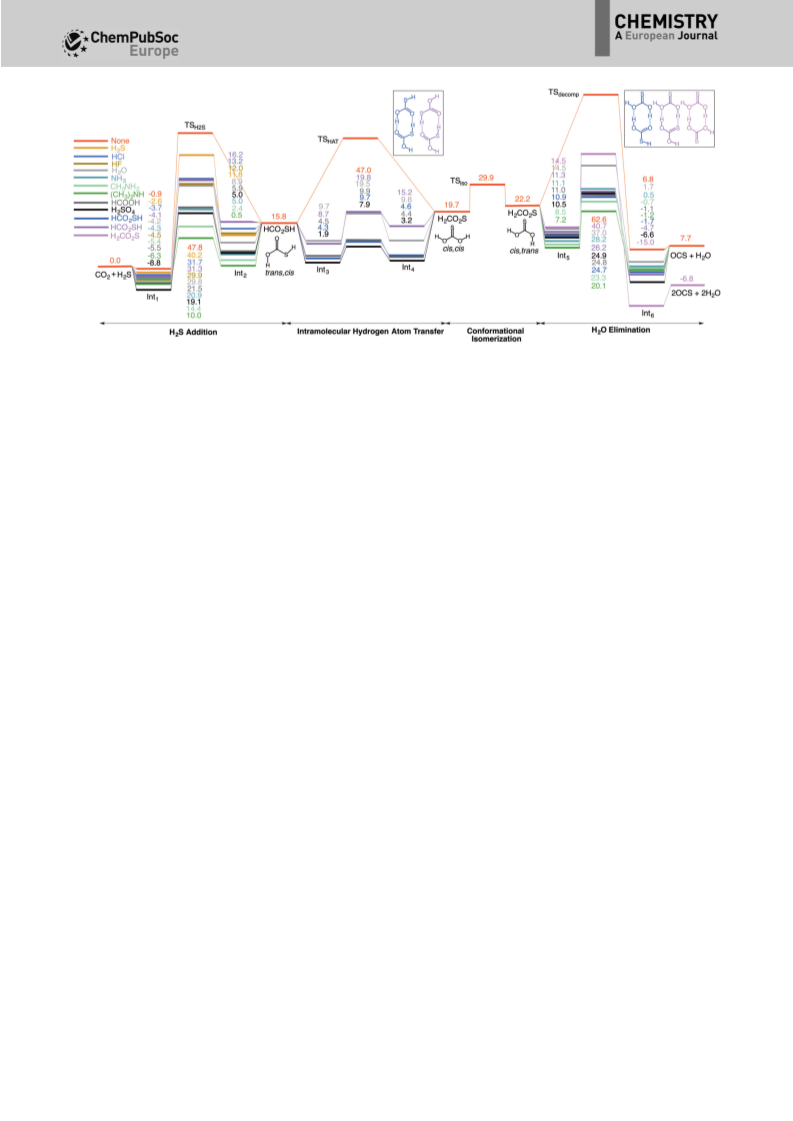
complex, Int1 between H2S and CO2, which has a nominal bind-
ing energy of 0.9 kcalmolÀ1 (Figure 1). Int1 then transforms into
trans,cis-monothiolcarbonic acid (HCO2SH) via 4-center transi-
tion state, TSH2S. The reaction has an effective barrier of
48.7 kcalmolÀ1, measured relative to Int1, and is endothermic
by 15.8 kcalmolÀ1. Though the hydrolysis of CO2 has been ex-
tensively explored,[32–35] the reaction of CO2 with H2S has not
received any attention until recently when Baltrusaitis et al. ex-
amined the gas-phase reaction between CO2 and reduced
sulfur compounds, H2S and CH3SH, using ground- and excited-
state density functional theory and coupled-cluster methods.[36]
Our calculated barrier of 48.7 kcalmolÀ1 and an endothermicity
of 15.8 kcalmolÀ1 are in reasonable agreement with their CR-
CC(2,3)/6-311+G(2df,2p)//CAM-B3LYP/6-311 +G(2df,2p) calcu-
lated values of 49.6 and 16.6 kcalmolÀ1, respectively. Additional
calculations suggest that the barrier to nucleophile addition
across the C=O bond of CO2 is tunable depending upon the
nature of a nucleophile, that is, the amine addition is more fa-
vorable than the H2O or methanol addition, which, in turn, is
preferred over the H2S addition (Supporting Information, Fig-
ure S1). Significant barrier tuning for a nucleophilic addition re-
action between XO2 (X=C, N, or S) and H2S is also achievable
by judiciously changing the central atom in XO2; sulfur dioxide,
SO2, shows more reactivity than nitric oxide, NO2, which, in
turn, does better than CO2 (Supporting Information, Figure S2).
The gas-phase CO2 activation in the presence of various cat-
alysts with single activation site is also examined here. The
effect of catalysis on the reaction is significant; for HF-, HCl-,
and H2O-catalyzed reactions, Int1 has a binding energy of 3.7–
4.5 kcalmolÀ1, and the effective barrier is lowered to 34.0-
35.4 kcalmolÀ1. Int2 is a postreaction complex in which trans,-
cis-HCO2SH and the catalyst are H-bonded and now mediates
the reaction. Int2 is 2.6–6.9 kcalmolÀ1 more stable than the sep-
arated products. The activation effect of N-based reagents,
NH3, CH3NH2, and (CH3)2NH is even higher. The Int1s and Int2s
are 4.3–6.3 kcalmolÀ1 and 10.8–15.3 kcalmolÀ1 more stable
than separated reactants and products, respectively. The rela-
tively larger stability of Int2 implies that the endothermic for-
mation of trans,cis-HCO2SH can be achieved by judicious selec-
tion of catalysis. Interestingly, the calculated barrier for the CO2
insertion correlates with the nature of amine; the barrier for
the unsubstituted amine, NH3, is 25.2 kcalmolÀ1, which is low-
ered to 19.8 kcalmolÀ1 upon single methyl substitution
H2S is an important sulfur compound that is emitted into
the atmosphere by natural and anthropogenic activities,
with fossil fuel burning as its main source.[27] The insertion of
CO2 into H2S provides a new mechanism for the formation
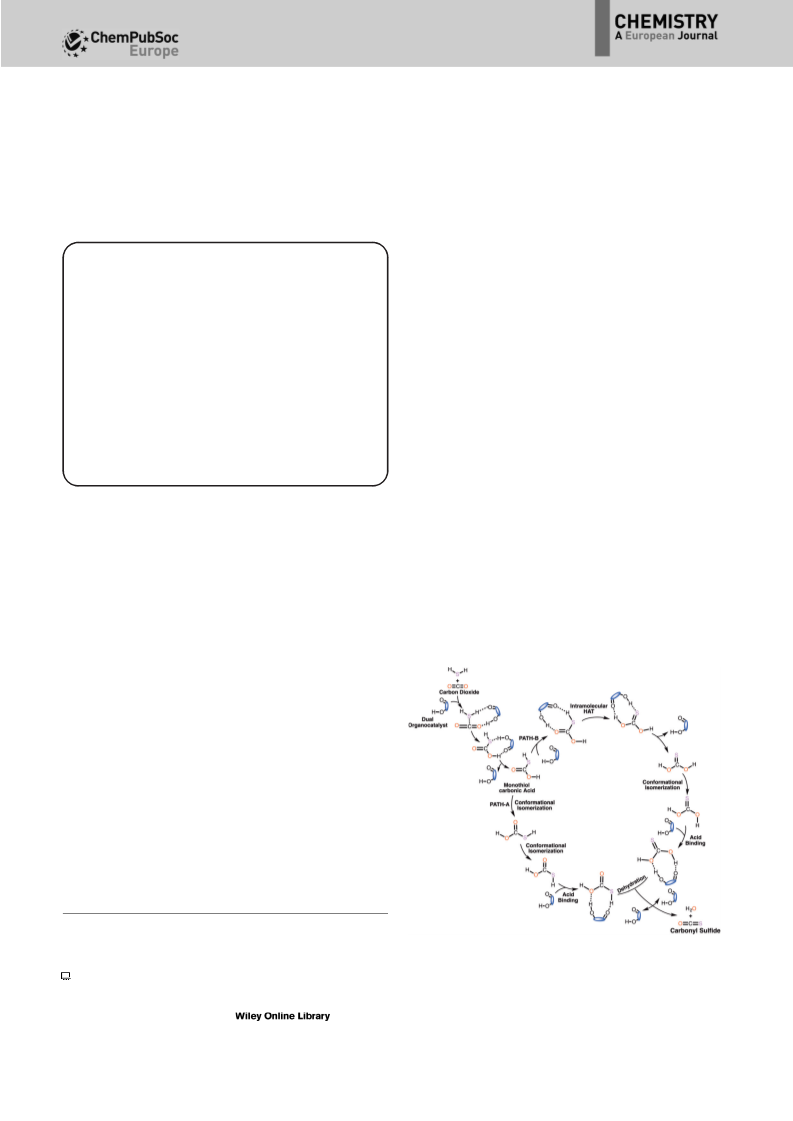
of carbonyl sulfide (O=C=S) in the troposphere (Scheme 1),
where it is one of the most abundant sulfur compounds.[27]
This reaction also holds immense significance for the atmos-
phere of Venus, where CO2 is the largest constituent (96.5%)
and the formation mechanism of OCS continues to remain un-
clear.[26]
Herein, we propose a new mechanism for the OCS formation
that takes advantage of H2S-induced CO2 activation by metal-
free dual catalysis (Scheme 1), and support its feasibility with
gas-phase electronic structure calculations. All calculations
were performed using the Gaussian 09[28] software package.
The reaction of H2S with CO2 leading to monothiolcarbonic
acid (HCO2SH), and subsequent decomposition of HCO2SH re-
sulting in OCS and H2O in the gas phase, were extensively ex-
amined by means of first-principles quantum chemical calcula-
tions. Both reactions were calculated with and without cata-
lysts. There are two possible decomposition pathways for
HCO2SH (Scheme 1). We have considered both in the present
work. The catalysts studied in the present work were H2S, H2O,
hydrogen fluoride (HF), hydrogen chloride (HCl), ammonia
(NH3), methylamine (CH3NH2), dimethylamine ((CH3)2NH),
HCO2SH, H2CO2S, HCOOH, and H2SO4. For analyzing the
HCO2SH-induced catalysis, we have considered three possible
modes of catalysis: ÀCOOH, ÀCOSH, and ÀCSOH. HCO2SH is ca-
pable of undergoing intramolecular HAT, which results in the
cis,cis conformer. We have used a different notation, H2CO2S, to
represent that cis,cis conformer, which has no hydrogen atom
directly bonded to sulfur atom. Considering that HCO2SH and
H2CO2S can exist in multiple conformers depending upon the
relative orientation of OH and/or SH moieties (Supporting In-
formation, Schemes S1 and S2), we have only explored the cat-
alysis that is due to their cis,cis and cis,trans conformations in
our calculations because the cis,cis conformer is the most
stable and the cis,trans form is involved in the sacrificial reac-
tions. The equilibrium and transition-state structures were fully
optimized using the M06-2X[29] level of density functional
theory and the augmented correlation-consistent triplet zeta
basis set, aug-cc-pVTZ.[30] The energetics of these reactions was
Chem. Eur. J. 2016, 22, 4359 – 4363
4360
ꢀ 2016 Wiley-VCH Verlag GmbH & Co. KGaA, Weinheim

 Kumar, Manoj