RSC Advances
Paper
reaction (Fig. 11D). Upon decreasing the mean size of Ru Education (no. 20130121130001), and the Program for Chang-
nanoparticles, the rate of fructose hydrogenation increased jiang Scholars and Innovative Research Team in Chinese
more rapidly. As a result, the rate of fructose hydrogenation Universities (no. IRT1036).
exceeded that of inulin hydrolysis over the catalysts with smaller
Ru nanoparticles. In other words, the rate-determining step
changed from the fructose hydrogenation to inulin hydrolysis
Notes and references
with decreasing the mean size of Ru nanoparticles over the Ru/
Cs 40 catalysts. Thus, it becomes understandable that
hexitols are produced as the main products over the catalyst
with a smaller mean size of Ru particles (in particular 1.9 or 2.3
nm), while fructose is formed dominantly over the one with
bigger Ru particles.
1 (a) D. Klemm, B. Heublein, H. P. Fink and A. Bohn, Angew.
Chem., Int. Ed., 2005, 44, 3358; (b) P. L. Dhepe and
A. Fukuoka, ChemSusChem, 2008, 1, 969; (c) S. Van de
Vyver, J. Geboers, P. A. Jacobs and B. F. Sels,
ChemCatChem, 2011, 3, 82; (d) C. H. Zhou, X. Xia,
C. X. Lin, D. S. Tong and J. Beltramini, Chem. Soc. Rev.,
3
PW12O
2011, 40, 5588; (e) W. Deng, Y. Wang, Q. Zhang and
Y. Wang, Catal. Surv. Asia, 2012, 16, 91; (f) H. Kobayashi
and A. Fukuoka, Green Chem., 2013, 15, 1740; (g)
M. Yabushita, H. Kobayashi and A. Fukuoka, Appl. Catal.,
B, 2014, 145, 1; (h) A. Wang and T. Zhang, Acc. Chem. Res.,
2013, 46, 1377.
2 S. J. Kays and S. F. Nottingham, Biology and Chemistry of
Jerusalem Artichoke: Helianthus Tuberosus L., CRC Press,
Boca Raton, 2007.
4
. Conclusion
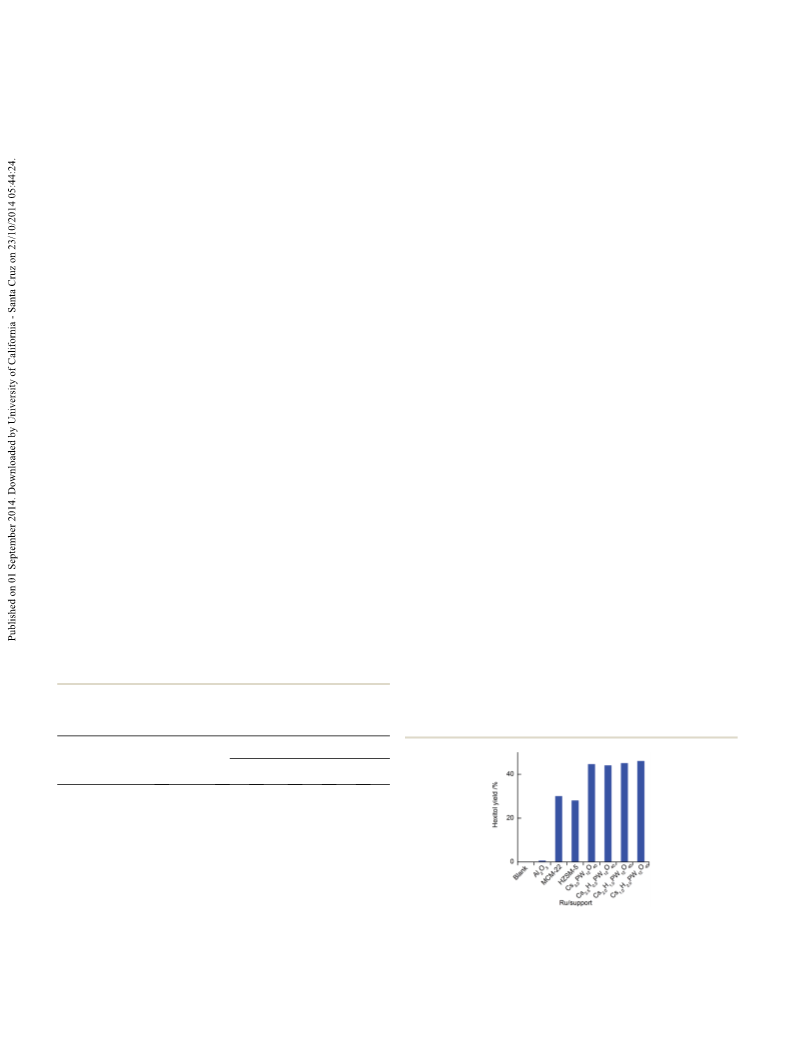
Ru nanoparticles loaded on the Keggin-type polyoxometalates,
i.e., Ru/Cs 40, were highly efficient for the conver-
sions of inulin and cellulose into hexitols in water in the pres-
ence of The Ru/Cs 40 catalysts exhibited
signicantly higher yields of hexitols than the Ru catalysts
loaded on other solid acids such as Al O , HZSM-5 and MCM-
x
H3ꢀxPW12O
H
2
.
x
H3ꢀxPW12
O
2
3
2
2. It is unexpected that the Ru/Cs
3
PW12
O
40 catalyst, which does
3 (a) A. W. Heinen, G. Papadogianakis, R. A. Sheldon,
J. A. Peters and H. van Bekkum, J. Mol. Catal., 1999, 142,
17; (b) A. W. Heinen, J. A. Peters and H. van Bekkum,
Carbohydr. Res., 2001, 330, 381.
not possess strong intrinsic Brønsted acidity, exhibits superior
performances for the conversions of both inulin and cellulose
into hexitols. Hexitol yields of 84% and 45% were achieved for
the conversions of inulin and cellulose over the Ru/Cs
3
PW12
O
40
4 L. Zhou, A. Wang, C. Li, M. Zheng and T. Zhang,
ChemSusChem, 2013, 5, 932.
catalyst at 363 K for 4 h and 433 K for 24 h, respectively. This
catalyst was robust during the recycling uses. We have
demonstrated that new Brønsted acid sites can be generated
5 T. Werpy and G. Petersen, Top Value Added Chemicals from
Biomass, 2004, vol. 1, pp. 58–60, http://www.pnl.gov/main/
publications/external/technical_reports/PNNL-14808.pdf.
6 C. Luo, S. Wang and H. Liu, Angew. Chem., Int. Ed., 2007, 46,
7636.
7 (a) R. Palkovits, K. Tajvidi, J. Procelewska, R. Rinaldi and
A. Ruppert, Green Chem., 2010, 12, 972; (b) J. Geboers,
S. Van de Vyver, K. Carpentier, P. Jacobs and B. Sels, Chem.
Commun., 2011, 47, 5590; (c) G. Liang, C. Wu, L. He,
J. Ming, H. Cheng, L. Zhuo and F. Zhao, Green Chem.,
2011, 13, 839.
8 (a) A. Fukuoka and P. L. Dhepe, Angew. Chem., Int. Ed., 2006,
45, 5161; (b) H. Kobayashi, H. Matsuhashi, T. Komanoya,
K. Hara and A. Fukuoka, Chem. Commun., 2011, 47, 2366.
9 (a) W. P. Deng, X. S. Tan, W. H. Fang, Q. H. Zhang and
Y. Wang, Catal. Lett., 2009, 133, 167; (b) W. Deng, M. Liu,
X. Tan, Q. Zhang and Y. Wang, J. Catal., 2010, 271, 22.
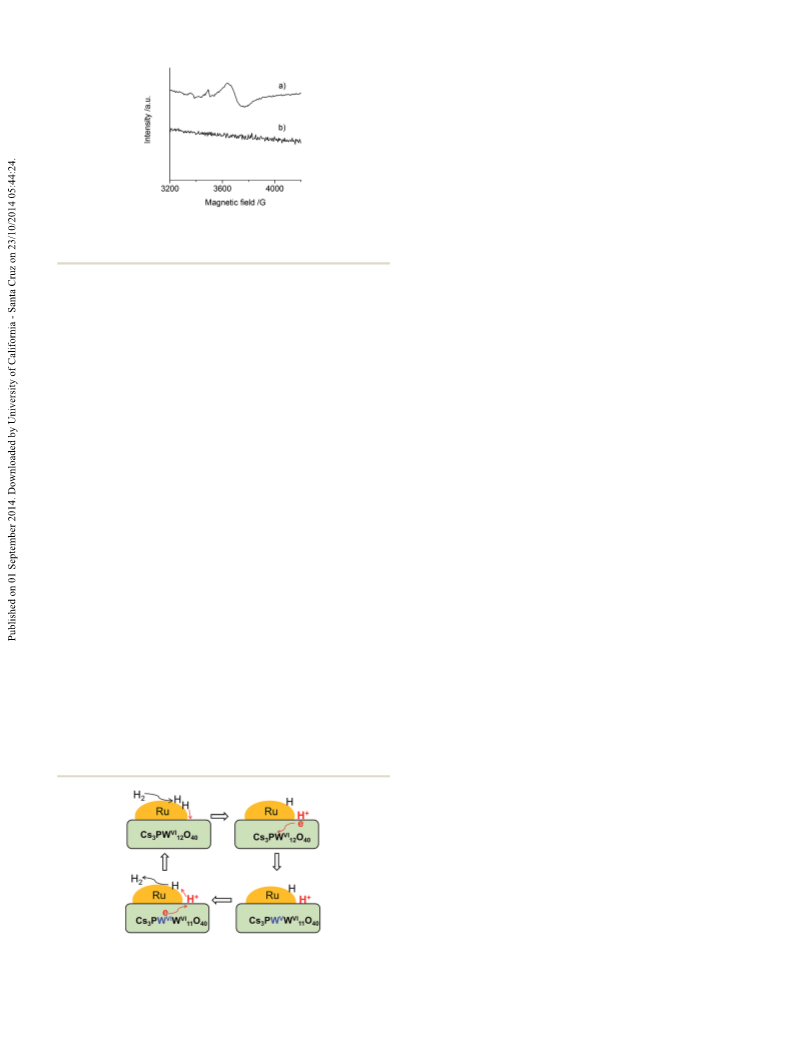
over the Ru/Cs
characterizations by pyridine-adsorbed FT-IR, Raman, and ESR
spectroscopic measurements, we propose that molecular H is
rst dissociated on Ru particles, and then, the H atoms spillover
to the Cs surface, which are subsequently converted to
protons by releasing electrons to the support. The H -originated
3 2
PW12O40 catalyst from molecular H . Through
2
3
PW12O
4
2
Brønsted acid sites are reversible and responsible for the
superior catalytic performance of the Ru/Cs PW O catalyst.
3
12 4
We further found that the mean size of Ru nanoparticles over
the Ru/Cs 40 catalyst exerted signicant effects on the
products distribution in the conversion of inulin in water under
atmosphere. For the catalyst with a larger mean size of Ru
3
PW12
O
H
2
nanoparticles (27 nm), fructose, a hydrolysis product, was
attained as the major product, whereas the catalysts with
smaller Ru nanoparticles afforded hexitols with higher yields.
The rates of both inulin hydrolysis and fructose hydrogenation 10 (a) S. Van de Vyver, J. Geboers, W. Schutyser, M. Dusselier,
were dependent on the mean size of Ru particles, and smaller
Ru particles favoured the reaction rates for both steps. The rate
of fructose hydrogenation increased more signicantly upon
decreasing the mean Ru particle size, and the rate determining
step changed from fructose hydrogenation to inulin hydrolysis
at the same time.
P. Eloy, E. Dornez, J. W. Seo, C. M. Courtin,
E. M. Gaigneaux, P. A. Jacobs and B. F. Sels,
ChemSusChem, 2012, 5, 1549; (b) P. Yang, H. Kobayashi,
K. Hara and A. Fukuoka, ChemSusChem, 2012, 5, 920; (c)
H. Kobayashi, Y. Hosaka, K. Hara, B. Feng, Y. Hirosaki and
A. Fukuoka, Green Chem., 2014, 16, 637.
11 W. Deng, Q. Zhang and Y. Wang, Dalton Trans., 2012, 41,
9817.
Acknowledgements
1
2 (a) K. Shimizu, H. Furukawa, N. Kobayashi, Y. Itaya and
A. Satusma, Green Chem., 2009, 11, 1627; (b) J. Tian,
J. Wang, S. Zhao, C. Jiang, X. Zhang and X. Wang,
Cellulose, 2010, 17, 587; (c) Y. Ogasawara, S. Itagaki,
This work was supported by the National Natural Science
Foundation of China (no. 21173172, 21103143, and 21033006),
the Research Fund for the Doctorial Program of Higher
43140 | RSC Adv., 2014, 4, 43131–43141
This journal is © The Royal Society of Chemistry 2014

 Deng, Weiping