G Model
CATTOD-8952; No. of Pages7
ARTICLE IN PRESS
M. de Cazes et al. / Catalysis Today xxx (2014) xxx–xxx
3
with blanks experiments carried out under identical conditions:
one containing only a solution of tetracycline (blank free) and the
other with a portion of a blank membrane crushed in small pieces
(blank immobilized).
initial mass of enzymes in the grafting solution and the mass of
immobilized enzymes (Eq. (3)).
ꢂ
ꢃ
Agrafted = Ainitial
=
Aleft + ˙Arinsing + ˙Aconditioning
(2)
(3)
Tetracycline degradation in the EMR was carried out in a batch
configuration where the retentate was continuously recycled and
the permeate exit was closed. Before each run, membranes were
first hydrated with osmosed water in the pilot unit in order
to eliminate potential free laccases that might not have been
20 mg L−1 of TC in osmosed water with a total volume of 2 L. The
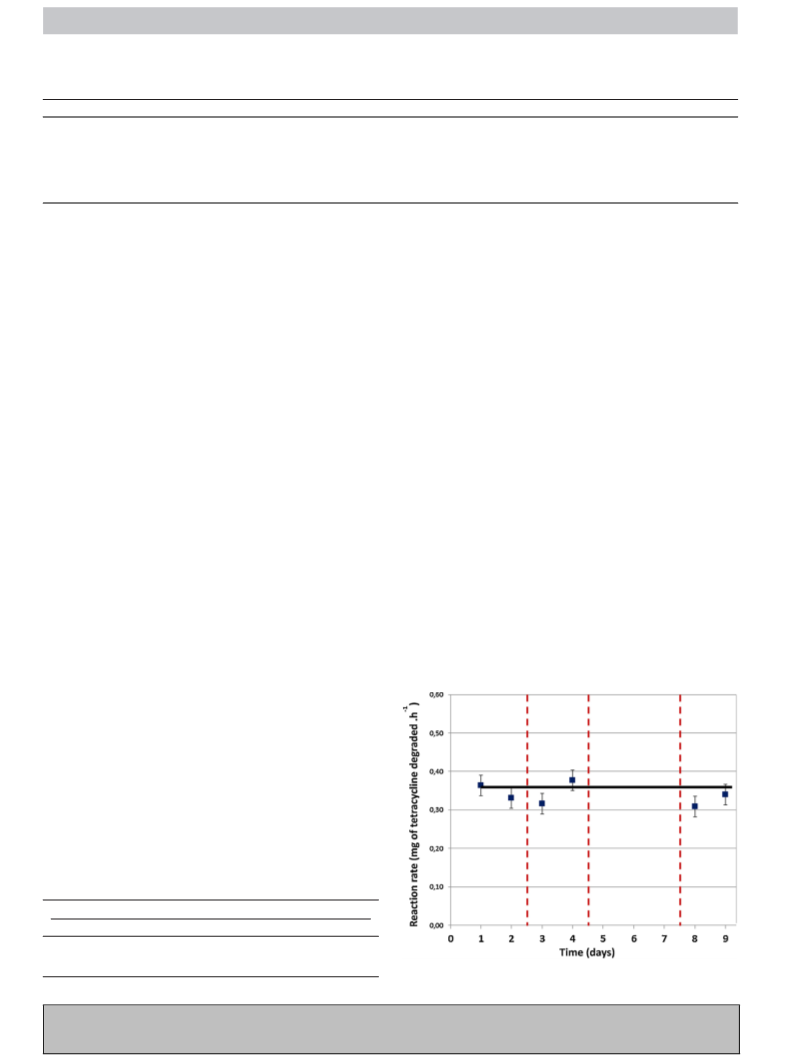
experiment was carried out during 10 days but the substrate solu-
tion was periodically replaced by a fresh one. The residual TC
percentage contained in each sample was calculated using the fol-
lowing equation (Eq. (1)):
Agrafted
ꢀimmobilization
=
× 100
Ainitial
where Agrafted corresponds to the activity of enzymes immobi-
lized on the membrane, Ainitial is the activity of enzymes in an
aliquot of the initial solution left at room temperature and ana-
lyzed with other solutions after the immobilization process, Aleft
is the enzymatic activity of the solution used for grafting after
enzymes immobilization, Arinsing is the activity of enzymes in the
rinsing solutions and Aconditioning the enzymatic activity in the rins-
ing solution used for the membrane hydration before using the
enzymatic membrane for degradation. ꢀimmobilization corresponds
to the immobilization yield of laccase on the ceramic membrane
(%).
ꢀ
ꢁ
CTC,sample
CTC,feed
Residual tetracycline % =
( )
× 100
(1)
where CTC,feed corresponds to the TC concentration in the initial
solution (mg L−1) and CTC,sample is the TC concentration measured
in the retentate (mg L−1).
The results obtained and presented in this study are the mean
values of several experiments realized under similar conditions.
After being used the ceramic supports were washed using the
standard cleaning procedure and their permeability was measured
to determine if they were reusable [14].
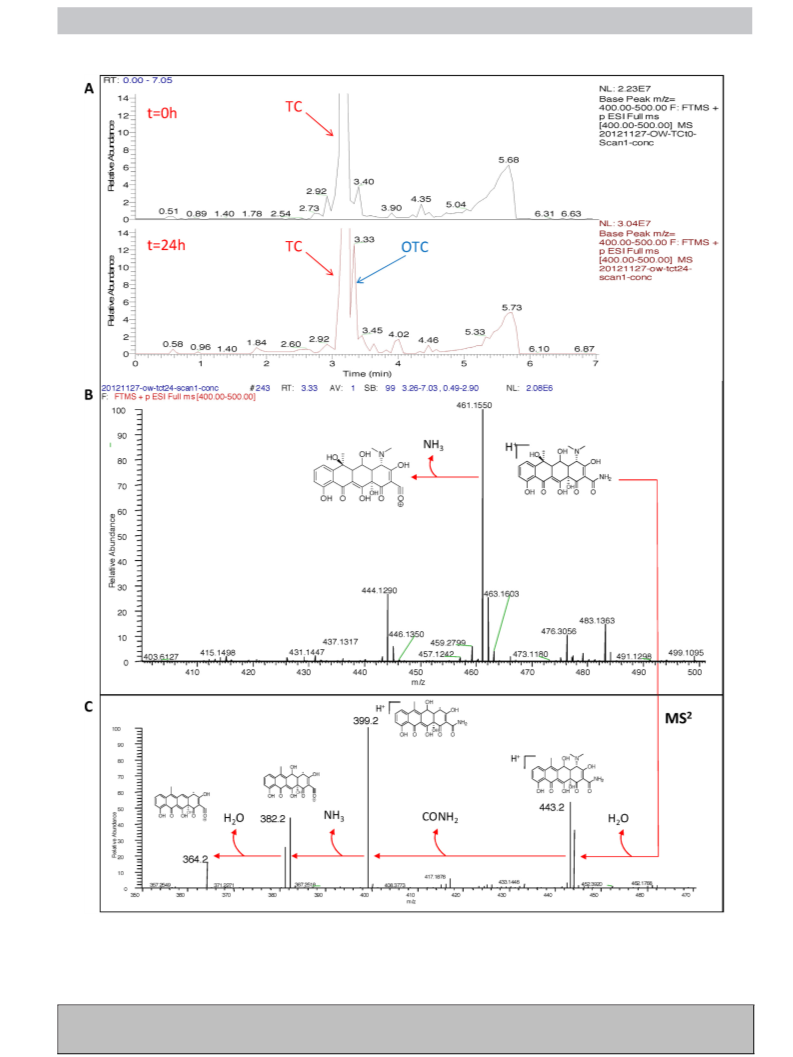
during the treatment was performed by liquid chromatogra-
phy coupled to a high resolution Orbitrap mass spectrometer
(LC–HRMS). Samples were prepared and eluted as described by
Gros et al. [27]. Chromatographic separation was achieved by using
an Aquity HSS T3 column (50 mm × 2.1 mm i.d., 1.7 m particle
size) in a TurboflowTM system coupled to an AccelaTM UHPLC
system (Thermo Scientific). The MS analysis was performed with
an electrospray ionization (ESI) interface coupled to a linear ion
trap-orbitrap mass spectrometer (LTQ Orbitrap VelosTM, Ther-
mos Scientific) under positive and negative ionization conditions
as described in Llorca et al. (under preparation). The mass accu-
racy accepted for the experiments was always within 5 ppm. The
MS acquisition was performed in full scan mode [100–1000 Da]
at resolving power of 60,000 FWHM. In parallel, data-dependent
MS/MS acquisition was carried out according to mass-to-charge
(m/z) ion intensity higher than 100.
2.5. Determination of the apparent kinetics parameters
The apparent kinetics parameters of Michaelis–Menten equa-
tion (Km and Vmax) of free and immobilized laccase were estimated
from initial reaction rates determined in batch experiments using
either TC or ABTS as substrate. All the reactions were carried out at
25 ◦C, with a concentration equivalent to 35 U mL−1 of free enzymes
or to 20 U mL−1 of immobilized enzymes. TC solutions were pre-
pared in osmosed water (pH 6) varying the concentration from 22.5
to 225 M whereas ABTS solutions were prepared at 10, 15, 25, 50
and 100 M in a 50 mM citrate-phosphate buffer pH 4.
3. Results and discussion
2.6. Analytical methods
SEM micrographs (Fig. 3) show that the gelatin is only deposited
on the ceramic membrane surface, the gelatin layer thickness is
0.6 m. The average immobilization yield determined as explained
above (Section 2.5) was equal to 13%. According to this value, a 3 cm
long piece of active membrane crushed in small parts into 100 mL of
water corresponds to a concentration of 0.01 g L−1 of Sigma product
containing laccase from T. versicolor.
The kinetics parameters of Michealis–Mentel equation (Km and
Vmax) of both free and immobilized enzymes were estimated for
two substrates (ABTS and TC). The calculated values obtained
thanks to Lineweaver–Burk equation are reported in Table 1.
It is known that the enzymatic activity is better with high Vmax
and low Km values. For both substrates, the Km value is 5 about times
lower with grafted enzymes. Therefore the bounded enzymes have
a higher apparent affinity with the substrate and in principle have
to be more efficient to degrade ABTS and TC than free enzymes.
The literature confirms these results because it was proved that
grafting enhanced the enzyme stability thanks to the bonding and
the accessibility of the active site by the substrate [28,29]. How-
ever regarding the Vmax values, although the concentration of free
enzyme was higher (35 U mL−1 and 20 U mL−1 for free and immo-
bilized enzyme, respectively) the Vmax value observed for grafted
enzymes was always higher. The rate of reaction would be thus
higher with immobilized laccase compared to the free laccase.
The structure of ceramic support and active membrane was
observed using scanning electron microscopy (SEM) (Hitachi
S4500).
Tetracycline concentration was determined by high-
performance liquid chromatography coupled to triple-quadrupole
mass spectrometry (HPLC–MS). Samples were injected through
an Onyx® C18 column (25 mm × 4.6 mm) with a Waters e2695
Separations Module, and the 410 m/z fragment was detected with
a Micromass Quattro micro API device at 120 ◦C. The isocratic
mobile phase used was made of HPLC grade water, 99% formic
acid, and acetonitrile (74.9:0.1:25) at a flow rate of 2 mL min−1. The
amount of TC was quantified with calibration standards prepared
by dilution of the TC stock solution with 20% of ethanol in osmosed
water.
The activity of free and immobilized laccase was determined at
different pH with ABTS as substrate as previously reported [14]. One
activity unit (U) corresponds to the quantity of enzymes needed to
The immobilization yield was determined from the difference
in enzyme activity (U) of the laccase solution before and after the
immobilization step, taking into account the enzyme activity mea-
sured in the solution after the immobilization and the totality of
washing solutions (Eq. (2)). It was calculated with the values of the
Please cite this article in press as: M. de Cazes, et al., Design and optimization of an enzymatic membrane reactor for tetracycline

 De Cazes