in animals has shown that it may cause mild transient hemo-
lysis.18–19 On the other hand, it is known that AB is stable in
vivo, has low affinity for body tissues, and is rapidly excreted.6
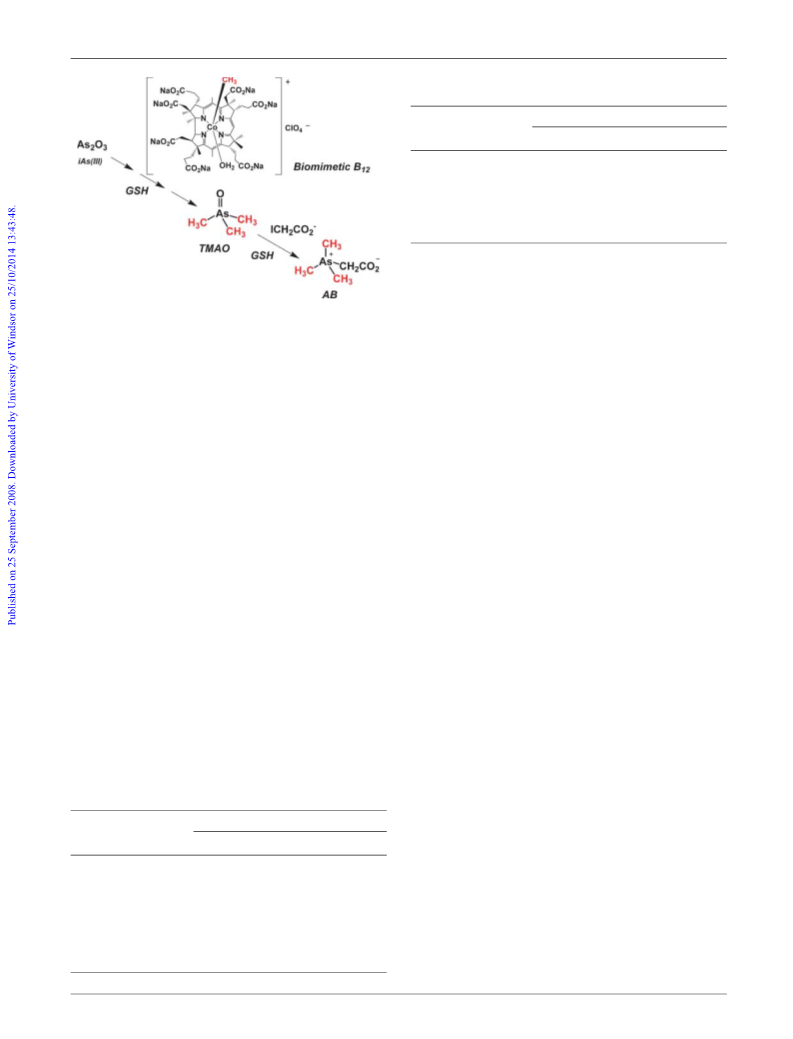
Thus, it can be inferred that desirable detoxification of arsenic
trioxide should proceed from conversion of arsenic trioxide
into TMAO with subsequent conversion into AB.
arsenicals generated in the process of producing chemical
agents.20
This research was supported in part by a grant program
‘‘Collaborative Development of Innovative Seeds’’ from the
Japan Science and Technology Agency (JST) and a Grant-
in-Aid for Scientific Research on Priority Areas (460) from the
Ministry of Education, Culture, Sports, Science and Technol-
ogy (MEXT) of Japan.
There is a report on a method for synthesizing AB from
TMA with halogenated acetate ester in an organic solvent to
form an AB ester that is subsequently hydrolyzed to produce
AB.11 However, there is no report describing the synthesis of
AB from TMAO in an aqueous solution under mild condi-
tions; our report is the first to describe such a synthesis. The
reaction does not require an organic solvent and it proceeds in
aqueous solution under mild conditions, and it can therefore
be regarded as an economical and eco-friendly process.
In summary, [i] we propose a new treatment system for
toxicants, i.e. ‘‘detoxification of arsenic’’ in which arsenic
trioxide is transformed into AB. [ii] To accomplish this
detoxification (iAs(III) - AB), we designed a two-step synth-
esis process [iAs(III) - TMAO - AB] involving reactions
under mild aqueous conditions. [iii] The first step in this two-
step process is the trimethylation of arsenic trioxide, which is
very difficult to accomplish selectively. In other words, the
following six types of arsenic compound may be produced
during methylation of arsenic trioxide: unchanged iAs(III),
iAs(V), MMA, DMA, TMAO, and TeMA. We succeeded,
for the first time, in selectively synthesizing TMAO from
arsenic trioxide by using naturally occurring vitamin B12
(methylcobalamin). [iv] To reproduce, in our biomimetic
system, the high selectivity shown by naturally occurring
vitamin B12, we successfully synthesized ‘‘biomimetic B12’’
by using a new synthesis method. [v] By using this ‘‘biomimetic
B12’’, we succeeded, in selectively synthesizing TMAO exclu-
sively from arsenic trioxide in a similar manner to the reaction
of naturally occurring vitamin B12; this is the first report of
such a synthesis. [vi] The second reaction (TMAO - AB) in
the two-step synthetic pathway is the first reported case in
which TMAO has been directly converted into AB in
an aqueous solution under mild conditions without the use
of organic solvents or the use of highly volatile TMA as
reactant. As described above, we propose a detoxification
system for converting a toxicant (arsenic trioxide) into a
nontoxic compound (AB) without the production of toxic
by-products, and our experiments have demonstrated the
feasibility of this process.
Notes and references
z Biomimetic B12 was prepared as follows. First, 4 M aqueous NaOH
(20 mL) was added to a solution of hydrophobic vitamin B12 (5 mg) in
methanol (10 mL).21 The mixture was stirred in a screw-capped
polypropylene tube and incubated in a thermostated bath at 30 1C
for 20 h. The solution was then neutralized with 6 M aqueous HCl and
diluted with ultra-pure water (10 mL).
1 R. Nickson, J. McArthur, W. Burgess, K. M. Ahmed, P.
Ravenscroft and M. Rahman, Nature, 1998, 395, 338–338; A. M.
Chowdhury and M. Jakariya, Science, 1999, 284, 1622; G. F. Sun,
Toxicol. Appl. Pharmacol., 2004, 198, 268–271.
2 H. Yamauchi, Y. Aminaka, K. Yoshida, G. Sun, J. Pi and M. P.
Waalkes, Toxicol. Appl. Pharmacol., 2004, 198, 291–296.
3 Evaluation of Carcinogenic Risks to Humans: Some Drinking Water
Disinfectants and Contaminations, Including Arsenic, International
Agency for Research on Cancer, Lyon, 2004, IARC Monographs,
vol. 84.
4 G. Reeske and A. H. Cowley, Chem. Commun., 2006, 1784–1786.
5 T. Kaise, S. Watanabe and K. Ito, Chemosphere, 1985, 14,
1327–1332.
6 M. Vahter and E. Marafante, Sci. Total Environ., 1983, 30,
197–211; H. Yamauchi, T. Kaise and Y. Yamamura, Bull. Environ.
Contam. Toxicol., 1986, 36, 350–355.
7 J. S. Edmonds and K. A. Francesconi, Experientia, 1987, 43,
553–557; J. S. Edmonds, Bioorg. Med. Chem. Lett., 2000, 10,
1105–1555.
8 F. Challenger, Chem. Rev., 1945, 36, 315–362.
9 D. J. Thomas, S. B. Waters and M. Styblo, Toxicol. Appl.
Pharmacol., 2004, 198, 319–326.
10 J. S. Edmonds and K. A. Francesconi, Nature, 1981, 289, 602–604.
11 H. Ismail and R. Toia, Pertanika, 1988, 11, 437–439; L. O. Moore
and P. J. Ehman, in Encyclopedia of Chemical Processing and
Design, ed. J. J. McKetta, Dekker, New York, 1977, vol. 3, pp. 396.
12 Y. Murakami, J. Kikuchi, Y. Hisaeda and O. Hayashida, Chem.
Rev., 1996, 96, 721–758.
13 L. Ljungdahl, E. Irion and H. G. Wood, Biochemistry, 1965, 4(12),
2771–2780.
14 G. N. Schrauzer, J. A. Seck, R. J. Holland, T. M. Beckham, E. M.
Rubin and J. W. Sibert, Bioinorg. Chem., 1972, 2, 93–124.
15 R. A. Zakharyan and H. V. Aposhian, Toxicol. Appl. Pharmacol.,
1999, 154, 287–291.
16 S. A. Pergantis, M. Miguens-Rodriguez, N. P. Vela and D. T.
Heitkemper, J. Anal. At. Spectrom., 2004, 19, 178–182.
17 T. Kaise, H. Yamauchi, Y. Horiguchi, T. Tani, S. Watanabe, T.
Hirayama and S. Fukui, Appl. Organomet. Chem., 1989, 3,
273–277.
18 H. Yamauchi, K. Takahashi, Y. Yamamura and T. Kaise, Toxicol.
Environ. Chem., 1989, 22, 69–76.
19 H. Yamauchi, T. Kaise, K. Takahashi and Y. Yamamura,
Fundam. Appl. Toxicol., 1990, 14, 399–407.
20 SCJ, in Report of Section of National Committee on Abandoned
Chemical Weapons, National Committee for Restoration of
Devastated Living Environments: Risk Assessment of Old and
Abandoned Chemical Weapons and Development of Safe
Advanced Destruction, Technologies, Science Council of Japan,
Tokyo, 2006, pp. 1–89.
The vitamin B12 derivatives and the GSH that are used in
the detoxification method developed in this study are safe and
environmentally friendly materials. Therefore, our detoxifica-
tion process is also safe and environmentally friendly. Our
method for detoxification of inorganic arsenics could be
applied in the prevention of poisoning by inorganic arsenical
compounds that are present in well water, which has been a
widespread cause of chronic poisoning by arsenic. In addition,
the method could be used to detoxify surplus inorganic
arsenicals in industry, which currently present considerable
difficulties in terms of their safe disposal. Finally, a more-
specific application would be in the detoxification of inorganic
21 Y. Murakami and Y. Hisaeda, Bull. Chem. Soc. Jpn., 1985, 58,
2652–2658.
ꢁc
This journal is The Royal Society of Chemistry 2008
5124 | Chem. Commun., 2008, 5122–5124

 Nakamura, Koichiro