69
vacancies, which promote the diffusion of Na+. This amounts to
an increase of decomposition rate and accounts for the increase
of rate observed at higher concentrations. Boldyrev [79] demon-
strated the sucking of interstitials in silver oxalate by doping it
with Cd2+. They observed that the conductance of silver oxalate was
considerably decreased by doping with Cd2+. The cation vacancies
generated in the silver oxalate lattice by doping suck the interstitial
when the Cd2+ doping is excessive (more than 1.5 mol%), the inter-
stitial concentration becomes so low that conduction via vacancy
mechanism becomes prominent. Silver halides doped with Cd2+
[80] and sodium nitrite doped with Ba2+ [81] also showed decrease
in conductivity due to similar reasons.
[2] P.M. Madhusudanan, K. Krishnan, K.N. Ninan, Thermal analysis, Vol. 2: Pro-
ceedings of the Seventh International Conference on Thermal Analysis, 1982,
p. 226.
[3] E. Urbanovici, E. Segal, The heating rate as a variable in non-isothermal kinet-
ics: II. A method to evaluate the non-isothermal kinetic parameters using this
principle and integration over low ranges of variables, Thermochim. Acta 107
(1986) 353–357.
[4] J. Moll, D. Kerug, D. Lept, Thermal analysis, Vol. 1: Proceedings of the Sixth
International Conference on Thermal Analysis, 1980, p. 57.
[5] E. Urbanovici, E. Segal, On a new classical method to evaluate non-isothermal
kinetic parameters, Thermochim. Acta 107 (1986) 359–363.
[6] E. Urbanovici, E. Segal, New equations in non-isothermal kinetics taking into
account the dependences A(␣) and E(␣), Thermochim. Acta 98 (1986) 385–390.
[7] K. Krishnan, K.N. Ninan, P.M. Madhusudanan, Computation of activation energy
spectrum – a new approach, Thermochim. Acta 101 (1986) 365–371.
[8] E.S. Freeman, B. Carroll, The application of thermoanalytical techniques to
reaction kinetics: the thermogravimetric evaluation of the kinetics of the
decomposition of calcium oxalate monohydrate, J. Phys. Chem. 62 (1958)
394–397.
[9] E.L. Simons, A.E. Newkirk, New studies on calcium oxalate monohydrate: a
guide to the interpretation of thermogravimetric measurements, Talanta 11
(1964) 549–571.
4. Conclusions
[10] K.H. Stern, High Temperature Properties and Thermal Decomposition of Inor-
ganic Salts with Oxy Anions, CRC Press LLC, Florida, 2001.
[11] S. Vyazovkin, Thermal analysis, Anal. Chem. 76 (2004) 3299–3312.
[12] C. Deng, J. Cai, R. Liu, Kinetic analysis of solid state reactions: evaluation of
approximations to temperature integral and their applications, Solid State Sci.
11 (2009) 1375–1379.
[13] Y. Huang, Y. Cheng, K. Alexander, D. Dollimore, The thermal analysis study of
the drug captopril, Thermochim. Acta 367 (2001) 43–58.
[14] D. Dollimore, C. O’Connell, A comparison of the thermal decomposition of
preservatives, using thermogravimetry and rising temperature kinetics, Ther-
mochim. Acta 324 (1998) 33–48.
[15] I. Halikia, P. Neou-Syngouna, D. Kolitsa, Isothermal kinetic analysis of the ther-
mal decomposition of magnesium hydroxide using thermogravimetric data,
Thermochim. Acta 320 (1998) 75–88.
[16] S. Vyazovkin, C.A. Wight, Model-free and model-fitting approaches to kinetic
analysis of isothermal and nonisothermal data, Thermochim. Acta 340–341
(1999) 53–68.
[17] M.E. Brown, Introduction to Thermal Analysis: Techniques and Applications,
2nd ed., Kluwer Academic Publishers, The Netherlands, 2001.
[18] M.A. Gabal, A.A. El-Bellihi, H.H. El-Bahnasawy, Non-isothermal decomposition
of zinc oxalate–iron(II) oxalate mixture, Mater. Chem. Phys. 81 (2003) 174–182.
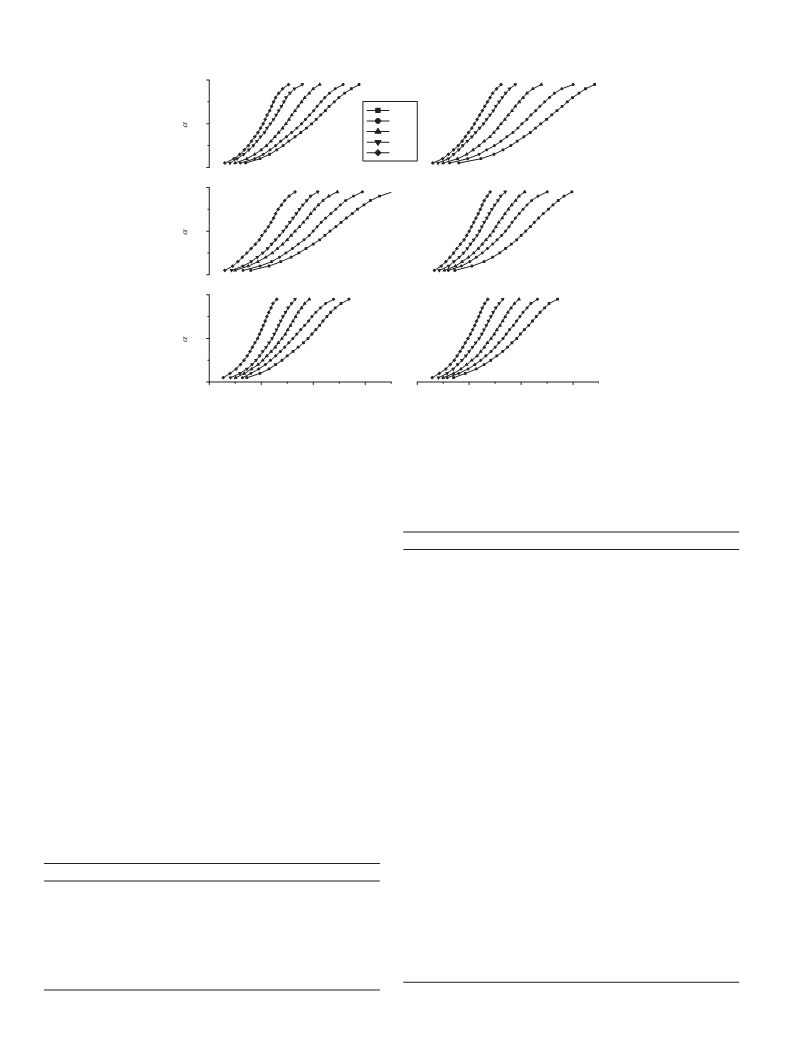
The thermal decomposition and kinetics of sodium oxalate as
a function of dopant, Al3+, concentration is investigated by ther-
mogravimetric analysis in the temperature range 783–803 K under
isothermal conditions. We observed that no single kinetic equa-
tion fitted the whole ˛ versus t curve with a single rate constant
throughout the reaction. Separate kinetic analysis of the ˛ versus t
data of acceleratory (˛ = 0.05 − 0.5) and deceleratory (˛ = 0.5 − 0.95)
stages of the thermal decomposition reveal that the acceleratory
stage is best fitted with Prout–Tompkins model (a model developed
on the assumption of branching nucleation) and the contracting
cylinder model (a model in which the advancement of interface
into the bulk of the reactant particle proceeds only from the edges
of the crystal surfaces upon which nucleation occurs or simply
speaking the inward movement of the interface is two dimen-
sional/cylindrical in nature) best describes the deceleratory stage.
The correspondence of acceleratory stage of the decomposition
with Prout–Tompkins model indicates that the nucleus growth
takes place by propagation of chains. The decrease of the rate in
the decay period is likely to be due to the merging of these chains,
leading to the kinetics in accordance with the contracting cylinder
model. The observed decrease in the decomposition rate, at lower
dopant concentrations, is explained on the basis of the sucking in
of Na+ interstitials to the normal lattice sites, while the increase at
higher dopant concentrations is accounted by the sudden increase
in the concentration of cation vacancies.
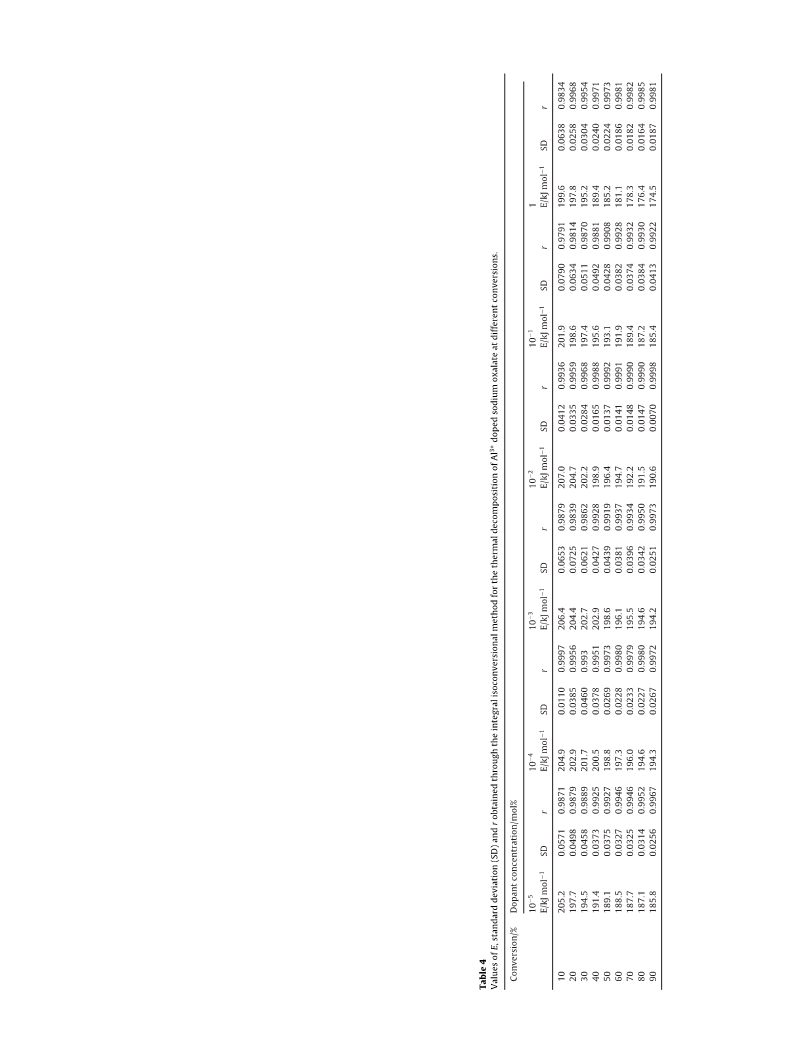
The kinetic results obtained from the integral isoconversional
method, for the entire range of conversion (˛ = 0.05 − 0.95) of the
thermal decomposition of Al3+ doped sodium oxalate samples,
shows that the values of E are independent of conversion above
50%; however, below 50% the E values depend on conversion. This
implies that the pretreatment affects the nucleation and its growth
in the solid. Once the decay starts, i.e., after the completion of nucle-
ation and its growth, the decomposition process continues with a
steady decrease in the value of E till the end of the process. We
observed that the activation energy for the thermal decomposition
of Al3+ doped sodium oxalate with a dopant concentration of 1 mol%
shows lower values (more than 10%) than the values obtained for
other samples studied, which is attributed to the high concentra-
tion of defects present in the lattice. The observed change in rate of
decomposition with dopant concentration could not be explained
on the basis of electron transfer or bond breaking but favours a
diffusion controlled mechanism for the thermal decomposition of
sodium oxalate.
[19] J. Garcia-Guinea, V. Correcher, E. Lozano-Diz, M.A. Banares, P. Lopez-Arce, A.M.
García, D.A. Moreno, Effect of thermal annealing on synthetic sodium oxalate
crystals, J. Anal. Appl. Pyrolysis 91 (2011) 332–337.
˜
[20] E. Lamprecht, G.M. Watkins, M.E. Brown, The thermal decomposition of cop-
per(II) oxalate revisited, Thermochim. Acta 446 (2006) 91–100.
[21] H. Tanaka, Thermal analysis and kinetics of solid state reactions, Thermochim.
Acta 267 (1995) 29–44.
[22] A. Perejón, P.E. Sánchez-Jiménez, J.M. Criado, L.A. Pérez-Maqueda, Kinetic anal-
ysis of complex solid-state reactions. A new deconvolution procedure, J. Phys.
Chem. 115B (2011) 1780–1791.
[23] J. Cai, R. Liu, Y. Wang, Kinetic analysis of solid-state reactions: a new integral
method for nonisothermal kinetics with the dependence of the preexponential
factor on the temperature (A = A0Tn), Solid State Sci. 9 (2007) 421–428.
[24] J. Cai, R. Liu, Kinetic analysis of solid-state reactions: precision of the activation
energy obtained from one type of integral methods without neglecting the
low temperature end of the temperature integral, Solid State Sci. 10 (2008)
659–663.
[25] J. Málek, T. Mitsuhashi, J.M. Criado, Kinetic analysis of solid-state processes, J.
Mater. Res. 16 (2001) 1862–1871.
[26] V.A. Benderskii, D.E. Makarov, C.A. Wight, Chemical Dynamics at Low Temper-
atures, Wiley, New York, 1994, p. 385.
[27] M.E. Brown, D. Dollimore, A.K. Galwey, Reactions in the Solid State, Compre-
hensive Chemical Kinetics, vol. 22, Elsevier, Amsterdam, 1980, p. 340.
[28] S. Vyazovkin, C.A. Wight, Isothermal and nonisothermal reaction kinetics
in solids: in search of ways toward consensus, J. Phys. Chem. 101A (1997)
8279–8284.
[29] T.B. Brill, K.J. James, Kinetics and mechanisms of thermal decomposition of
nitroaromatic explosives, Chem. Rev. 93 (1993) 2667–2692.
[30] H.F. Mark, N.M. Bikales, C.G. Overberger, G. Menges (Eds.), Encyclopedia of
Polymer Science and Engineering, Wiley, New York, 1989, p 231 & 690.
[31] S. Vyazovkin, C.A. Wight, Isothermal and nonisothermal kinetics of thermally
stimulated reactions of solids, Int. Rev. Phys. Chem. 17 (1998) 407–433.
[32] D. Dollimore, Thermal analysis, Chem. Rev. 68 (1996) 63–72.
[33] A.K. Galwey, Is the science of thermal analysis kinetics based on solid founda-
tions?: a literature appraisal, Thermochim. Acta 413 (2004) 139–183.
[34] S. Vyazovkin, Kinetic concepts of thermally stimulated reactions in solids: a
view from a historical perspective, Int. Rev. Phys. Chem. 19 (2000) 45–60.
[35] B.V. L’vov, Kinetics and mechanism of thermal decomposition of nickel, man-
ganese, silver, mercury and lead oxalates, Thermochim. Acta 364 (2000)
99–109.
References
[36] H.S.G. Murhty, M.S. Rao, T.R.N. Kutty, Thermal decomposition of titanyl
oxalates—II: kinetics of decomposition of barium titanyl oxalate, J. Inorg. Nucl.
Chem. 7 (1975) 1875–1878.
[1] A.K. Galwey, M.E. Brown, Thermal Decomposition of Ionic Solids, Elsevier,
Amsterdam, 1999.

 Jose John