7664 Inorganic Chemistry, Vol. 49, No. 17, 2010
Hill et al.
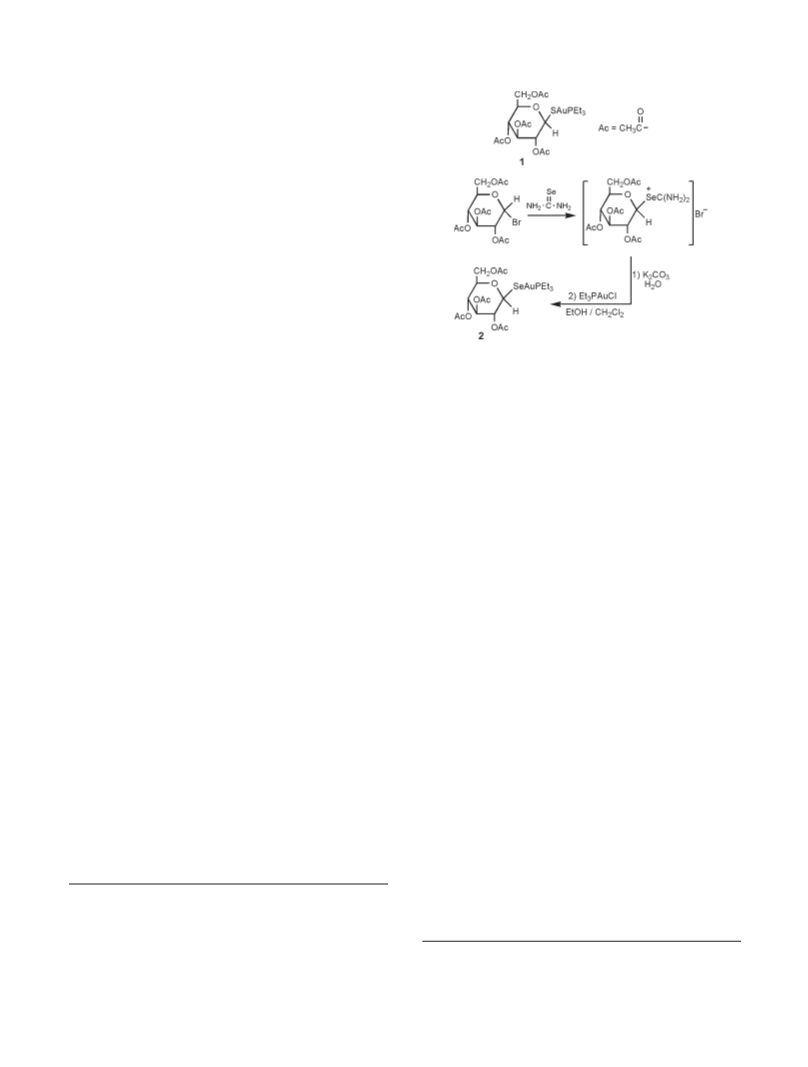
have had a long tradition of use, particularly in Japan.7 AF (1),
on the other hand, is effective when given orally, both in the
treatment of RA and psoriatic arthritis.8 The biological me-
chanism of action of gold-based drugs remains undeciphered in
its totality. However, its behavior in biological systems has been
the object of intense study,9 and significant progress has been
made. A key aspect of the biochemical behavior of gold agents
is the displacement of a coordinating sulfur ligand by naturally
occurring sulfhydryl compounds.10-14 Intheexchangereaction
with albumin, the tetraacetylthioglucose portion of AF is
displaced by the SH of cysteine-34,11,13 the only reduced cys-
teine residue, to form AlbSAuPEt3.11-14 This is followed by
displacement of the phosphine ligand and the generation of
Et3PO.11-14 The rate of in vitro generation of Et3PO from
AlbSAuPEt3 is fastest for the thiolate ligands that have the
greatest affinity for gold.11 AF also reacts in vivo and in whole
blood to form Et3PO as a metabolic product.12 Studies of
related AF analogues suggest that for R3PAuX, increasing the
bulk and basicity of the phosphine (R = CH3 < CH3CH2 <
(CH3)2CH) retards its oxidation to R3PdO. Conversely in-
creasing the affinity of the anion for gold(I) favors oxidation
and formation of phosphine oxide.11
The reactions of auranofin and other gold(I) species
with selenoproteins are significant for their metabolism and
enzymology16-19 and in the development of treatments for
arthritis,9d,20,21 cancer,9e,21-24 and a variety of parasitic25-28
and infectious29 diseases. Numerous gold(I) model complexes
with selenium ligands have been characterized,30-36 and the
field has recently been reviewed.37
Described herein is the synthesis and spectroscopic charac-
1
terization (EXAFS, 197Au Mossbauer, and H, 13C, 31P, 77Se
€
NMR, and ESI-MS) of SeAF. The results of in vitro ligand
exchange studies with albumin and cysteine-modified albumin
using 31P NMR spectroscopy and chromatographic separation
are reported. SeAF was tested in vivo against three immuno-
logical models related to inflammation and RA. Only one
report38 and two patents39,40 describing the synthesis of SeAF
have appeared in the literature, but no information regarding
its solution chemistry, biochemistry, or biological activity has
been presented subsequently.
Experimental Methods
Materials. Sephadex G-50 and 5,50-dithiobis(2-nitrobenzoic
acid) were obtained from Sigma Biochemicals; BSA (fatty acid
free, lot no. 10740823-51) from Boehringer Mannheim Bio-
chemicals Co.; and Iodoacetamide-blocked BSA (Ac-BSA) was
prepared as described previously.11 Cysteine-blocked BSA (Cys-
BSA lot no. 11 m) from Miles Chemical Co.; D2O (99.8 d),
Since selenols have higher affinities for mercury(II) and
gold(I) than do thiols and also undergo more rapid exchange
with disulfides than do thiols,15 it was of interest to us to
prepare seleno-auranofin (2) (SeAF, Et3PAuSe-tagl) and to
compare its biological and bioinorganic behavior with AF. In
addition, we sought further insight into the chemistry of cys-
teine-34 of albumin in the reduced (thiolate) and oxidized
(disulfide with a nonprotein thiol) states with gold compounds.
(19) Lothrop, A. P.; Ruggles, E. L.; Honda, R. J. Biochemistry 2009, 48,
6213–6223.
(20) Roberts, J. R.;Shaw, C. F., III. Biochem. Pharmacol. 1998, 55, 1291–1299.
(21) Ott, I. Coord. Chem. Rev. 2010, 253, 1670–1681.
(22) Hickey, J. L.; Ruhayel, R. A.; Barnard, P. J.; Baker, M. V.; Berners-
Price, S. J.; Filipovska, A. J. Am. Chem. Soc. 2008, 130, 12570–12571.
(23) Talbot, S.; Nelson, R.; Self, W. T. Br. J. Pharmacol. 2008, 154, 940–948.
(7) (a) Miyamoto, T.; Miyaji, S.; Horiuchi, Y.; Hara, M.; Ishihara, K. J.
Jpn. Soc. Int. Med. 1974, 63, 1190–1197. (b) Yoshizawa, H.; Azuma, T.;
Hazama, T. Ryumachi 1973, 13, 366–7. (c) Oka, Y. Ryumachi 1973, 12, 311–23.
(8) Bernstein, D. I.; Bernstein, I. L.; Bodenheimer, S. S.; Pietrusko, R. G.
J. Allergy Clin. Immunol. 1988, 81, 6–16.
(9) (a) Proceedings of the Symposium on Bioinorganic Chemistry of Gold
Coordination Compounds; Sutton, B. M., Franz, R. G., Eds.; Smith Kline and
French Laboratories: Philadelphia, PA, 1981. (b) Shaw, C. F. III. The Biochem-
istry of Gold; Schmidbaur, H., Ed.; John Wiley & Sons: Chichester, U.K., 1999;
pp 250-308. (c) Shaw, C. F., III. Chem. Rev. 1999, 99, 2589–2600. (d) Messori,
L.; Marcon, G. Met. Ions Biol. Syst. 2004, 41, 279–304. (e) Messori, L.; Marcon,
G. Met. Ions Biol. Syst. 2004, 42, 385–425.
(10) (a) Shaw, C. F., III.; Schaeffer, N. A.; Elder, R. C.; Eidsness, M. K.;
Trooster, J. M.; Calis, H. M. G. J. Am. Chem. Soc. 1984, 106, 3511–3521. (b)
Isab, A. A.; Hormann, A. L.; Hill, D. T.; Griswold, D. E.; Martino, M. J.; Shaw,
C. F., III. Inorg. Chem. 1989, 28, 1321–1326.
(11) (a) Coffer, M. T.; Shaw, C. F., III.; Hormann, A. L.; Mirabelli, C. T.;
Crooke, S. T. J. Inorg. Biochem. 1987, 30, 177–187. (b) Isab, A. A.; Shaw, C. F.,
III.; Locke, J. Inorg. Chem. 1988, 27, 3406–3409.
€
(24) Rigobello, M. P.; Gandin, V.; Folda, A.; Rundlof, A. K.; Fernandes,
€
A. P.; Bindoli, A.; Marzano, C.; Bjornstedt, M. Free Radical Biol. Med. 2009,
47, 710–721.
(25) Bonilla, M.; Denicola, A.; Novoselov, S. V.; Turanov, A. A.;
Protasio, A.; Izmendi, D.; Gladyshev, V. N.; Salinas, G. J. Biol. Chem.
2008, 283, 17898–17907.
(26) Kuntz, A. N.; Davioud-Charvet, E.; Sayed, A. A.; Califf, L. L.;
ꢀ
Arner, Williams, D. L. PLoS Medicine 2007, 4, 1071–1086.
(27) Lobanov, A. V.; Gromer, S.; Salinas, G.; Gladyshev, V. N. Nucl.
Acid Res. 2006, 34, 4012–4024.
(28) Angelucci, F.; Sayed A. A.; Williams, D. L.;, Boumis, G.; Brunori,
M.; Dimastrogiovanni, D.; Miele, A. E.; Pauly, F.; Bellelli, A. J. Biol. Chem.
2009, 284, 28977-28985.
(29) Jackson-Rosario, S.; Cowart, D.; Myers, A.; Tarrien, R.; Levine,
R. L.; Scott, R. A.; Self, W. T. J. Biol. Inorg. Chem. 2009, 14, 485–496.
(b) Jackson-Rosario, S.; Self, W. T. J. Bacteriol. 2009, 191, 4035–4040.
(30) (a) Du Mont, W.-W.; Kubiniok, S.; Lange, L.; Pohl, S.; Sock, W.;
Wagner, I. Chem. Ber. 1991, 124, 1315–1320. (b) Wagner, I.; du Mont, W.-W.
J. Organomet. Chem. 1990, 395, C23–C25.
(12) Intoccia, A. P.; Flanagan, T. L.; Walz, D. T.; Gutzait, L.; Swagzdis,
J. E.; Flagiello, J. Jr.; Hwang, B.Y-H.; Dewey, R. H. In Proceedings of the
Symposium on Bioinorganic Chemistry of Gold Coordination Compounds;
Smith Kline and French Laboratories: Philadelphia, PA, 1981, pp21-33.
(13) (a) Malik, N. A.; Otiko, G.; Razi, M. T.; Sadler, P. J. J. Inorg. /
Biochem. 1980, 12, 317–322. (b) Malik, N. A.; Otiko, G.; Razi, M. T.; Sadler, P. J.
in Sutton, B. M.; Franz, R. G., Eds., Proceedings of the Symposium on
Bioinorganic Chemistry of Gold Coordination Compounds, Smith Kline and
French Laboratories; Philadelphia, PA, 1981, pp 82-97.
€
(31) Jones, P. G.; Thone, C. Chem. Ber. 1991, 124, 2725–2729.
(32) Ahmad, S.; Isab, A. A.; Al-Arfaj, A. R.; Arnold, A. P. Polyhedron
2002, 21, 2099–2105.
(33) Ahmad, S.; Isab, A. A.; Persanowski, H. P.; Hussain, M. S.; Akhtar,
M. N. Trans. Metal Chem. 2002, 27, 177–183.
(34) Ahmad, S.; Akhtar, M. N.; Isab, A. A.; Al-Afraj, A. R.; Hussain,
M. S. J. Coord. Chem. 2000, 51, 225–234.
(35) Bhabak, K. P.; Mugesh, G. Inorg. Chem. 2009, 48, 2449–2455.
(36) Isab, A. A.; Aktar, M. N.; Al-Arfaj, A. R. J. Chem. Soc., Dalton
Trans. 1995, 1483–1487.
(14) Coffer, M. T.; Shaw, C. F., III.; Eidness, M. K.; Watkins, J. W., II.;
Elder, R. C. Inorg. Chem. 1986, 25, 333–340.
(15) (a) Arnold, A. P.; Tan, K. S.; Rabenstein, D. L. Inorg. Chem. 1986, 25,
2433–2437. (b) Isab, A. A. Transition Met. Chem. 1994, 19, 495–498. (c) Pleasants,
J. C.; Guo, W.; Rabenstein, D. L. J. Am. Chem. Soc. 1989, 111, 6553–6558.
(d) Lewis, S. D.; Misra, D. C.; Shafer, J. A. Biochemistry 1980, 19, 6129–6137.
(37) Molter, A.; Nohr, F. Coord. Chem. Rev. 2010, 254, 19–45.
(38) Pill, T.; Breu, W.; Wagner, H.; Beck, W. Chem. Ber. 1991, 124, 713–717.
(39) Stockel, R. F.; Duma, P. E. alpha,omega-bis(diphenylphosphino)-
hydrocarbon bis(thiosugar)gold and bis(selenosugar)gold derivatives.
U.S. Patent 4,680,286, 1987.
€
(16) Becker, K.; Gromer, S.; Schirmer, R. H.; Muller, S. Eur. J. Biochem.
(40) Hill, D. T.; Johnson, R. K. Use of selenium-containing compounds
for negating the toxic effects of gold compounds used in the treatment of
rheumatoid arthritis, and a novel selenium-containing gold compound and
use thereof as an anti-rheumatoid arthritis medicine. EP 0189306, assigned
to Snamprogetti SpA, 1986.
2000, 267, 6118–6125.
(17) Gromer, S.; Arscott, L. D.; Williams, C. H., Jr.; Schirmer, R. H. J.
Biol. Chem. 1998, 32, 20096–20101.
(18) Steinbrenner, H.; Bilgic, E; Alili, L.; Sies, H.; Brenneisen, P.. Free
Radical Res. 2006, 40, 936–943.

 Hill, David T.