2
060
W. J. Spillane, J.-B. Malaubier / Tetrahedron Letters 51 (2010) 2059–2062
maintained with KCl over the pH range studied and solutions were
buffered with a stock solution of 0.01 M TRIS-cacodylate. In some
cases at pHs ꢀ11–12 the increase in both 2a and 2b could be fol-
lowed simultaneously and the variation in rate was at maximum
Log kobs ¼ mYOTs þ lNOTs
where the second term measures the sensitivity (l) of the hydrolysis
to nucleophilicity through the use of the NOTs parameter which is a
measure of the nucleophilicity of each solvent mixture. A priori
since m is low, one would expect for this hydrolysis that the nucle-
ophilicity would be important and this is the case; an l value of 0.93
and an m value of 0.24 being found from the plot for the extended
equation (r = 0.98). These values strongly support a mechanism
involving nucleophilic attack by water in the hydrolysis of 1a and
a lesser role for the ionizing power of the solvent. In the extended
equation the m value is expected to be somewhat different to that
found in the basic Grunwald–Winstein equation. Kevill has sug-
gested that l/m ratios of greater than 1.6 indicate a bimolecular
7
%. Product studies carried out at several points on the pH/H_ pro-
file showed that 2a/2b formed almost quantitatively. For example,
the absorbance of a ‘spent’ kinetic solution of 1a in 1.5 M KOH was
within 4% of the absorbance measured for a freshly made-up
ꢂ4
1
ꢁ 10 M solution of 2b. The agreement between spent and
spiked solutions was always within 6%.
The first pK of 1a (loss of the first proton from NH
be derived from the pH/H_-rate profile below as 9.45. This kinetic
pK is in good agreement with the UV value of 9.5 in 70% aqueous
MeOH. In water, the second pK
based on these pK values and spectrophotometric determinations
in this laboratory in MeCN, which gave pK values of 15.1 and 21.4
for the first and second ionizations, respectively, it should be ꢀ15–
a
2 2
SO O–) can
a
1
5
a
has not been determined but
mechanism and values between 0 and 1 may be found for unimo-
a
22,23
lecular reactions.
In the present study the l/m value is 3.9.
a
22
Hydrolysis studies by the Kevill group on series of carbonyl-
23
and sulfonyl- chlorides showed that l/m values falling into both
1
6
1
6. The hydrogen
a
a to the carbonyl group in 1a will have a pK in
categories were found for the former and they were assigned to
water of ꢀ16.5 since this is the reported value for cyclopenta-
‘
ionization’ or addition–elimination mechanisms, respectively,
whereas for the latter all the values were ꢀ2 and they were inter-
preted as indicating an S 2 solvolytic displacement mechanism.
For an N-acylsulfamate ester of the type, R-CONHSO O-Ar, which
was found to undergo an S 2 type reaction, an l/m value of 3.3
1
7
a
none. This pK should be virtually the same for both 1b and 1c
since the distance from the nitrogen centre to the carbonyl centre
is considerable and any effect on the ionization would be minimal.
The pH/H_-rate profile displays two distinct regions reminis-
N
2
N
cent of those obtained for the simpler sulfamate NH
2
SO
–p. However, the change in the slope from zero to unity for
this ester occurs at about pH 5 whereas for 1a this change occurs
at about pH 9.5. This lateral shift is due to the fact that the pK
of the former is 7.29 while the corresponding pK for 1a is about
pK units higher. In the pH-independent region the reacting spe-
cies will be 1a, and above the pK
2 6 4-
OC H
may be calculated from data for its hydrolysis in similar aqueous
1
2
NO
2
24
EtOH mixtures.
Another type of solvent-reactivity mechanistic probe that can
be applied here involves the use of two solvent mixtures with iden-
tical ionizing power (same YOTs) but very different nucleophilicities
a
a
2
a
(
differing NOTs). If the hydrolysis is significantly slowed down in
a
of 1a ꢀ9.5, it will be 1b and even-
the solvent of lower nucleophilicity, this suggests that the solvent
is playing an important role as a nucleophile. The results of the
application of this method to the hydrolysis of 1a are given in Table
tually 1c. Two important conclusions can be made from
examination of Figure 1. First the upward curvature indicates that
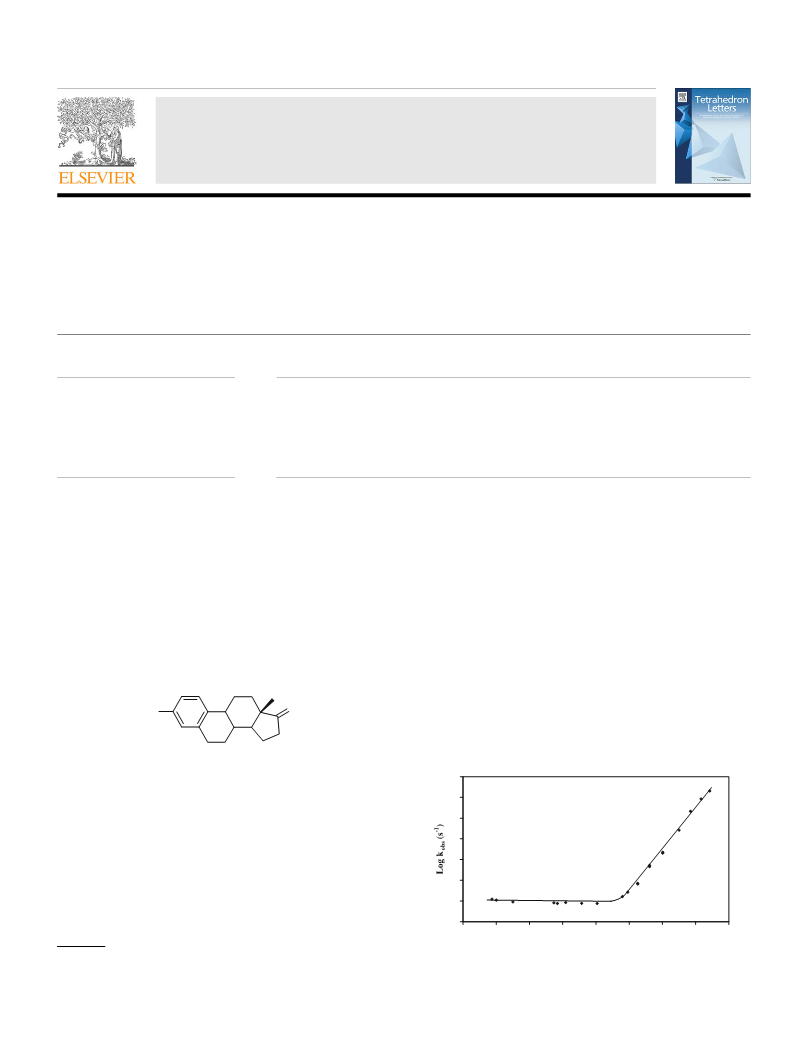
a change in mechanism occurs,18,19 and second, in the pH-indepen-
2. It can be readily seen that employing 97% trifluoroethanol (TFE),
dent region there is no catalysis and the upward line has a slope of
8
5% TFE and 97% hexafluoro-i-propanol (HFIP) results in a moder-
ꢂ
1
indicating that the process occurring is first order in [OH ].
In order to probe the mechanism on the non-catalyzed section
ate reduction in rate thus pointing to an important role for water as
a nucleophile in the hydrolysis of 1a. Curiously, though the ratios
in Table 2 are considerably lower than those observed for the
of the pH/H_ profile a Grunwald–Winstein plot (see Supplemen-
tary data) was constructed using twelve rate constants at 50 °C
for reaction of 1a in aqueous EtOH mixtures containing from 90%
to 20 water content and using YOTs values20 for these solutions
hydrolysis of other compounds including the simpler ester
1
NH
2
SO
2
OC
6
H NO
4
2
-p. The hydrolysis of the ester 667-COUMATE
(
3), which is the subject of considerable interest, gives ratios in line
(
(
Table 1). The pH ranged from 5.68 (90% water content) to 6.45
20% water content).
25
with those in Table 2.
Kinetic solvent isotope effects (KSIEs) kH2O/kD2O for 1a of 3.93
The plot yields an m value of 0.13 (correlation coefficient,
(
pD = 6.61, at 60 °C) and 5.48 (pD = 12.90, at 15 °C) have been
determined. The former value supports a bimolecular S 2 path-
way in the flat region of the pH/H_ rate profile. The reacting spe-
cies will be d -1a because of rapid exchange of the protons for
deuterons in D O however, this will not contribute to the isotope
effect since the ND centre is not involved in the slow step of the
2 reaction at sulfur and the value of 3.93 is a KSIE. At pD 12.90
r = 0.97). Values of m at this level are interpreted as indicating sup-
port for a bimolecular mechanism; in this case, most likely an S
N
N
2
1
mechanism involving attack by water at the sulfur of 1a. The data
can be scrutinized in another way using the extended Grunwald–
Winstein equation (see Supplementary data),21
2
2
2
S
N
Table 1
Rate data for hydrolysis of 1a in aqueous EtOH and parameters for Grunwald–
Winstein plots
on the ascending part of the profile d-1b will be deuterated on
nitrogen and the isotope effect observed (5.48) is a KIE effect
reflecting extensive cleavage of the deuterium-nitrogen bond in
b
Log (kobs)c (sꢂ1
)
Water–Ethanol
Y
OTs
N
OTs
2
6
the slow step of an E1cB reaction.
9
8
7
7
6
5
5
5
4
3
2
2
0–10
0–20
5–25
0–30
3.78
3.32
3.11
2.84
1.97
1.92
1.83
1.29
0.92
0.47
0.23
0.00
ꢂ0.41
ꢂ0.34
ꢂ
ꢂ4.73
ꢂ4.78
ꢂ4.86
ꢂ4.95
ꢂ5.04
ꢂ5.06
ꢂ5.07
ꢂ5.09
ꢂ5.12
ꢂ5.20
ꢂ5.22
ꢂ5.24
O
a
O
ꢂ0.35
ꢂ0.23
—
0–40
6.8–43.2
5.2–44.8
0–50
0–60
0–70
NH SO O
2
2
—
ꢂ0.09
ꢂ0.08
ꢂ0.05
—
3
a
5–75
0–80
Activation data were determined for the hydrolysis of 1a at var-
ious pHs and in 1.5 M and 3 M KOH. The energy of activation E
was obtained from the Arrhenius equation and the heat of activa-
0.00
a
a
b
c
20
These two YOTs values were interpolated from the literature.
N
à
à
OTs values were taken from the literature.20
tion
DH and the change in entropy DS were calculated from the
The rates are the average of three runs with less than 4% deviation.
Eyring equation. Table 3 tabulates the values obtained and the

 Spillane, William J.