3584
Kwang-Sei LEE and Ill Won KIM
(Vol. 70,
reported separately. Although both MH RO -type crys- Brain Korea 21 Program of Ministry of Education,
2
4
tals and KHCO3 undergo thermal decomposition at high Project No. D-0025.
temperatures, there is a big diꢀerence between MH2RO4-
type crystals and KHCO3. In MH2RO4-type crystals,
1)
2)
3)
I. C. Hisatsune and T. Adl: J. Phys. Chem. 74 (1970) 2875.
S. Hauss u¨ hl: Solid State Commun. 57 (1986) 643.
S. Kashida and K. Yamamoto: J. Solid State Chem. 86 (1990)
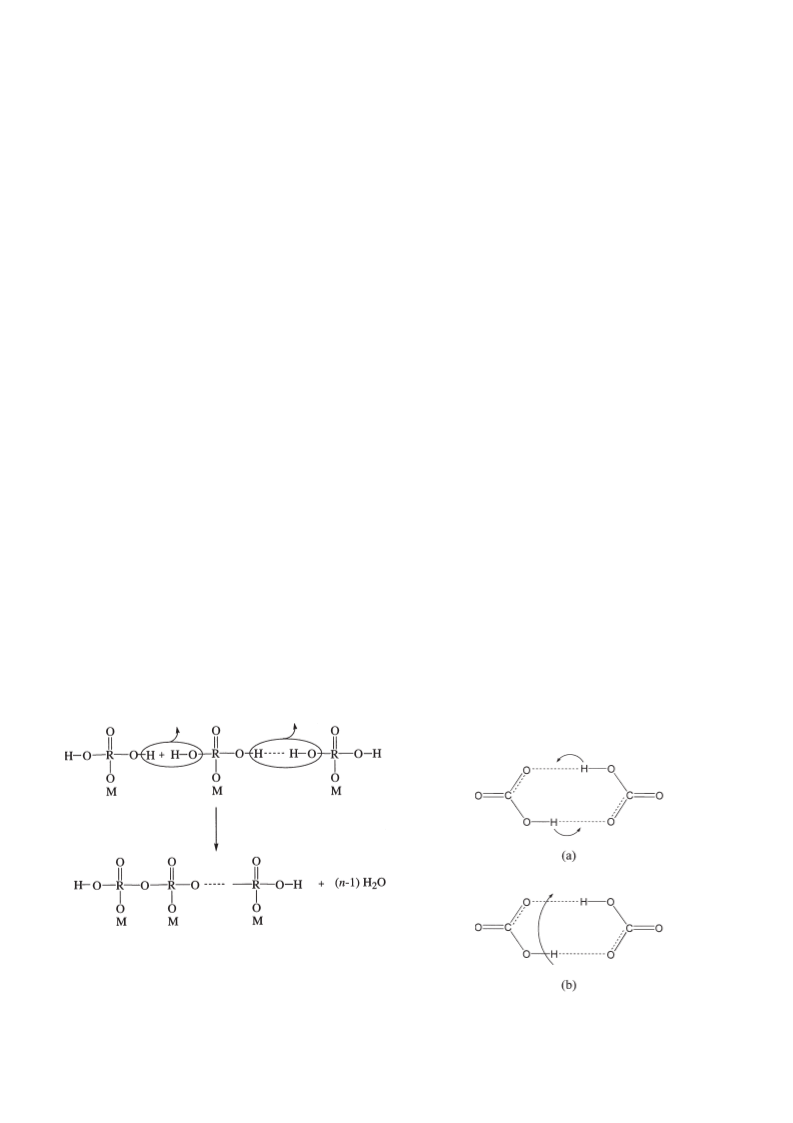
monomers condenses into polymers according to reaction
4) and so the onset temperature is designated as Tp. On
(
the other hand, in KHCO3 dimers are decomposed into
monomers via intermediate stage of reaction (1) and so
onset temperature is designated as Td.
1
80.
4) S. Kashida, S. Ikeda and Y. Nakai: J. Phys. Soc. Jpn. 63 (1994)
643.
M. Machida, N. Koyano and Y. Iwata: J. Kor. Phys. Soc. 32
1998) S176.
4
5
)
)
In the higher temperature region we should involve
the formation of protonic defect HCO3 molecules on
lattice cation sites by proton transfer from HCO3 ions to
another carbonate molecules, because the migration of
protonic defects requires low energy in the lower
temperature region and so defect formation requires
most of energy, assuming that the HCO ions in KHCO
(
6
S. Takasaka, Y. Tsujimi and T. Yagi: J. Kor. Phys. Soc. 29 (1996)
S444.
7) S. Takasaka, Y. Tsujimi and T. Yagi: Phys. Rev. B 56 (1997)
0715.
1
8
)
S. Takasaka, Y. Tsujimi and T. Yagi: J. Kor. Phys. Soc. 32 (1998)
S565.
S. Takasaka, Y. Tsujimi and T. Yagi: Ferroelectrics 219 (1998)
3
3
9
)
is in a state of torsional oscillation, from which it changes
to a state of free rotation in the vicinity of 373 K. This
free rotation might cause the generation of a large
number of protonic defects giving rise to an increase in
electrical conductivity. In order to test which kinds of
defects contribute to the electrical conductivity, the
detailed experimental study is underway and will be
reported elsewhere.
4
10) Y. L. Grand, D. Rouede, J. Wienold and J. Glinnemann: J. Phys.
7.
Soc. Jpn. 67 (1998) 1451.
1) M. M. Abdel-Kader, M. Fadly, M. A. Taleb, K. Eldehamy and
A. I. Ali: Phys. Status Solidi A 142 (1994) 69.
1
1
2) A. I. Ali, B. S. Kim and I. Yu: J. Kor. Phys. Soc. 35 (1999) S1419.
3) A. I. Ali: Ph. D. Thesis, Seoul National University, 2001.
14) Ph. Colomban and A. Novak: Proton Conductors, ed. Ph.
1
Colomban (Cambridge University Press, Cambridge, 1992) p. 80.
5) V. H. Schmidt: J. Mol. Struct. 177 (1988) 257; Ferroelectrics 78
1988) 207.
1
(
x5. Conclusions
We found the new transformation anomalies at 155 K
1
6) Ph. Colomban and A. Novak: Anhydrous Materials: Oxonium
Perchlorate, Acid Phosphates, Arsenates, Sulphates and Selenates
in Proton Conductors, ed. Ph. Colomban (Cambridge University
Press, Cambridge, 1992) Chaps. 10 and 11.
(
Tc2), 373 K (Td) and 459 K in KHCO3. The low-
temperature transformation is likely to be due to freezing
of proton motions, while the high-temperature transfor-
mation begins at temperature 373 K (Td) well below
1
1
7) K.-S. Lee: J. Phys. Chem. Solids 57 (1996) 333.
8) J.-H. Park, K.-S. Lee, J.-B. Kim and J.-N. Kim: J. Phys.:
Condens. Matter 8 (1996) 5491; ibid. 9 (1997) 9457.
19) J.-H. Park, K.-S. Lee and J.-N. Kim: J. Kor. Phys. Soc. 32 (1998)
4
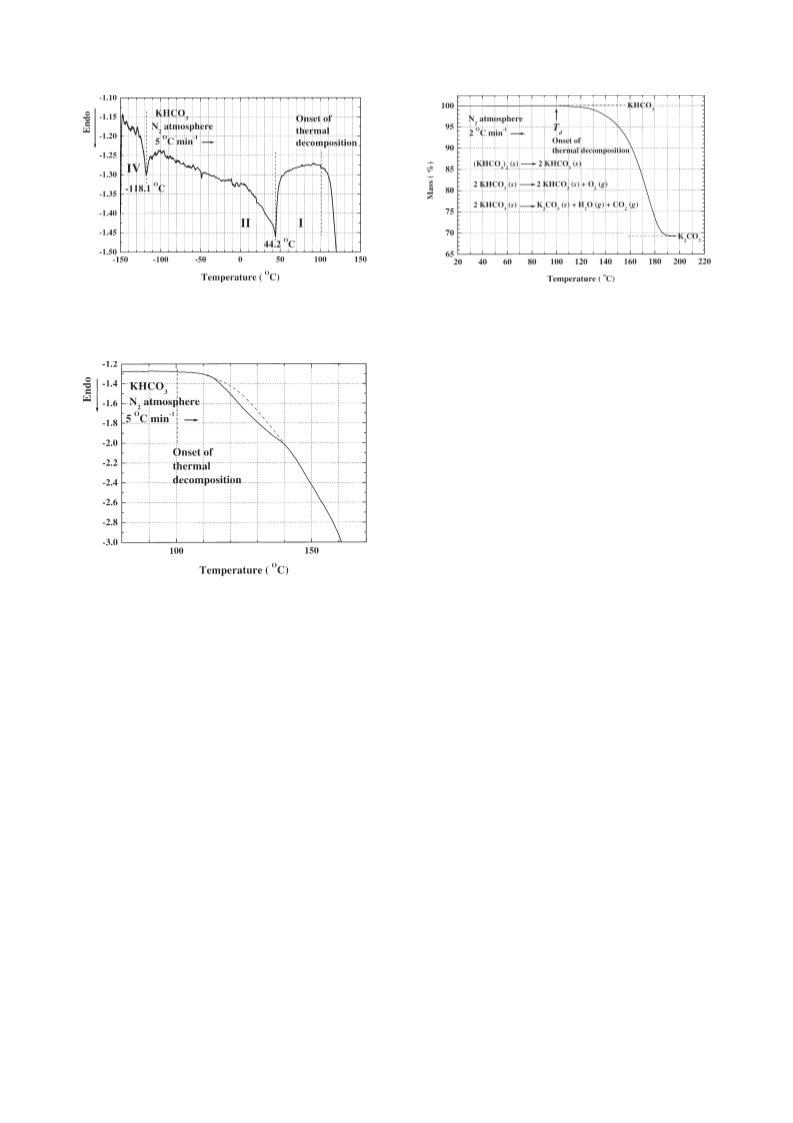
ture 373 K (T ) which is interpreted as an onset of
59 K. The bulk mass of KHCO decreases at tempera-
3
d
Suppl. S1149.
0) J.-H. Park, K.-S. Lee and J.-N. Kim: J. Phys.: Condens. Matter
0 (1998) 9593.
2
2
2
partial thermal decomposition, i.e., the chemical reaction
begins at about 373 K (Td) and reaches a complete
thermal decomposition of KHCO3 into K2CO3 around
1
1) K.-S. Lee, J.-H. Park, K.-B. Kim, J.-B. Kim and J.-N. Kim: J.
Phys. Soc. Jpn. 66 (1997) 1268.
2) J.-L. Kim and K.-S. Lee: J. Phys. Soc. Jpn. 65 (1996) 2664.
4
59 K. The ꢁrst stage of two high-temperature transfor-
mations is accompanied by the escape of O2, and the
second stage is related with the loss of H2O and CO2.
These phenomena are discussed in terms of proton
migration through the hydrogen-bonded network by
concerted two-proton jumps, intrabond and interbond
jumps.
23) K.-S. Lee, J.-L. Kim, H.-T. Jeong and S.-Y. Jeong: J. Kor. Phys.
Soc. 29 (1996) Suppl. S424.
2
4) W. P. Gomes and W. Dekeyser: Factors Inꢀuencing the Reactiv-
ity of Solids, ed. N. B. Hannay (Plenum Press, New York, 1976)
Treatise on Solid State Chemistry, Vol. 4 (Reactivity of Solids),
pp. 61{113.
25) F. C. Tompkins: Decomposition Reactions, ed. by N. B. Hannay
Plenum Press, New York, 1976) Treatise on Solid State
Chemistry, Vol. 4 (Reactivity of Solids), pp. 193{231.
(
Acknowledgements
2
6) M. E. Brown: Introduction to Thermal Analysis: Techniques and
Applications (Chapman and Hall, New York, 1988) Chaps. 2 and
This work was supported by grant No. 2001-1-11400-
12-1 from the Basic Research Program of the Korea
0
Science and Engineering Foundation and in part by the
1
3.

 Lee, Kwang-Sei