
Aquatic Toxicology p. 13 - 25 (2000)
Update date:2022-08-10
Topics:
 Regoli, Francesco
Nigro, Marco
Bompadre, Stefano
Winston, Gary W.
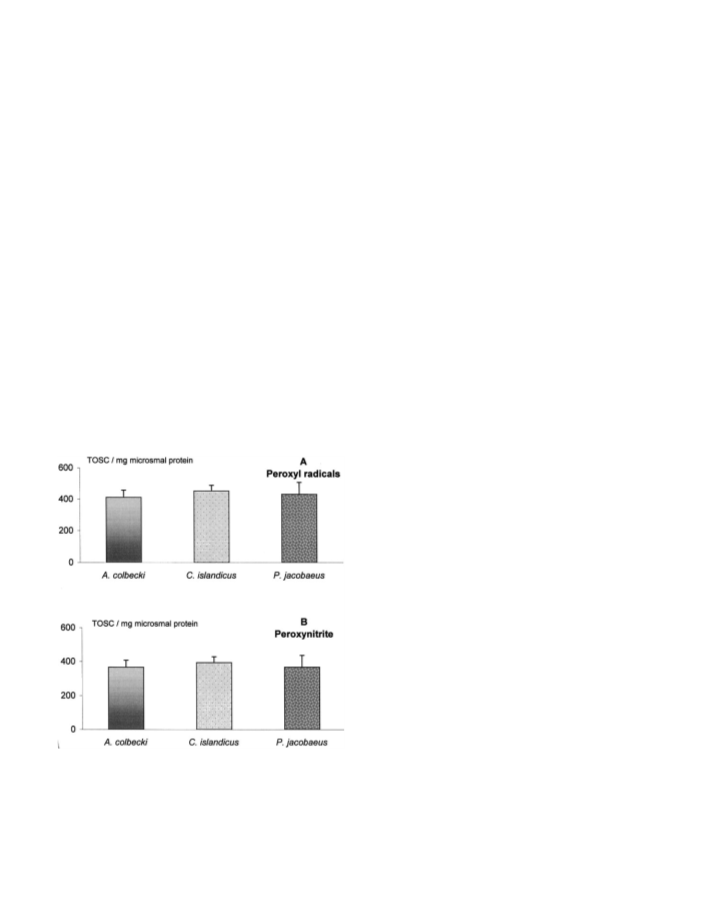
The enhanced formation of reactive oxygen species (ROS) is a common pathway of toxicity induced by stressful environmental conditions. In polar environments, characterization of antioxidant defences in key sentinel species may be of particular value as early detection biomarkers of unforeseen effects of human activities which are progressively increasing in these remote areas. The complexities associated with predicting the consequences at the 'organism level' of variations of specific antioxidant defences have been recently overcome by the ability to quantify an index of specific biological resistance to various kinds of ROS. The total oxyradical scavenging capacity (TOSC) assay has been used in three species of scallops for quantifying their ability to neutralize peroxyl (ROO·) and hydroxyl (·OH) radicals and peroxynitrite (HOONO). Adamussium colbecki and Chlamys islandicus represent key organisms for monitoring Antarctic and Arctic regions while Pecten jacobaeus was chosen for a comparison with a related temperate species. TOSC values for ROO· were significantly higher in A. colbecki indicating this species as the most efficient scavenger of ROO·. Mediterranean scallops had the lowest TOSC for ROO·. A. colbecki also exhibited the highest scavenging capacity for ·OH with values more than 2- fold greater than for C. islandicus and P. jacobaeus. TOSC for HOONO was lower for all scallops as compared to those for ROO· or ·OH. TOSC for microsomes was not significantly different among the species for any ROS studied, and the percentage contribution to the specific TOSC for the various oxidants of microsomes of all scallops accounted for 1-3% of the total TOSC of the post-mitochondrial fraction. The specific TOSC of scallop microsomes for ·OH was approximately ten times lower than that for ROO· or HOONO. The higher basal capability of the Antarctic scallop to neutralize different reactive oxygen species is discussed in terms of a possible adaptation to this extreme environment and TOSC is validated as a quantifiable measure of susceptibility to oxidative stress in marine organisms. (C) 2000 Elsevier Science B.V.




Contact:+86-158-05817090
Address:ROOM 9F, FLAT 2, GUODU DEVELOPING BLDG, No.182, ZHAOHUI ROAD
Jinan Decheng Hemu Medical Technology Co.,Ltd.
Contact:+86-531-68650525
Address:NO.554 Zhengfeng Road High-new Technology Development Zone
Beyond Pharmaceutical Co., Ltd
Contact:+86-571-8195-3185
Address:No. 13-1, Liansheng Road, Yuhang District
website:http://www.hope-chem.com
Contact:86-21-58090396-805
Address:Floor 4, Building 5, No.588 Tianxiong Road, Zhoupu International Medical Zone, ShangHai, China
Kunming Biohome Technology Co. Ltd.
website:http://www.biohometech.com/
Contact:86-871-67428869
Address:kunming
Doi:10.1039/a902427a
(1999)Doi:10.1021/jacs.6b08417
(2016)Doi:10.1007/s00706-007-0674-6
(2007)Doi:10.1016/0008-6215(90)84006-G
(1990)Doi:10.1002/adsc.200900826
(2010)Doi:10.1007/s11095-010-0145-3
(2010)
