Chemistry Letters 2000
389
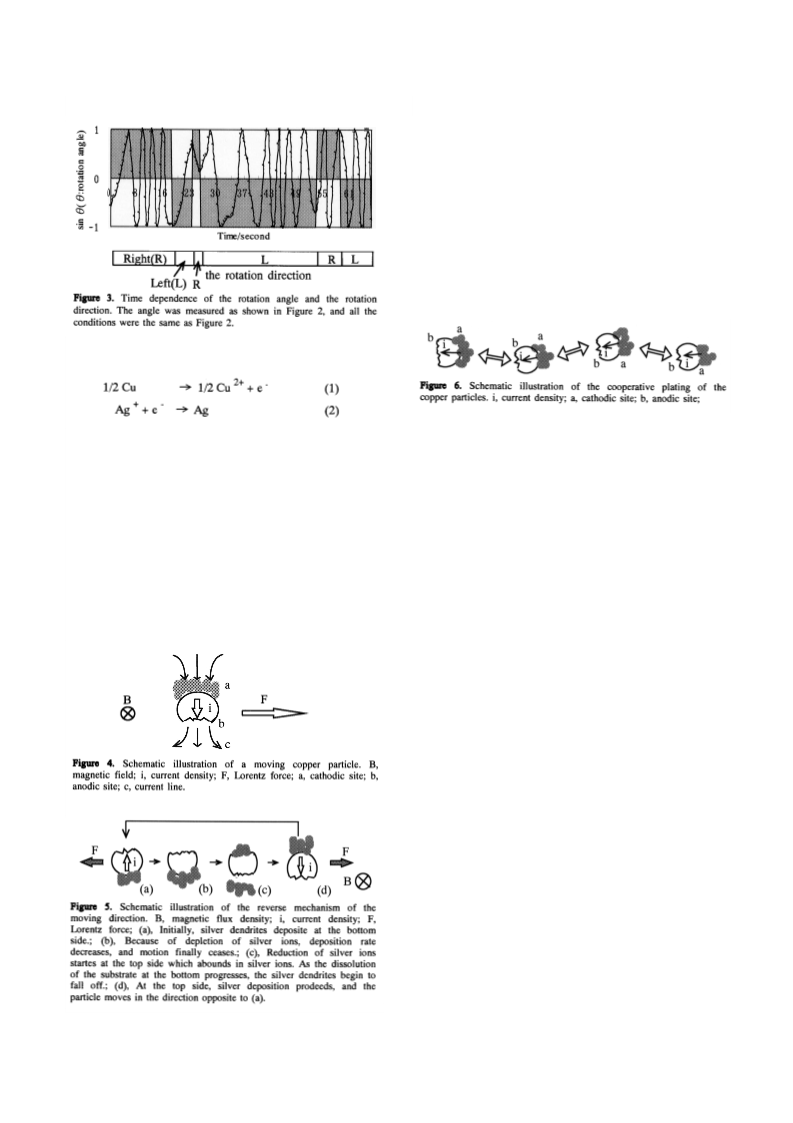
On the anodic side, however, the silver ions can be sufficiently
supplied, so that the reduction of silver ions starts at the former
anodic site (c). On the former cathodic side, among the roots of
the dendrites, the copper substrate dissolves because of the
anodic dissolution of copper (d).
Namely, the cathodic and anodic sites are exchanged, so
that the current in (a) and (d) flow in the opposite directions,
and the Lorentz forces operate reversely. This is the reason why
the rotation changes the direction. As the reactions proceed, at
the new cathodic site, silver dendrites grow, whereas the silver
dendrites at the new anodic site are removed by the dissolution of
the copper substrate. Because the dendrites tend to fall off, the
period of each state of the plating becomes uncertain.
In this plating, it is thought that an electrochemical local cell
is formed between the following anodic and cathodic reactions,
In an actual system, all the particles behave cooperatively
just like one gigantic particle. This is because the particle den-
sity is so high that the neighboring particles have the great
probability to contact each other. Figure 6 schematically repre-
sents such effect; an electrolytic current penetrates all the
ordered particles in one direction. The anodic and cathodic
sites of each particle go hand in hand with those of the neighbor
particle. Therefore, according to the mechanism mentioned
above, if one particle changes the current direction, all other
particles also change the directions. This situation in Figure 6
is similar to the phase transition represented by the Ising model
for ferromagnetism materials.14
As mentioned above, the dendrites are rough and eager to
fall off from the copper substrate. From these experimental
results, as shown in Figures 4 and 5, we can suppose the mech-
anism of this phenomenon as follows: Assuming that this
motion comes from a cooperative effect of a lot of particles, we
can pick up one particle as the representative of all other parti-
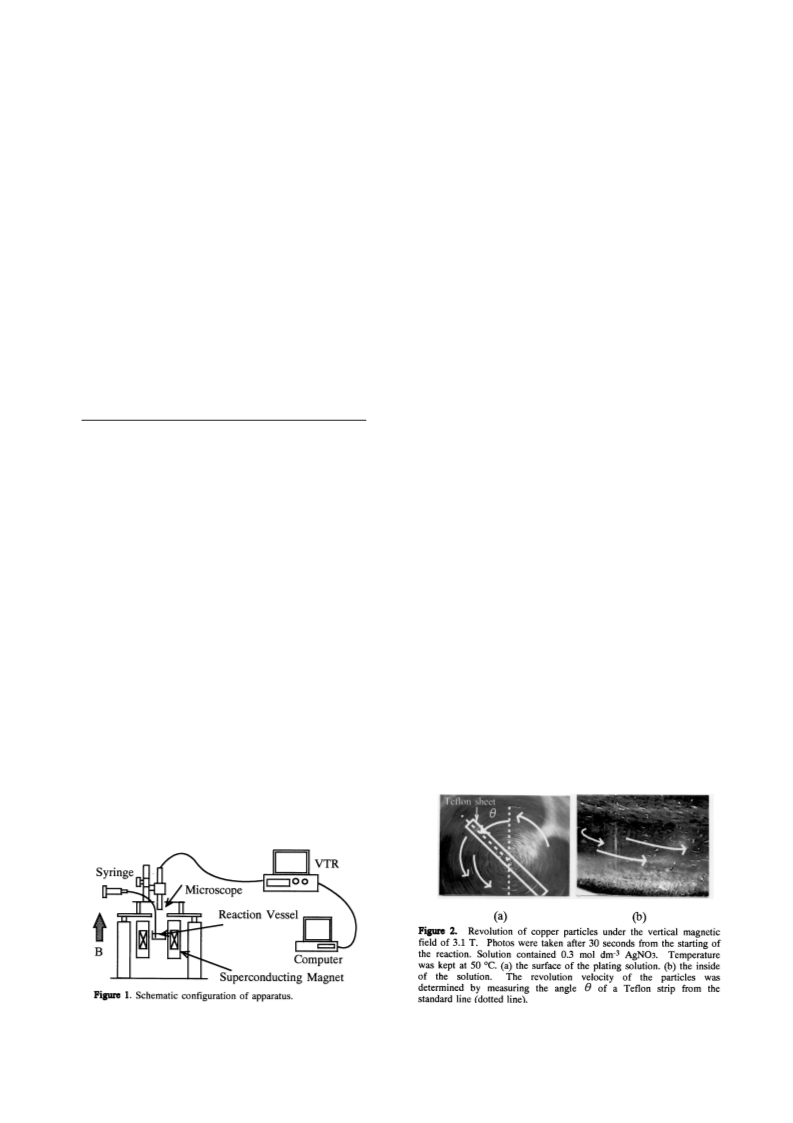
cles. Figure 4 indicates how the particle moves, i.e., inside the
particle, from the cathodic site to the anodic site, an electrolytic
current flows, so that in the magnetic field, a localized Lorentz
force is produced, and the particle moves to the right side. As
explained in Figure 5, after a certain time elapses, the cathodic
portion is roughly covered with silver dendrites, and the silver
ions are depleted in the solution near the dendrites. Therefore, the
whole reaction rate decreases and finally the motion ceases (b).
This is only a qualitative elucidation, so that we are now
attempting to quantitatively examine the oscillatory behavior of
this rotation.
References
1
2
3
K. Kitazawa, Kagaku Kogyo, 48,769 (1997).
S. Ueno and M. Iwasaka, J. Appl. Phys., 75, 7177 (1994).
N. Hirota, T. Homma, H. Sugawara, K. Kitazawa, M. Iwasaka, S.
Ueno, H. Yokoi, Y. Kakudate, S. Fujiwara, and K. Kawamura, Jpn.
J. Appl. Phys., 34, 991 (1995).
4
5
Y. Ikezoe, N. Hirota, J. Nakagawa, and K. Kitazawa, Nature, 393,
749 (1998).
M. Hamai, M. Tagami, I. Mogi, K. Watanabe, and M. Motokawa, in
“The proceeding of 2nd Symposium on New Magneto-Science ’98,”
JST, Kawaguchi (1998), p. 150.
6
7
M. Motokawa, in “The abstract of the International Workshop on
Chemical, Physical and Biological Processes under High Magnetic
Fields,” JST, Kawaguchi (1999), p. 24.
R. Aogaki, A. Tadano, and K. Shinohara, in “Fluid Mechanics and
Its Applications, Transfer Phenomena in Magnetohydrodynamic and
Electroconducting Flows,” ed by A. Alemany, Ph. Marty, and J. P.
Thibault, Kluwer Academic Publishers, Dordrecht (1999), Vol. 51,
p. 169.
8
9
K. Shinohara and R. Aogaki, Electrochemistry, 67, 126 (1999).
K. Shinohara and R. Aogaki, Chem. Lett., 1998, 1239.
10 A. Katsuki, S. Watanabe, R. Tokunaga, and Y. Tanimoto, Chem.
Lett. 1996, 219.
11 I. Mogi, S. Okubo, and M. Kamiko, Curr. Top. Cryst. Growth Res.,
3, 105 (1997).
12 I. Mogi, Electrochemistry, 67, 187 (1999).
13 S. Yonemochi, T. Iwasaka, and R. Aogaki, The Journal of the
Surface Finishing Society of Japan, 50, 1015 (1999).
14 T. Yabe, S. Kawata, and M. Fukuda, in “Introduction of Physical
Simulation,” Asakura-shoten, Tokyo (1989), p.11.

 Yonemochi, Shin-Ichi