ARTICLE IN PRESS
M. Udovic et al. / Journal of Solid State Chemistry 179 (2006) 3252–3259
3258
(
characterized by the three-fold coordination of atoms of
Within this ternary system, for a fixed concentration of
TiO , the increasing content of Bi O provides a practically
oxygen) in the spectra of the xTiO –(100ꢀx) glassy
2
2
2
3
samples (see Fig. 3) allows us to think that those are
monophase systems in which TiO6 polyhedrons are
interconnected via TeO4/2 disphenoids like in the TiTe O
linear increase of glass densities which is readily explained
by the very high molecular weight of the latter oxide.
We focus now on the evolution of the spectra in
Figs. 4–6(b), (d), (e) with the aim to comment the items
(iv)–(vi) in Section 3.3 in terms of the structural changes in
the Bi O –TiO –TeO glasses. A sharp strengthening of the
3
8
lattice. This implies the existence of the two types of
bridges in those glasses: Te–O–Ti and Te–O–Te bridges.
The former bridges would manifest their presence in the
spectra by bands similar to those observed for TiTe O .
However, positions and relatively weak intensities of those
bands (see Fig. 3) cannot influence dramatically the initial
shape of the spectrum (i.e. that of pure TeO glass), which
2
3
2
2
oscillator D which lowers its position with increasing y [see
Fig. 6(b), (d), (e)] indicates beyond any reasonable doubt
3
8
2
ꢀ
that an increasing number of [TeO3] ortho-groups are
formed in the glasses, and the latter evaluate to a ‘‘classic’’
tellurite structures with complex anions resembling those in
2
can account for point (i).
Now we concentrate on the items (ii) and (iii). Note first
that the peculiarities of the evolution of spectra indicated
there resemble those observed in the Raman spectra of
the Bi Te O
4
lattice. In other words, an increasing
11
2
modifier (Bi O ) content provokes a ‘‘normal’’ progressive
2
3
transformation of the TeO2 glass network into a typic
tellurite structure, i.e., into an ensemble of alternate
complex tellurite anions and monoatomic cations.
pure TeO during its glass–liquid transformation [19] at
2
heating. A vanishing of the weak shoulder of the band
4
wing above 700 cm (see Fig. 4 in [19]), was interpreted as
ꢀ
1
00–500 cm simultaneously with the strengthening of the
The evolution of the band occupying interval between
ꢀ1
ꢀ
1
400 and 500 cm (items iv and v), is in line with the above
1
ꢀ
indication of the breaking of the inter-chain bridges in
TeO at melting leading to the appearance of the Te–O
terminal bonds in the liquid.
conclusion. Actually, its shift towards 400 cm
just
indicates a decay of the initial framework (y ¼ 0) and its
depolymerization with increasing y, i.e. the replacement of
the strong Te–O–Te and Te–O–Ti bridges by weaker
Te–O–Bi linkages which were discussed above, when
considering the spectrum of crystalline Bi Te O . It can
2
The similar idea comes in mind when analysing the
spectra in Figs. 3 and 6(a)–(c). Reasoning from the above-
mentioned peculiarities of the crystal chemistry of the
TiTe O lattice, we are led to conclude that the glass
2
4
11
be added, that, theoretically, the formation of any
3
8
structures within the xTiO –(100ꢀx)TeO system can be
yBiO1.5–xTiO –(100ꢀxꢀy)TeO glass structure implies a
2
2
2
2
specified in terms of solid solutions of TiO in TeO , as it
2
possibility for appearance of another types of bridges like
Ti–O–Ti, Bi–O–Bi and Ti–O–Bi, but none of them can be
‘‘revealed’’ from the spectra.
2
was proposed above for the TiTe O crystalline lattice.
3
8
Actually, the formation of those glasses with increasing x
would change the coordination polyhedrons neither
around Ti atom nor around Te atom, and would result
in the following alterations: (a) the disappearance of the
We note that the transformation of glassy TeO network
2
induced by an addition of modifiers with cations having a
valence of one or two, as a rule, reduces the T values [1].
g
‘
decay of oscillator B), which are weak since they involve
˚
the weak axial Te–O bonds (about 2.15 A in length); (b) the
formation of stronger Te–O–Ti bridges (made of two
˚
relatively strong bonds having 1.95 A in length) replacing
just mentioned Te–O–Te linkages. These account for the
items (ii) and (iii), respectively.
‘standard’’ inter-chain Te–O–Te linkages (leading to a
Therefore, it is important to underline that the T values of
g
our glasses always increases with the progressive additions
of TiO2 or Bi O . Thus, it can be suggested that the
2
3
substitution of the Te–O–Te bridges by new Te–O–M
bridges in which the M-elements have valences of three,
four and higher, would augment thermal and mechanical
resistance of tellurite glasses, whether they are of frame-
work-type or not.
The fact of such a transformation is indirectly confirmed
by our another observations: glass transition temperature
T increases with increasing TiO content, thus indicating
5. Summary and conclusions
g
2
the substitution of the Te–O–Te bridges inherent of pure
TeO2 by the stronger chemical linkages Te–O–Ti. In
general, our interpretation of the experimental data is in
line with results early obtained by Sabadel et al. [3,11,12].
A glass forming domain was evidenced in the yBiO1.5
–
xTiO –(100ꢀxꢀy)TeO system, but no glass formation
2
2
was observed in the yBiO –xZrO –(100ꢀxꢀy)TeO
1
.5
2
2
system. For y ¼ 0, the evolution of the Raman spectra of
4
.2. Bi O –TiO –TeO glasses
2
the TiO –TeO glasses at increasing TiO content allows us
2
2
3
2
2
2
to conclude that no tellurite anions are built up in that
structure, and the Te–O–Te linkages are progressively
substituted by Te–O–Ti, due to which the framework
arrangement of the glass is kept. In contrast to this, the
addition of Bi O results in breaking off the initial glass
Under ice-quenching conditions, the glass forming
domain for the Bi O –TeO binary system extends in a
2
3
2
very narrow range of composition (only up to ꢁ4 mol% of
BiO ). However, the addition to this system of the third
1
.5
2
3
component, TiO , results in a broad glass domain
2
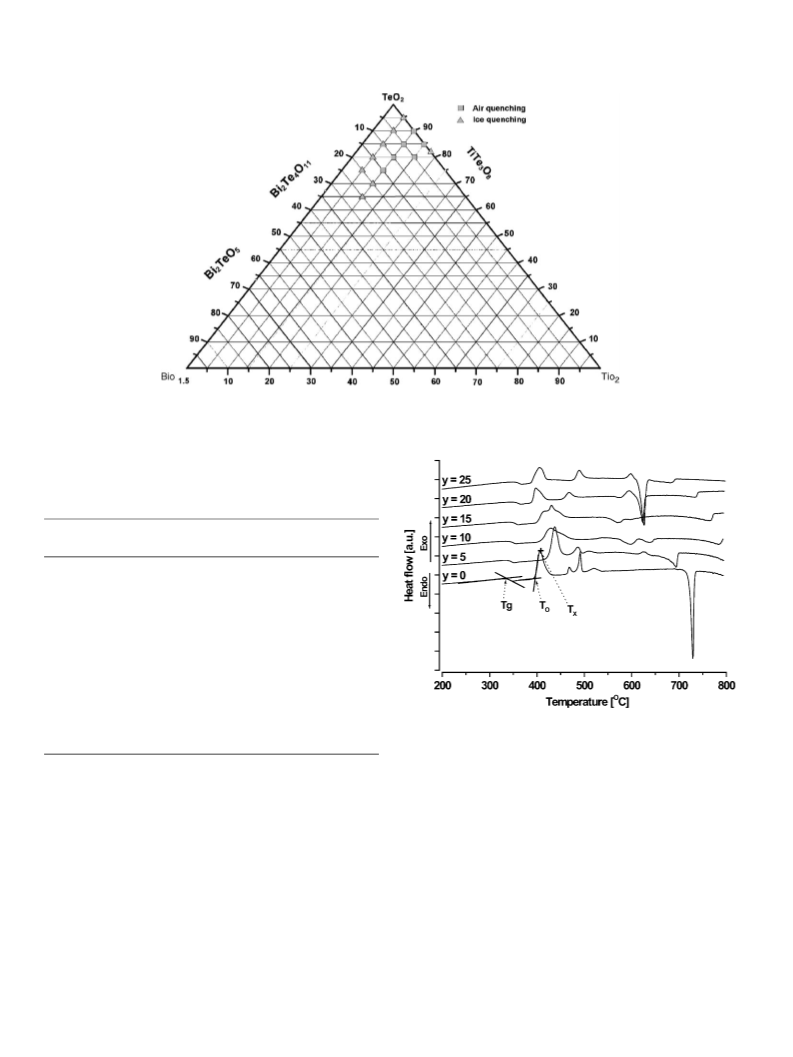
extending in some cases up to 25 mol% of BiO1.5 (Fig. 1).
framework, thus provoking its depolymerization, and in
forming local complex tellurite anions interconnected via

 Udovic