Evaluation Only. Created with Aspose.PDF. Copyright 2002-2021 Aspose Pty Ltd.
D. Linda et al. / Materials Research Bulletin 45 (2010) 1816–1824
1817
effect is not ordinary. Actually, as a rule, the addition of a
modifier causes the TeO2 framework to depolymerize into
island-type isolated complex anions [TenOm]2(mꢀ2n)ꢀ, thus
decreasing the susceptibility value [16]. Exceptions to this rule
are the glasses in which the modifier contains highly
polarisable cations, in particular Tl+ [15];
NaCl (temperature about ꢀ14 8C). Glass-forming region was
determined by optical inspection of the obtained products (which
were in the case of glassy samples transparent) and by using X-ray
diffraction (D5000 Siemens diffractometer, Sol-X detector, Cu K
a
radiation, step size = 0.048).
Glass transition (Tg) and crystallization (Tc) temperatures were
measured by heat flux differential scanning calorimetry (Netztsch
STA 409 apparatus). The powdered samples (ꢂ30 mg) were
introduced into platinum crucibles and the DSC curves were
recorded between 20 and 500 8C using a heating rate of 10 8C/min
and under nitrogen atmosphere. The glass transition temperature
was taken at the inflection point of the slope change of the
calorimetric signal associated with this transition. The crystalliza-
tion temperature was taken (when an exothermic peak was
observed) at the intersection of the slope of this exothermic peak
with the baseline. The densities of glassy samples were measured
on finely ground powders by helium pycnometry (Accupyc 1330
pycnometer).
(iii) the Raman gain coefficient of the glasses can be up to 58 times
that of a standard Corning 7980-2F fused silica [17].
However, TeO2–Tl2O glasses materials were found relatively
brittle and characterized by a low thermal stability. To overcome
this drawback, maintain the good non-linear characteristics of the
glasses, and even enlarge the scope of their interesting optical
properties, the Tl2O–MxOy–TeO2 ternary systems were recently
investigated at our laboratory. In particular, quite satisfactory
results relating the thermo-mechanical stability were achieved by
adding TiO2 to thallium tellurite system [18].
Our last activity in that field concerns the influence of the Ag2O
modifier introduced into Tl2O–TeO2 glasses. Indeed, according to
previous reports on silver-doped phosphate glasses [19], it is
expected that Tl2O–Ag2O–TeO2 glasses would show some inter-
esting photoluminescent properties (without loosing their initial
high non-linearity), resulting from the presence of silver cations.
Some results of structural studies of silver tellurite glasses and
of some metal-oxide silver tellurite ternary glasses have been
already published [1,20–22]. More or less large glassy domains
were found with respect to the melting and quenching conditions.
In particular, a glassy domain was revealed in a range 0–46 mol%
AgO0.5 in Ref. [21]. In analyzing neutron diffraction and Raman
spectra data, the authors concluded that a progressive depolymer-
isation of the TeO2 glass structure occurs with increasing modifier
oxides content. This depolymerisation is characterized by the
transformation of the TeO4 disphenoids into TeO3 units [20–22].
Such a structural change is a trivial fact for MxOy–TeO2 glasses [11].
One of the rare exceptions is the case M = Ti for which the Ti–O
bond distances in the glassy structure are very close to the Te–O
ones. Consequently, the Te–O–Te bridges are just replaced by Te–
O–Ti ones and the glass framework is conserved [18].
The Raman spectra of powder sample were recorded in the 80–
1000 cmꢀ1 range and in back-scattering mode at 514.532 nm using
a
T64000 Jobin-Yvon spectrophotometer operating in triple
subtractive configuration (1800 grooves/mm) associated to
a
liquid nitrogen-cooled CCD detector. Measurements were per-
formed at low power (<10 mW on the surface of the sample) of the
excitation line, in order to avoid any damage of the glasses. The
scattered light was collected through a microscope objective (50ꢁ
LWD) and confocal filtering (0.1 mm). The spectral resolution was
about 2.5 cmꢀ1 at the exciting line. All samples were measured
three times to check the reproducibility of spectra and to enhance
the accuracy of the data by accumulation.
The Raman measurements of bulk sample were carried out on
an inVia Reflex Raman spectrometer of the Renishaw Company at
514 nm. The spectra were recorded in a linefocus mode (in order to
minimize the damage of the samples) centred to 500 cmꢀ1 over a
time of 1 s with the diffraction grating of 1800 grooves/mm
(spectral resolution about 2.7 cmꢀ1). The laser power at the sample
level and through an objective 50ꢁ was 20 mW.
A stable silver tellurite crystalline phase was detected in the
Ag2O–TeO2 phase diagram, Ag2TeO3 [23]. This phase exits in two
3. Results and analysis
polymorphic forms,
a metastable orthorhombic form which
3.1. Glass formation
transforms irreversibly into the monoclinic stable variety above
573 K [24].
To the best of our knowledge, no crystalline compound and no
glass have been evidenced within the binary Ag2O–Tl2O system.
We can only indicate some investigations of ternary systems (see
e.g., the study of silver–thallium borate glasses [25]).
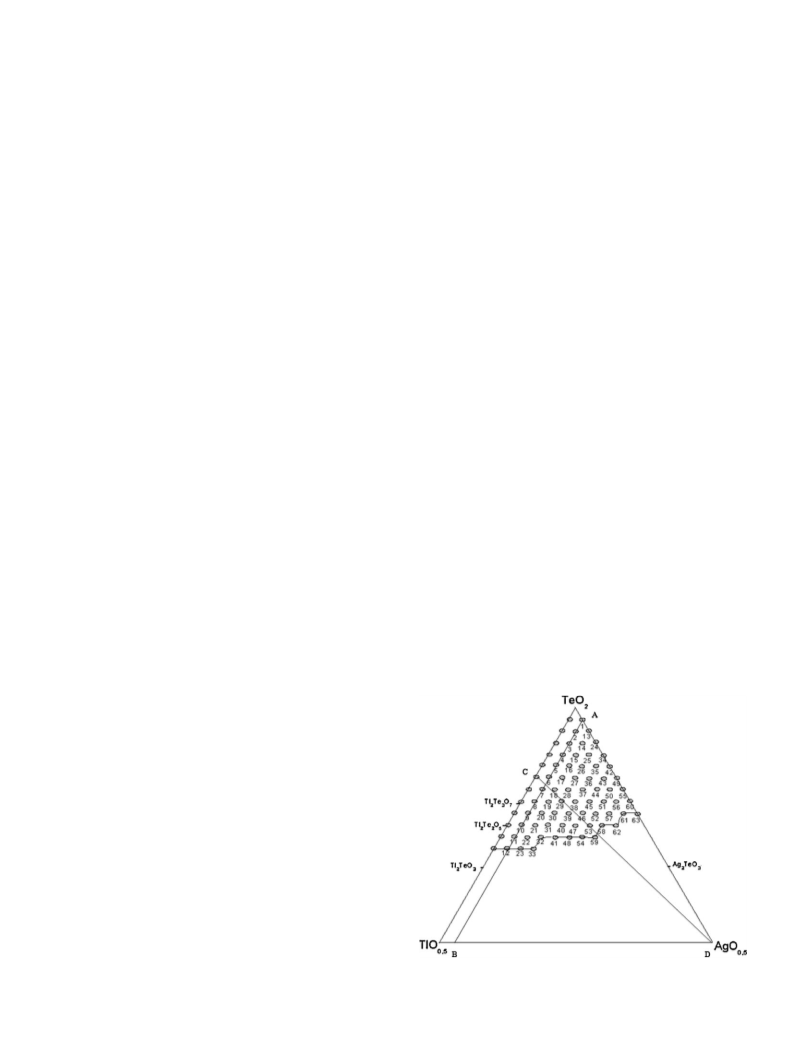
A large glass forming domain observed within the Tl2O–Ag2O–
2 system is presented in Fig. 1. The glasses are all yellow, the
T[()$DFIGT] eO
Our present work was initially aimed at the determination of
the glass formation domain within the Tl2O–Ag2O–TeO2 ternary
system which has never been explored. Then, the thermal
behaviour of the glasses including the measurements of the
glass-transition (Tg) and crystallization (Tc) temperatures was
studied and the evolution of the glassy structure with increasing
modifier component was analysed by using Raman spectroscopy.
The results obtained are presented and discussed in this paper.
2. Experimental
Glassy samples were prepared by first melting at 800 8C in air
for 15 min in platinum crucibles intimate mixtures of high purity
Tl2CO3 (Aldrich, 99.9%), Ag2O (99.9%) and home-made TeO2. The
former was prepared by decomposition, at 550 8C, of commercial
H6TeO6 (Aldrich, 99.9%). The decomposition of Tl2CO3 (CO2
evaporation) was ensured during the melting. The melts (2 g for
the bulk samples and 200 mg for the powder samples) were then
fast-quenched in a freezing mixture consisting of ice, ethanol and
Fig. 1. Glass forming domain at 800 8C under ice-quenching conditions within the
Tl2O–Ag2O–TeO2 system.

 Linda
Linda