Angewandte
Communications
Chemie
Water Splitting
Synergistic Cocatalytic Effect of Carbon Nanodots and Co3O4
Nanoclusters for the Photoelectrochemical Water Oxidation on
Hematite
Peng Zhang+, Tuo Wang+, Xiaoxia Chang, Lei Zhang, and Jinlong Gong*
Abstract: Cocatalysis plays an important role in enhancing the
activity of semiconductor photocatalysts for solar water
splitting. Compared to a single cocatalyst configuration,
a cocatalytic system consisting of multiple components with
different functions may realize outstanding enhancement
through their interactions, yet limited research has been
reported. Herein we describe the synergistic cocatalytic effect
between carbon nanodots (CDots) and Co3O4, which promotes
the photoelectrochemical water oxidation activity of the Fe2O3
photoanode with a 60 mV cathodically shifted onset potential.
The C/Co3O4-Fe2O3 photoanode exhibits a photocurrent den-
sity of 1.48 mAcmÀ2 at 1.23 V (vs. reversible hydrogen
electrode), 78% higher than that of the bare Fe2O3 photoanode.
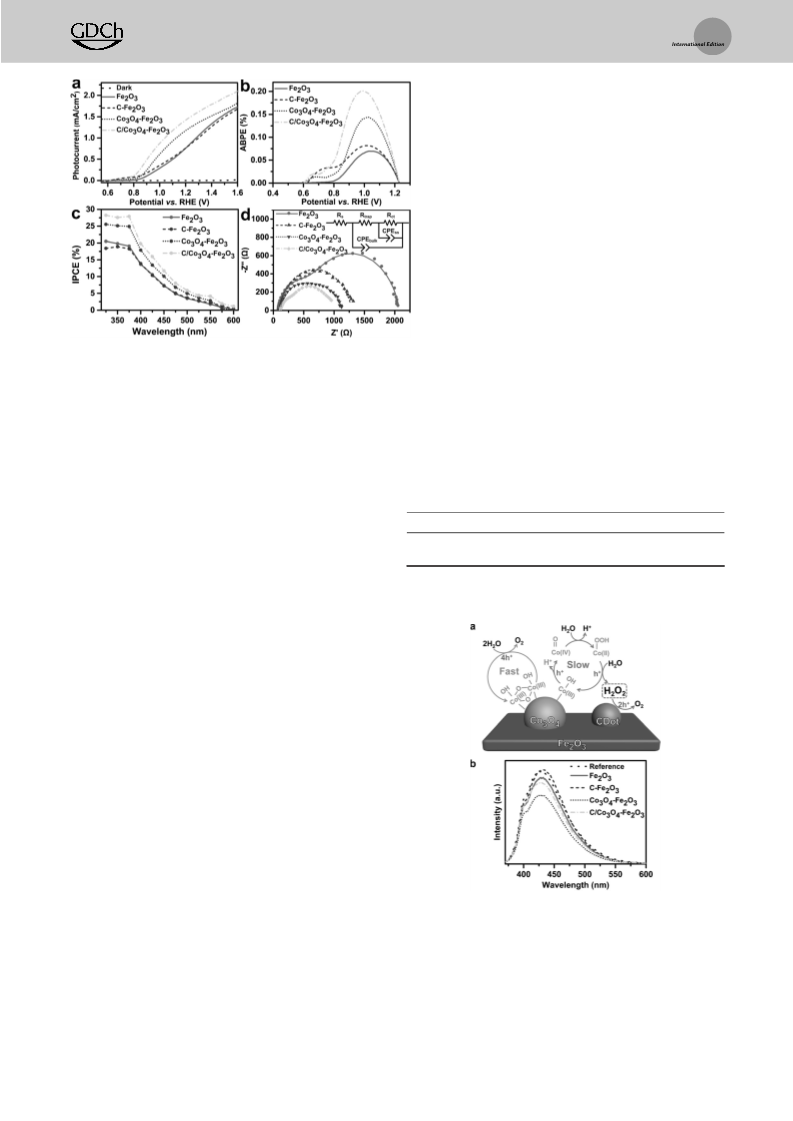
The slow reaction process on the single CoIII-OH site of the
Co3O4 cocatalyst, oxidizing H2O to H2O2 with two photo-
generated holes, could be accelerated by the timely H2O2
oxidation to O2 catalyzed on CDots.
iridium and ruthenium oxides, cobalt-based materials are
earth-abundant and cost-effective.[7] Cobalt phosphate (Co-
Pi) showed a prominent promotive effect on the activity of
hematite (a-Fe2O3) for photoelectrochemical water oxidation
with a substantial cathodic onset potential shift and an
enhanced photocurrent density.[8] It was demonstrated that
the Co-Pi could increase the lifetime of photogenerated holes
and retard the recombination of charge carriers.[9] The
photocatalytic water-oxidation activity of Fe2O3 photoanode
could also be effectively improved by integration of an
inorganic Co3O4 cocatalyst.[10]
Metal-free materials are also investigated as cocatalysts
for solar water splitting. Graphitic carbon nanodots (CDots)
were demonstrated to enhance the photocatalytic water-
oxidation activates of TiO2 nanotube arrays,[11] ZnO nanowire
arrays,[12] and Ag3PW12O40 photocatalyst.[13] Most recently,
a CDots/C3N4 composite photocatalyst showed an outstand-
ing activity for solar water splitting with an overall solar-
energy conversion efficiency of 2.0%.[14] It was proposed that
the CDots performed as highly active catalysts for the
decomposition of H2O2, which was considered as the inter-
mediate spices from a two-step-two-electron water-splitting
process on C3N4. Comparing with the one-step-four-electron
water-splitting route, such a reaction pathway is kinetically
favored, which leads to the high activity of the CDots/C3N4
photocatalyst.
Cocatalysts ranging from metal oxides to metal-free
materials have been widely studied for improving the activity
of semiconductor photocatalysts. However, relevant research
mostly focuses on single-component cocatalyst, whose coca-
talytic effect is restricted to the physical, chemical and
electronic properties of the material. As complex processes
are involved in the water-oxidation reaction, single cocatalyst
can hardly realize the acceleration of all these processes
simultaneously. Thus, to achieve better a performance it is
desirable to fabricate a cocatalytic system with different
functions for synergistic enhancement. Fe2O3 is selected to
demonstrate the effectiveness of cocatalyst systems owing to
its notoriously slow surface reaction kinetics for water
oxidation.[15] By comparing the activity of Fe2O3 photoanodes
with different cocatalysts (i.e., CDots, Co3O4, and both of
them), we demonstrated that Co3O4 and CDot cocatalysts
showed a synergistic cocatalytic effect. Ex situ detection of
H2O2 from electrolyte was conducted to investigate the
mechanism of the effect.
H
ydrogen production via solar water splitting is one of the
most promising approaches to develop sustainable energy
resources.[1] Semiconductor photocatalysts with suitable
band-gap structures, good charge-carrier conductivities, and
fast surface reaction kinetics are desired to achieve high solar-
energy conversion efficiencies.[2] The surface reaction kinetics
of photocatalysts could be enhanced by integrating cocata-
lysts, which can provide surface reaction sites with lower
overpotentials.[3] Moreover, cocatalysts could act as selective
trapping sites for photogenerated electrons/holes and sup-
press the recombination of charge carriers.[4] Thus, strategies
of cocatalysts loading have been extensively developed to
enhance the activity of semiconductor photo-absorbers with
slow surface reaction kinetics. Much attention has been paid
to the water oxidation half reaction since it is regarded as the
rate determining and kinetically unfavored process (with four
electrons involved to produce one O2 molecule).[5]
Cobalt-based compounds have been developed as coca-
talysts for photocatalytic water oxidation.[6] Comparing with
[*] Dr. P. Zhang,[+] Prof. T. Wang,[+] X. Chang, Prof. L. Zhang, Prof. J. Gong
Key Laboratory for Green Chemical Technology of Ministry of
Education, School of Chemical Engineering and Technology, Tianjin
University, Collaborative Innovation Center of Chemical Science and
Engineering
Tianjin 300072 (China)
E-mail: jlgong@tju.edu.cn
[+] These authors contributed equally to this work.
The Fe2O3 photoanode was prepared by a previously
reported hydrothermal approach (see Supporting Informa-
tion for experimental details).[16] The Fe2O3 photoanode
obtained shows a one-dimensional wormlike structure (Fig-
Supporting information and the ORCID identification number(s) for
Angew. Chem. Int. Ed. 2016, 55, 5851 –5855
ꢀ 2016 Wiley-VCH Verlag GmbH & Co. KGaA, Weinheim
5851

 Zhang, Peng