10.1002/anie.201707134
Angewandte Chemie International Edition
COMMUNICATION
the hydrogen source.[24] In comparison, in reactions of 1a and 1n
containing 1 equiv of D2O, significant amounts of deuterium was
incorporated in products 2a and 2n, while no deuterium was
detected in the recovered starting material after partial
conversions. Interestingly, careful nOe analysis of 2n revealed
that the deuterium was predominantly added syn to the inserting
aryl ring on the indoline. This indicates that after the insertion,
the resulting carbon−nickel bond was mainly protonated at the
front side of the carbon center.
[1] Reviews: a) O. Loiseleur, M. Hayashi, N. Schmees, A. Pfaltz, Synthesis
1997, 1338; b) A. B. Dounay, L. E. Overman, Chem. Rev. 2003, 103,
2945; c) M. Shibasaki, E. M. Vogl, T. Ohshima, Adv. Synth. Catal. 2004,
346, 1533; d) L. F. Tietze, H. Ila, H. P. Bell, Chem. Rev. 2004, 104,
3453; e) D. Mc Cartney, P. J. Guiry, Chem. Soc. Rev. 2011, 40, 5122.
[2] Examples: a) E. W. Werner, T.-S. Mei, A. J. Burckle, M. S. Sigman,
Science 2012, 338, 1455; b) B. J. Stokes, A. J. Bischoff, M. S. Sigman,
Chem. Sci. 2014, 5, 2336; c) L. Xu, M. J. Hilton, X. Zhang, P.-O. Norrby,
Y.-D. Wu, M. S. Sigman, O. Wiest, J. Am. Chem. Soc. 2014, 136, 1960;
d) H. H. Patel, M. S. Sigman, J. Am. Chem. Soc. 2015, 137, 3462; e) Z.-
M. Chen, M. J. Hilton, M. S. Sigman, J. Am. Chem. Soc. 2016, 138,
11461; f) C. M. Avila, J. S. Patel, Y. Reddi, M. Saito, H. M. Nelson, H. P.
Shunatona, M. S. Sigman, R. B. Sunoj, F. D. Toste, Angew. Chem. Int.
Ed. 2017, 56, 5806; Angew. Chem. 2017, 129, 5900.
[3] Examples: a) W.-Q. Wu, Q. Peng, D.-X. Dong, X.-L. Hou, Y.-D. Wu, J.
Am. Chem. Soc. 2008, 130, 9717; b) Z. Yang, J. Zhou, J. Am. Chem.
Soc. 2012, 134, 11833; c) J. Hu, H. Hirao, Y. Li, J. Zhou, Angew. Chem.
Int. Ed. 2013, 52, 8676; Angew. Chem. 2013, 125, 8838; d) J. Hu, Y. Lu,
Y. Li, J. Zhou, Chem. Commun. 2013, 49, 9425; e) C. Wu, J. Zhou, J.
Am. Chem. Soc. 2014, 136, 650; f) G. M. Borrajo-Calleja, V. Bizet, T.
Burgi, C. Mazet, Chem. Sci. 2015, 6, 4807; g) C. C. Oliveira, A. Pfaltz, C.
R. D. Correia, Angew. Chem. Int. Ed. 2015, 54, 14036; Angew.Chem.
2015, 127,14242; h) Q.-S. Zhang, S.-L. Wan, D. Chen, C.-H. Ding, X.-L.
Hou, Chem. Commun. 2015, 51, 12235; i) G. M. Borrajo-Calleja, V. Bizet,
C. Mazet, J. Am. Chem. Soc. 2016, 138, 4014.
Furthermore, when cyclization of 1a was conducted together
with n-butyl bromides under slightly modified conditions, the
benzylnickel species in the catalytic cycle was trapped by C3-
alkylation to give 4a in moderate yield and 99.6% ee, along with
an uncyclized coupling product 5a (Scheme 5). In nOe analysis
of 4a, magnetization transfer was detected between the benzylic
hydrogen and methyl group on the indoline. Therefore, the butyl
group and inserting aryl ring are situated syn to each other. A
similar result was obtained in the reaction of isobutyl bromide.
These are the first examples of asymmetric coupling between
two organic halides and an unsaturated bond (indole in this case)
that give a high level of enantioselectivity.[25]
[4] Examples: a) A. Minatti, X. Zheng, S. L. Buchwald, J. Org. Chem. 2007,
72, 9253; b) S. Liu, J. Zhou, Chem. Commun. 2013, 49, 11758; c) S.
Mannathan, S. Raoufmoghaddam, J. N. H. Reek, J. G. de Vries, A. J.
Minnaard, ChemCatChem 2017, 9, 551; d) Rh-catalyzed asymmetric
reductive Heck reaction to produce oxindoles in high ee: Lautens, M.;
Jang, Y. J.; Larin, E. M. Angew. Chem. Int. Ed., 2017.
DOI: 10.1002/anie.201704922
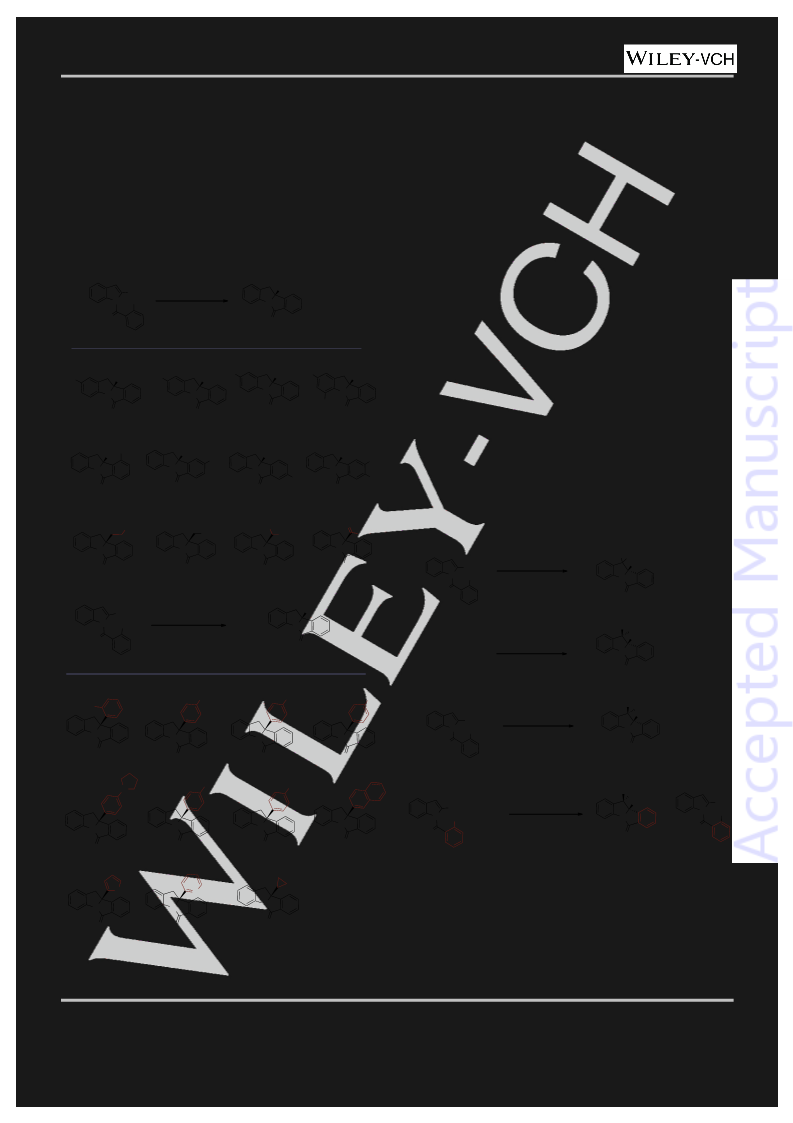
The indole ring of 2a can be easily brominated by treatment
of Br2. Furthermore the amide linkage in 2a was cleaved by
NaBH4 to give alcohol 6b and deoxygenated by borane to afford
6c.[6a; 26] In all cases, no ee erosion was detected (Scheme 6).
[5] a) S. Cacchi, Pure Appl. Chem. 1990, 62, 713; b) A. L. Gottumukkala, J.
G. de Vries, A. J. Minnaard, Chem.-Eur. J. 2011, 17, 3091.
[6] a) C. Shen, R.-R. Liu, R.-J. Fan, Y.-L. Li, T.-F. Xu, J.-R. Gao, Y.-X. Jia, J.
Am. Chem. Soc. 2015, 137, 4936; b) asymmetric cyclization followed by
alkynylation: R.-R. Liu, Y.-G. Wang, Y.-L. Li, B.-B. Huang, R.-X. Liang,
Y.-X. Jia, Angew. Chem. Int. Ed. 2017, 56, 7475; Angew. Chem. 2017,
129, 7583; nonstereoselective examples: c) R.-R. Liu, Y. Xu, R.-X. Liang,
B. Xiang, H.-J. Xie, J.-R. Gao, Y.-X. Jia, Org. Biomol. Chem. 2017, 15,
2711; d) R.-R. Liu, T.-F. Xu, Y.-G. Wang, B. Xiang, J.-R. Gao, Y.-X. Jia,
Chem. Commun. 2016, 52, 13664.
Me
Me
Me
NaBH4
BH3
Me2S
N
N
H
N
THF/CH3OH
THF, reflux
2a
O
6b OH
6c
95% yield
[7] W. Kong, Q. Wang, J. Zhu, Angew. Chem. Int. Ed. 2017, 56, 3987;
96% ee
65% yield
Angew.Chem. 2017, 129, 4045.
[8] G. Yue, K. Lei, H. Hirao, J. Zhou, Angew. Chem. Int. Ed. 2015, 54, 6531;
Angew.Chem. 2015, 127, 6631.
Br2, AcOH
CH2Cl2
[9] K. S. Egorova, V. P. Ananikov, Angew. Chem. Int. Ed. 2016, 55, 12150;
Br
Me
N
Angew.Chem. 2016, 128, 12334.
[10] DFT calculation: a) Lin, L. Liu, Y. Fu, S.-W. Luo, Q. Chen, Q.-X. Guo,
Organometallics 2004, 23, 2114; b) V. H. Menezes da Silva, A. A. C.
Braga, T. R. Cundari, Organometallics 2016, 35, 3170.
O
6a
90% yield
[11] a) T. M. Gøgsig, J. Kleimark, S. O. Nilsson Lill, S. Korsager, A. T.
Lindhardt, P.-O. Norrby, T. Skrydstrup, J. Am. Chem. Soc. 2011, 134,
443; b) A. R. Ehle, Q. Zhou, M. P. Watson, Org. Lett. 2012, 14, 1202; c)
S. Z. Tasker, A. C. Gutierrez, T. F. Jamison, Angew. Chem. Int. Ed.
2014, 53, 1858; Angew. Chem. 2014, 126, 1889
[12] a) R. Matsubara, T. F. Jamison, J. Am. Chem. Soc. 2010, 132, 6880; b)
R. Matsubara, T. F. Jamison, Chem.-Asian. J. 2011, 6, 1860.
[13] a) R. Matsubara, A. C. Gutierrez, T. F. Jamison, J. Am. Chem. Soc.
2011, 133, 19020; b) E. A. Standley, T. F. Jamison, J. Am. Chem. Soc.
2013, 135, 1585; c) M. R. Harris, M. O. Konev, E. R. Jarvo, J. Am. Chem.
Soc. 2014, 136, 7825.
[14] A nonstereoselective process: a) J.-N. Desrosiers, L. Hie, S. Biswas, O.
V. Zatolochnaya, S. Rodriguez, H. Lee, N. Grinberg, N. Haddad, N. K.
Yee, N. K. Garg, C. H. Senanayake, Angew. Chem. Int. Ed. 2016, 55,
11921; Angew. Chem. 2016, 128, 12100; an enantioselective process:
b) J.-N. Desrosiers, J. Wen, S. Tcyrulnikov, S. Biswas, B. Qu, L. Hie, D.
Kurouski, L. Wu, N. Grinberg, N. Haddad, C. A. Busacca, N. K. Yee, J. J.
Song, N. K. Garg, X. Zhang, M. C. Kozlowski, C. H. Senanayake, Org.
Lett. 2017, 19, 3338.
[15] Examples: a) G. P. Boldrini, D. Savoia, E. Tagliavini, C. Trombini, A. U.
Ronchi, J. Organomet. Chem. 1986, 301, C62; b) S. A. Lebedev, V. S.
Lopatina, E. S. Petrov, I. P. Beletskaya, J. Organomet. Chem. 1988, 344,
253; c) R. Shrestha, S. C. M. Dorn, D. J. Weix, J. Am. Chem. Soc. 2013,
135, 751; d) I. R. Márquez, D. Miguel, A. Millán, M. L. Marcos, L. Á. de
Cienfuegos, A. G. Campaña, J. M. Cuerva, J. Org. Chem. 2014, 79,
1529; review: e) J. Streuff, A. Gansäuer, Angew. Chem. Int. Ed. 2015,
54, 14232. Angew.Chem. 2015, 127,14438.
Scheme 6. Product derivatization without ee loss
In summary, we report the first example of nickel-catalyzed
asymmetric reductive Heck cyclization that provides fused
indolines in good ee values. Mechanistically, it is distinct from
the palladium-catalyzed process as reported by Jia et al. in how
the nickel-carbon bond is converted to a C-H bond to release the
product, protonation of the carbon-nickel bond versus hydride
donation followed by C-H reductive elimination on Pd.
Acknowledgements
We thank Singapore Ministry of Education Academic Research
Fund (MOE2015-T1-001-166 and MOE2014-T1-001-021) and
GSK-EDB Trust Fund (Green and Sustainable Manufacturing
Award 2013) for financial support.
Keywords: nickel catalysis • reductive Heck reaction •
[16] Stereoselective synthesis of indolines: a) R. Dalpozzo, G. Bartoli, G.
Bencivenni, Chem. Soc. Rev. 2012, 41, 7247; b) K. W. Quasdorf, L. E.
Overman, Nature 2014, 516, 181; c) C.-X. Zhuo, C. Zheng, S.-L. You,
asymmetric catalysis • indoline • cyclization
This article is protected by copyright. All rights reserved.

 Qin, Xurong