Welcome to LookChem.com Sign In|Join Free
  • or

Encyclopedia

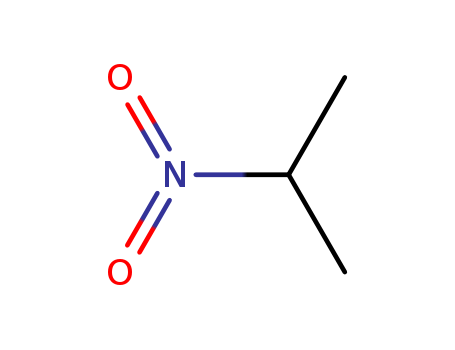
2-Nitropropane

Base Information
  • Chemical Name:2-Nitropropane
  • CAS No.:79-46-9
  • Deprecated CAS:104306-46-9
  • Molecular Formula:C3H7 N O2
  • Molecular Weight:89.0941
  • Hs Code.:29042000
  • European Community (EC) Number:201-209-1
  • ICSC Number:0187
  • NSC Number:5369
  • UN Number:2608
  • UNII:GKV234L2QH
  • DSSTox Substance ID:DTXSID6020981
  • Nikkaji Number:J3.845H
  • Wikipedia:2-Nitropropane
  • Wikidata:Q209453
  • NCI Thesaurus Code:C44313
  • Metabolomics Workbench ID:50352
  • ChEMBL ID:CHEMBL261886
  • Mol file:79-46-9.mol
2-Nitropropane

Synonyms:2-nitropropane

Suppliers and Price of 2-Nitropropane
Supply Marketing:
Business phase:
The product has achieved commercial mass production*data from LookChem market partment
Manufacturers and distributors:
  • Manufacture/Brand
  • Chemicals and raw materials
  • Packaging
  • price
Total 19 raw suppliers
Chemical Property of 2-Nitropropane
Chemical Property:
  • Appearance/Colour:liquid 
  • Melting Point:-93 ºC 
  • Boiling Point:119-122 ºC 
  • Flash Point:28 ºC 
  • PSA:45.82000 
  • Density:0.992 
  • LogP:1.19470 
  • Water Solubility.:1.7 g/100 mL (20℃) 
  • XLogP3:0.8
  • Hydrogen Bond Donor Count:0
  • Hydrogen Bond Acceptor Count:2
  • Rotatable Bond Count:0
  • Exact Mass:89.047678466
  • Heavy Atom Count:6
  • Complexity:54.3
  • Transport DOT Label:Flammable Liquid
Purity/Quality:

98% *data from raw suppliers

Safty Information:
  • Pictogram(s):  
  • Hazard Codes: T:Toxic;
     
  • Statements: R10:; R20/22:; R45:; 
  • Safety Statements: S45:; S53:; 
MSDS Files:

SDS file from LookChem

Total 1 MSDS from other Authors

Useful:
  • Chemical Classes:Nitrogen Compounds -> Nitros, Aliphatic
  • Canonical SMILES:CC(C)[N+](=O)[O-]
  • Inhalation Risk:A harmful contamination of the air can be reached rather quickly on evaporation of this substance at 20 °C.
  • Effects of Short Term Exposure:The vapour is irritating to the eyes and respiratory tract. The substance is mildly irritating to the skin. The substance may cause effects on the central nervous system. Exposure far above the OEL could cause liver impairment and death.
  • Effects of Long Term Exposure:The substance defats the skin, which may cause dryness or cracking. This substance is possibly carcinogenic to humans.
Technology Process of 2-Nitropropane

There total 62 articles about 2-Nitropropane which guide to synthetic route it. The literature collected by LookChem mainly comes from the sharing of users and the free literature resources found by Internet computing technology. We keep the original model of the professional version of literature to make it easier and faster for users to retrieve and use. At the same time, we analyze and calculate the most feasible synthesis route with the highest yield for your reference as below:

synthetic route:
Guidance literature:
With dihydrogen peroxide; sodium carbonate; In methanol; at 60 ℃; under 750.075 Torr;
Guidance literature:
With sodium nitrite; In N,N-dimethyl-formamide; at 50 ℃; for 5h; Reagent/catalyst; Solvent; Time;

Reference yield: 65.0%

Guidance literature:
With N-hydroxyphthalimide; air; Nitrogen dioxide; In various solvent(s); at 100 ℃; for 14h; under 3800.26 Torr;
DOI:10.1021/jo025632d
Refernces

10.1039/jr9620003040

The research investigates the interaction of acrylonitrile and benzaldehyde in the presence of various compounds, including methanol, piperidine, and 2-nitropropane. 2-nitropropane is used as one of the key reactants to study its interaction with acrylonitrile and benzaldehyde in the presence of Triton B. The purpose is to investigate the cyanoethylation process and the effect of benzaldehyde on the reaction mechanism. When 2-nitropropane is used in combination with benzaldehyde and acrylonitrile, it leads to the formation of specific products, including 2,2'-cyanoethyl-2-nitropropane and a high-boiling alcohol, which upon dehydration yields a-(2-methyl-2-nitropropyl)cinnamonitrile. These products provide evidence for the interference of benzaldehyde in the cyanoethylation process, similar to its role in reactions with methanol and piperidine. The study concludes that the extent of benzaldehyde's interference in these reactions can provide insights into the rate of protonation of intermediate carbanions.

Synthesis by the S(RN)1 reaction of a new series of imidazo[1,2-a]pyridine derivatives with pharmacological potentialities

10.1016/S0040-4020(01)87129-5

The study investigates the SRN1 reaction between 2-chloromethyl-3-nitroimidazo[1,2-a]pyridine and various nitronate anions, including those from aliphatic, cyclic, and heterocyclic nitroalkanes, to synthesize new potential pharmacological derivatives. The reaction involves the C-alkylation of 2-chloromethyl-3-nitroimidazo[1,2-a]pyridine by nitronate anions, followed by base-promoted nitrous acid elimination to form products with a trisubstituted double bond at the 2-position. Key chemicals include 2-chloromethyl-3-nitroimidazo[1,2-a]pyridine as the starting material, various nitroalkanes (e.g., 2-nitropropane, nitrocyclopentane) as sources of nitronate anions, and tetrabutylammonium hydroxide as a phase-transfer catalyst. The synthesized compounds are being evaluated for their potential pharmacological properties, particularly their affinity for specific receptors related to anxiolytic and hypnotic effects.


Post a RFQ

Enter 15 to 2000 letters.Word count: 0 letters

Attach files(File Format: Jpeg, Jpg, Gif, Png, PDF, PPT, Zip, Rar,Word or Excel Maximum File Size: 3MB)

1 Customer Service

What can I do for you?
Get Best Price

Get Best Price for 79-46-9