Welcome to LookChem.com Sign In|Join Free
  • or

Encyclopedia

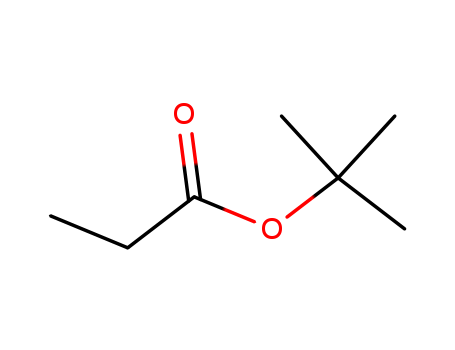
tert-Butyl propionate

Base Information
  • Chemical Name:tert-Butyl propionate
  • CAS No.:20487-40-5
  • Molecular Formula:C7H14 O2
  • Molecular Weight:130.187
  • Hs Code.:2915509000
  • European Community (EC) Number:606-566-0
  • UNII:43953CC10D
  • DSSTox Substance ID:DTXSID20174459
  • Nikkaji Number:J100.394A
  • Wikidata:Q27258627
  • Mol file:20487-40-5.mol
tert-Butyl propionate

Synonyms:tert-Butyl propionate;20487-40-5;tert-butyl propanoate;t-Butyl propanoate;Propanoic acid, 1,1-dimethylethyl ester;1,1-Dimethylethyl propionate;tert-?Butyl propionate;Propionic acid, tert-butyl ester;t-butyl propionate;Propionic Acid tert-Butyl Ester;UNII-43953CC10D;43953CC10D;propanoic acid t butyl ester;SCHEMBL63935;1,1-Dimethylethyl propanoate;tert-Butyl propionate, 99%;C2H5C(O)OC(CH3)3;AMY3894;DTXSID20174459;MFCD00009304;AKOS009156953;B3327;CS-0188223;FT-0638004;D89002;2-HYDROXY-3-PHENYL-PROPIONICACIDMETHYLESTER;tert-Butyl propionate, puriss., >=98.5% (GC);J-013353;Q27258627

Suppliers and Price of tert-Butyl propionate
Supply Marketing:
Business phase:
The product has achieved commercial mass production*data from LookChem market partment
Manufacturers and distributors:
  • Manufacture/Brand
  • Chemicals and raw materials
  • Packaging
  • price
  • TRC
  • tert-Butyl Propionate
  • 250mg
  • $ 45.00
  • TCI Chemical
  • tert-Butyl Propionate >98.0%(GC)
  • 25g
  • $ 86.00
  • TCI Chemical
  • tert-Butyl Propionate >98.0%(GC)
  • 100g
  • $ 281.00
  • Sigma-Aldrich
  • tert-Butyl propionate 99%
  • 25g
  • $ 117.00
  • Sigma-Aldrich
  • tert-Butyl propionate 99%
  • 100g
  • $ 265.00
  • Oakwood
  • tert-Butyl propionate
  • 10g
  • $ 20.00
  • Oakwood
  • tert-Butyl propionate
  • 5g
  • $ 12.00
  • Oakwood
  • tert-Butyl propionate
  • 100g
  • $ 150.00
  • Oakwood
  • tert-Butyl propionate
  • 25g
  • $ 45.00
  • American Custom Chemicals Corporation
  • TERT-BUTYL PROPIONATE 95.00%
  • 100G
  • $ 2783.87
Total 16 raw suppliers
Chemical Property of tert-Butyl propionate
Chemical Property:
  • Vapor Pressure:14.5mmHg at 25°C 
  • Melting Point:-80.46°C (estimate) 
  • Refractive Index:n20/D 1.393(lit.) 
  • Boiling Point:121.5°Cat760mmHg 
  • Flash Point:25.4°C 
  • PSA:26.30000 
  • Density:0.881g/cm3 
  • LogP:1.73810 
  • XLogP3:1.6
  • Hydrogen Bond Donor Count:0
  • Hydrogen Bond Acceptor Count:2
  • Rotatable Bond Count:3
  • Exact Mass:130.099379685
  • Heavy Atom Count:9
  • Complexity:100
Purity/Quality:

98%,99%, *data from raw suppliers

tert-Butyl Propionate *data from reagent suppliers

Safty Information:
  • Pictogram(s):  
  • Hazard Codes:F,Xi 
  • Statements: 10-36/37/38-11 
  • Safety Statements: 16-36/37/39-26 
MSDS Files:

SDS file from LookChem

Total 1 MSDS from other Authors

Useful:
  • Canonical SMILES:CCC(=O)OC(C)(C)C
Technology Process of tert-Butyl propionate

There total 4 articles about tert-Butyl propionate which guide to synthetic route it. The literature collected by LookChem mainly comes from the sharing of users and the free literature resources found by Internet computing technology. We keep the original model of the professional version of literature to make it easier and faster for users to retrieve and use. At the same time, we analyze and calculate the most feasible synthesis route with the highest yield for your reference as below:

synthetic route:
Refernces

Stereoselective coupling of prochiral radicals with a chiral C2-symmetric nitroxide

10.1021/ja000520u

The research investigates the factors influencing stereoselectivity in the coupling reaction between a chiral C2-symmetric nitroxide, trans-2,5-dimethyl-2,5-diphenylpyrrolidin-1-oxyl (DPPO), and various stabilized secondary prochiral radicals. The study aims to understand how steric and electronic effects, as well as reaction conditions such as temperature, solvent polarity, and viscosity, impact the stereoselectivity of the coupling reactions. Key chemicals used include DPPO as the chiral nitroxide, and prochiral radicals generated from substrates like tert-butyl propionate, methyl propionate, and benzyl hydrazines through methods involving CuCl2 oxidation, Mn(salen) catalysis, and lead dioxide oxidation. The researchers found that higher stereoselectivity was achieved in reactions carried out at 0 °C compared to those started at -78 °C and warmed to room temperature. Solvent viscosity significantly affected stereoselectivity, with higher selectivity observed in less viscous solvents like diethyl ether (dr = 5.2:1) compared to more viscous solvents like ethylene glycol (dr = 2.1:1). Solvent polarity had a less pronounced effect, with relatively constant diastereoselectivity across solvents of varying polarity. Ab initio calculations predicted a C-O-N angle of attack greater than 110° at a carbon-oxygen bond-forming distance of approximately 2.2 ?, though no transition state was identified. The study concludes that while steric effects play a significant role in stereoselectivity, electronic effects and reaction conditions also contribute to the overall outcome of the coupling reactions.

A NEW SYNTHESIS OF 3-AMINO-2-ALKENOATES

10.1016/S0040-4039(00)87168-3

The research presents a novel synthetic method for creating 3-amino-2-alkenoates, which are valuable intermediates for synthesizing various heterocycles like pyridines, pyrimidines, indoles, and isothiazoles. These compounds also exhibit anti-inflammatory properties in some N-aroyl derivatives. The study explores the use of magnesium enolates of t-butyl (or ethyl) acetate and t-butyl propionate, which react with nitriles to produce 3-amino-2-alkenoates with Z configuration. The researchers initially attempted using lithium enolate of t-butyl acetate but found it ineffective due to the instability of the primary adduct and the inability of the lithium ion to incorporate the nitrile group. Instead, they successfully employed magnesium enolate derived from diisopropylamine and ethylmagnesium bromide, achieving efficient yields of the desired compounds. The procedure was applicable to various nitriles, although those with relatively acidic o-hydrogen atoms resulted in lower yields. Protected acetaldehyde cyanohydrins also yielded good results. The products were characterized by GLC and 1H-NMR spectroscopy, confirming their structures and configurations.


Post a RFQ

Enter 15 to 2000 letters.Word count: 0 letters

Attach files(File Format: Jpeg, Jpg, Gif, Png, PDF, PPT, Zip, Rar,Word or Excel Maximum File Size: 3MB)

1 Customer Service

What can I do for you?
Get Best Price

Get Best Price for 20487-40-5