Welcome to LookChem.com Sign In|Join Free
  • or

Encyclopedia

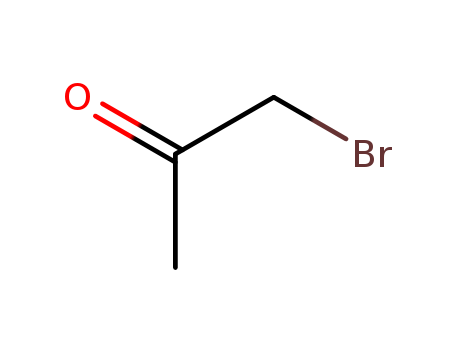
Bromoacetone

Base Information
  • Chemical Name:Bromoacetone
  • CAS No.:598-31-2
  • Molecular Formula:C3H5BrO
  • Molecular Weight:136.976
  • Hs Code.:29147000
  • European Community (EC) Number:209-928-2
  • ICSC Number:1074
  • UN Number:1569
  • UNII:3O8L0EWR5Q
  • DSSTox Substance ID:DTXSID6060507
  • Nikkaji Number:J3.305G
  • Wikipedia:Bromoacetone
  • Wikidata:Q421365
  • Pharos Ligand ID:YHCMAS34DGT8
  • Metabolomics Workbench ID:57923
  • ChEMBL ID:CHEMBL1085947
  • Mol file:598-31-2.mol
Bromoacetone

Synonyms:bromoacetone

Suppliers and Price of Bromoacetone
Supply Marketing:
Business phase:
The product has achieved commercial mass production*data from LookChem market partment
Manufacturers and distributors:
  • Manufacture/Brand
  • Chemicals and raw materials
  • Packaging
  • price
  • TRC
  • Bromoacetone
  • 50mg
  • $ 60.00
  • American Custom Chemicals Corporation
  • BROMOACETONE 95.00%
  • 500G
  • $ 3346.40
  • American Custom Chemicals Corporation
  • BROMOACETONE 95.00%
  • 5MG
  • $ 550.00
  • AHH
  • 1-Bromo-2-propanone 90%
  • 500g
  • $ 530.00
Total 20 raw suppliers
Chemical Property of Bromoacetone
Chemical Property:
  • Appearance/Colour:clear colorless liquid 
  • Vapor Pressure:7.19mmHg at 25°C 
  • Melting Point:-36.5 °C 
  • Refractive Index:1.449 
  • Boiling Point:136.999 °C at 760 mmHg 
  • Flash Point:75.324 °C 
  • PSA:17.07000 
  • Density:1.55 g/cm3 
  • LogP:0.97030 
  • XLogP3:0.7
  • Hydrogen Bond Donor Count:0
  • Hydrogen Bond Acceptor Count:1
  • Rotatable Bond Count:1
  • Exact Mass:135.95238
  • Heavy Atom Count:5
  • Complexity:42.2
  • Transport DOT Label:Poison Inhalation Hazard Flammable Liquid
Purity/Quality:

99% *data from raw suppliers

Bromoacetone *data from reagent suppliers

Safty Information:
  • Pictogram(s):  
  • Hazard Codes: 
  • Statements: 11-23/24/25-34 
  • Safety Statements: 26-36/37/39 
MSDS Files:

SDS file from LookChem

Useful:
  • Chemical Classes:Toxic Gases & Vapors -> Other Toxic Gases & Vapors
  • Canonical SMILES:CC(=O)CBr
  • Inhalation Risk:No indication can be given about the rate at which a harmful concentration of this substance in the air is reached on evaporation at 20 °C.
  • Effects of Short Term Exposure:Lachrymation. The substance is severely irritating to the eyes, skin and respiratory tract.
  • Uses Chemical war gas.
Technology Process of Bromoacetone

There total 73 articles about Bromoacetone which guide to synthetic route it. The literature collected by LookChem mainly comes from the sharing of users and the free literature resources found by Internet computing technology. We keep the original model of the professional version of literature to make it easier and faster for users to retrieve and use. At the same time, we analyze and calculate the most feasible synthesis route with the highest yield for your reference as below:

synthetic route:

Reference yield: 95.0%

Guidance literature:
With Cl(CF2)4SO2Br; at 0 ℃;
Guidance literature:
dimethyltitanocene; N,N-dimethyl acetamide; In toluene; at 65 ℃; Schlenk technique; Inert atmosphere;
With bromine; In toluene; at -78 ℃; for 0.0333333h; Schlenk technique; Inert atmosphere;
With water; In toluene; at 20 ℃; for 1h; regioselective reaction; Schlenk technique; Inert atmosphere;
DOI:10.1080/00397911.2013.765484
Refernces

STRUCTURE AND AMBIPHILIC REACTIVITY OF INDOLIZINES. 2. 8(6)-ACETYL- AND CYANOINDOLIZINES

10.1007/BF00663856

The research focuses on the synthesis and reactivity of 8(6)-acetyl- and cyanoindolizines. The purpose is to explore the effects of substituents on the structure and reactivity of indolizines, particularly those substituted in the pyridine ring, as this area has received little attention. The researchers used the Chichibabin method to synthesize these compounds from 2-methyl-3(5)-acetyl and cyanopyridines and α-bromoketones. Key chemicals used include 2-methyl-3-cyanopyridine, bromoacetone, and sodium bicarbonate. The study concludes that electron-acceptor substituents in positions 6 and 8 of the indolizine nucleus deepen the color and increase the λmax values in UV spectra, with the 8-isomers being more deeply colored than the 6-isomers. Additionally, the researchers attempted base-catalyzed rearrangement of acetylindolizines to indoles but found that the presence of a nitro-group or a similarly electronegative substituent is necessary for successful recyclization.

Post a RFQ

Enter 15 to 2000 letters.Word count: 0 letters

Attach files(File Format: Jpeg, Jpg, Gif, Png, PDF, PPT, Zip, Rar,Word or Excel Maximum File Size: 3MB)

1 Customer Service

What can I do for you?
Get Best Price

Get Best Price for 598-31-2