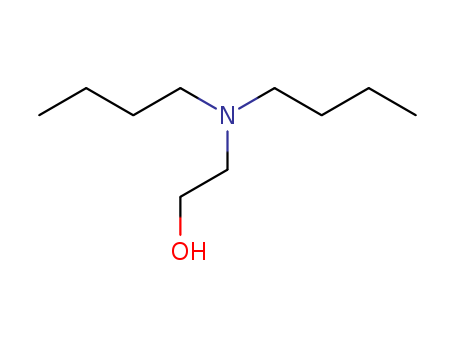
Chemical Property of 2-(Dibutylamino)ethanol
Chemical Property:
- Appearance/Colour:colourless liquid
- Vapor Pressure:0.000473mmHg at 25°C
- Melting Point:-70°C(lit.)
- Refractive Index:n20/D 1.444(lit.)
- Boiling Point:229.5°Cat760mmHg
- PKA:14.77±0.10(Predicted)
- Flash Point:91.7°C
- PSA:23.47000
- Density:0.873g/cm3
- LogP:1.88090
- Solubility.:Practically insoluble in water
- Water Solubility.:4g/L at 20℃
- XLogP3:2.1
- Hydrogen Bond Donor Count:1
- Hydrogen Bond Acceptor Count:2
- Rotatable Bond Count:8
- Exact Mass:173.177964357
- Heavy Atom Count:12
- Complexity:77.9
- Transport DOT Label:Poison
- Purity/Quality:
-
98% *data from raw suppliers
2-(Dibutylamino)ethanol *data from reagent suppliers
Safty Information:
- Pictogram(s):
Toxic by ingestion and skin absorption. TLV: 0.5 ppm.
- Hazard Codes:C
- Statements:
21/22-34
- Safety Statements:
26-36/37/39-45
- MSDS Files:
-
SDS file from LookChem
Useful:
- Chemical Classes:Nitrogen Compounds -> Ethanolamines
- Canonical SMILES:CCCCN(CCCC)CCO
- Inhalation Risk:A harmful contamination of the air can be reached rather quickly on evaporation of this substance at 20 °C.
- Effects of Short Term Exposure:The substance is corrosive to the eyes and skin. The vapour is irritating to the respiratory tract. Corrosive on ingestion. The substance may cause effects on the central nervous system. This may result in convulsions and respiratory failure. Cholinesterase inhibition. Exposure could cause death. Medical observation is indicated. The effects may be delayed.
-
Uses
Dibutylaminoethanol
has found use as a conditioning agent for cellulose
acetate filaments to facilitate textile manufacture, a catalyst
in polyurethane foam manufacture, and an anticorrosion
additive for lubricants and hydraulic fluids, in the manufacture
of emulsifying and dispersing agents, and in the curing of
silicone resins. Organic syntheses 2-(Dibutylamino)ethanol (DBAE) may be used as a coreactant to enhance the electrochemiluminescence (ECL) of tris(2,2′-bipyridyl)ruthenium(II) [Ru(bpy)32+], employed in the ECL immunoassays and DNA probe assays. DBAE may also be used as a catalyst during the synthesis of protected D-erythro-(2S,3R)-sphingosine.