Welcome to LookChem.com Sign In|Join Free
  • or

Encyclopedia

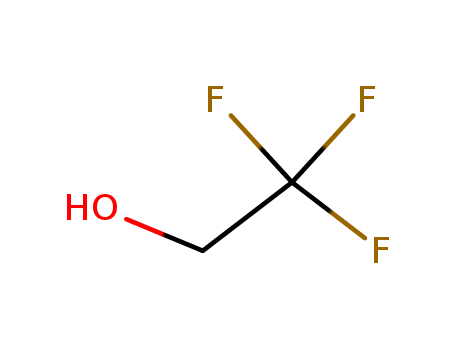
2,2,2-Trifluoroethanol

Base Information
  • Chemical Name:2,2,2-Trifluoroethanol
  • CAS No.:75-89-8
  • Molecular Formula:C2H3F3O
  • Molecular Weight:100.04
  • Hs Code.:29055910
  • European Community (EC) Number:200-913-6
  • NSC Number:451
  • UNII:8T8I76KYF1
  • DSSTox Substance ID:DTXSID0021751
  • Nikkaji Number:J2.396E
  • Wikipedia:2,2,2-Trifluoroethanol
  • Wikidata:Q2474643
  • Metabolomics Workbench ID:52312
  • ChEMBL ID:CHEMBL116675
  • Mol file:75-89-8.mol
2,2,2-Trifluoroethanol

Synonyms:2,2,2-Trifluoroethanol;Alcohol, Trifluoroethyl;Trifluoroethanol;Trifluoroethyl Alcohol

Suppliers and Price of 2,2,2-Trifluoroethanol
Supply Marketing:
Business phase:
The product has achieved commercial mass production*data from LookChem market partment
Manufacturers and distributors:
  • Manufacture/Brand
  • Chemicals and raw materials
  • Packaging
  • price
  • TRC
  • 2,2,2-Trifluoroethanol
  • 50g
  • $ 140.00
  • TCI Chemical
  • 2,2,2-Trifluoroethanol >99.0%(GC)
  • 500g
  • $ 118.00
  • TCI Chemical
  • 2,2,2-Trifluoroethanol >99.0%(GC)
  • 100g
  • $ 37.00
  • TCI Chemical
  • 2,2,2-Trifluoroethanol >99.0%(GC)
  • 25g
  • $ 17.00
  • SynQuest Laboratories
  • 2,2,2-Trifluoroethanol 99.0%
  • 250 g
  • $ 35.00
  • SynQuest Laboratories
  • 2,2,2-Trifluoroethanol 99.0%
  • 1 kg
  • $ 100.00
  • Strem Chemicals
  • 2,2,2-Trifluoroethanol, 99%
  • 250g
  • $ 160.00
  • Strem Chemicals
  • 2,2,2-Trifluoroethanol, 99%
  • 50g
  • $ 41.00
  • Sigma-Aldrich
  • 2,2,2-Trifluoroethanol BioUltra, for molecular biology, ≥99.0% (GC)
  • 250 mL
  • $ 551.00
  • Sigma-Aldrich
  • 2,2,2-Trifluoroethanol BioUltra, for molecular biology, ≥99.0% (GC)
  • 250ml-f
  • $ 532.00
Total 35 raw suppliers
Chemical Property of 2,2,2-Trifluoroethanol
Chemical Property:
  • Appearance/Colour:colorless liquid 
  • Vapor Pressure:70 mm Hg ( 25 °C) 
  • Melting Point:-44 °C(lit.) 
  • Refractive Index:n20/D 1.3(lit.)  
  • Boiling Point:74 °C at 760 mmHg 
  • PKA:12.4(at 25℃) 
  • Flash Point:29.4 °C 
  • PSA:20.23000 
  • Density:1.325 g/cm3 
  • LogP:0.54100 
  • Storage Temp.:Store at RT. 
  • Water Solubility.:Miscible with water, ethers, ketones, alcohols and chloroform. 
  • XLogP3:0.4
  • Hydrogen Bond Donor Count:1
  • Hydrogen Bond Acceptor Count:4
  • Rotatable Bond Count:0
  • Exact Mass:100.01359920
  • Heavy Atom Count:6
  • Complexity:38.5
Purity/Quality:

99% *data from raw suppliers

2,2,2-Trifluoroethanol *data from reagent suppliers

Safty Information:
  • Pictogram(s): ToxicT,FlammableF,HarmfulXn 
  • Hazard Codes:Xn,T,F 
  • Statements: 10-20/21/22-37/38-41-62-38-36/37/38 
  • Safety Statements: 26-36-39-45-36/37/39-16 
MSDS Files:

SDS file from LookChem

Total 1 MSDS from other Authors

Useful:
  • Chemical Classes:Other Classes -> Halogenated Alcohols
  • Canonical SMILES:C(C(F)(F)F)O
  • Description 2,2,2-trifluoroethanol or trifluoroethanol is called TFEA or TEF, it is important intermediate of the fluorine-containing aliphatic, it is colorless, it is miscible liquids with water, it has similar odor with ethanol. Due to the strong electron-withdrawing effect of trifluoromethyl, acid of trifluoromethyl is stronger than ethanol, it can generate hydrogen-bonded stable complex (such as: tetrahydrofuran, pyridine) with heterocyclic compound. Due to this unique physical and chemical properties and special molecular structure, it has different performance with other alcohols, it can participate in a variety of organic reactions, it can be oxidized to acetaldehyde trifluoromethyl or trifluoroacetic acid, it can also provide trifluoromethyl, it can participate in the Still-Gennari improvements of Horner-Wadsworth-Emmons reaction. It has wide range of uses in medicine, pesticides, dyes, energy, and other aspects of organic synthesis. The main use of trifluoroethanol is as anesthetic, at the earliest, fluorine acetylene ether which synthesized by trifluoroethanol and acetylene takes place of bigger side effects of bromine-fluoro alkanes as anesthetic, and then trichloroethanol is used as raw material to develop non-flammable, low toxicity isoflurane alkanes and high performance of the new anesthetic of chlorofluoroalkane. Trifluoroethanol can be introduced into drug structure as trifluoromethyl of functional group, it can generate significant physiological activity, increase fat-soluble of molecules, improve efficacy or reduce side effects of the organism, its synthetic drugs have central nervous system stimulants fluticasone Seoul, substituted pyridines stomach cytoplasmic proton pump inhibitor Lansoprazole and Pariprazole, antiarrhythmic drugs flecainide with amines and analgesic drugs benzodiazepines and dysuria treatment KMD-3212 and so on.
  • Uses (1) It can be used as import agent of trifluoroethyl and trifluoroacetic ethoxycarbonyl agent, synthetic narcotics fluoride ether (Fluroxene), isoflurane (Isoflurane) and to chlorine halothane (Desflurane), central nervous system stimulants fluticasone Seoul (Flowotyl), proton pump inhibitor lansoprazole (Lansoprazol, pp inhibitors), anti-arrhythmic drugs flecainide with amine (Flecamide), analgesics, benzodiazepines (Quazepam), difficulty urinating therapeutic drug KMD-3213, herbicide trifluoromethyl thiomethyl (Triflusulfuronmethyl). (2) It can be used for chemical reagents. (3) It can be used as solvent, it can be used as import agent of trifluoroethyl and trifluoroacetic ethoxycarbonyl agent, it can be also used as pharmaceutical, pesticide intermediates. (4) It can be used as solvent, it is also used as medicine, pesticide intermediates. In synthesis of medical anaesthetics, pharmaceuticals, and agrochemicals; in polymerizations. Protein denaturant; stabilizes peptide structures. Cleaning solvent; eluent in HPLC separations; working fluid in Rankine heat cycle systems. Environmentally friendly alternative to CFCs. Trifluoroethanol serves as a solvent and a raw material in organic chemistry and biology. TFE is a solvent of choice for hydrogen peroxide-mediated oxidations of sulfides. Trifluoroethanol acts as a protein denaturant. It is used in the manufacture of certain pharmaceuticals and drug substances. The drug fluromer, which is 2,2,2-trifluoro-1-vinyloxyethane, is the vinyl ether of trifluorethanol. It is an effective solvent for peptides and proteins, and used for NMR-based protein folding studies, and in the manufacture of nylon. As a source of the trifluoromethyl group, it is employed in several organic reactions, for example in Still-Gennari modification of Horner-Wadsworth-Emmons reaction (HWE) reaction. 2,2,2-Trifluoroethanol (Trifluoroethyl alcohol, TFE) is used to study the conformational states of proteins and the folding refolding processes of proteins.
Technology Process of 2,2,2-Trifluoroethanol

There total 238 articles about 2,2,2-Trifluoroethanol which guide to synthetic route it. The literature collected by LookChem mainly comes from the sharing of users and the free literature resources found by Internet computing technology. We keep the original model of the professional version of literature to make it easier and faster for users to retrieve and use. At the same time, we analyze and calculate the most feasible synthesis route with the highest yield for your reference as below:

synthetic route:
Guidance literature:
With trans-[(2,6-bis(di-tert-butylphosphinomethyl)pyridine)Fe(H)2(CO)]; hydrogen; sodium methylate; In 1,4-dioxane; at 40 ℃; for 16h; under 18751.9 Torr; Glovebox; Inert atmosphere;
DOI:10.1002/anie.201311221
Guidance literature:
With Togni's reagent; C14H16Br2NO5V; In acetone; for 144h;
Refernces

The Interaction of π orbitals with a carbocation over three σ bonds

10.1021/jo951643d

The study investigates the semi-π analogue of double hyperconjugation, known as "hyperconjugation/conjugation," in 4-isopropylidenecyclohexyl mesylate (4-OMs) and compares it with the saturated analogue, trans-4-isopropylcyclohexyl mesylate (5-OMs). The researchers found that the unsaturated substrate 4-OMs reacts only four times faster than the saturated substrate 5-OMs in 97% trifluoroethanol, indicating no significant through-bond interaction of the double bond with the reactive center. This is attributed to less than ideal overlap of the γ,δ π orbitals with the R, σ orbitals. However, when an electron-rich tin atom is attached to the 4-position, it provides a large rate enhancement and changes the mechanism to carbocation formation through double hyperconjugation. The study concludes that the π bond does not effectively stabilize positive charge through two stages of conjugation in the studied system, suggesting that the hyperconjugation/conjugation mode may not be a viable mechanism under the given conditions.

Synthesis of quinazolin-4(3H)-ones via electrochemical decarboxylative cyclization of α?keto acids with 2-aminobenzamides

10.1016/j.mcat.2020.111345

The research primarily focuses on the development of an eco-friendly electrochemical method for synthesizing quinazolin-4(3H)-one derivatives, utilizing α-keto acids and 2-aminobenzamides as reactants. The process eliminates the need for homogeneous metal catalysts, bases, or external oxidants and operates under mild conditions with CO2 as a by-product. The experiments involved optimizing reaction conditions, such as the use of a platinum electrode setup, constant current, and 2,2,2-trifluoroethanol as the solvent with Bu4NPF6 as the electrolyte, resulting in a 90% yield of the desired product. The substrate scope was explored with various α-keto acids and 2-aminobenzamides, yielding a range of 2,3-disubstituted quinazolinone products. Control experiments confirmed the necessity of electric current and the involvement of radical species, suggesting a possible reaction mechanism involving anodic oxidation and decarboxylation steps.

General one-pot, two-step protocol accessing a range of novel polycyclic heterocycles with high skeletal diversity

10.1021/co300046r

The research focuses on the development of a one-pot, two-step protocol for synthesizing a variety of novel polycyclic heterocycles with high skeletal diversity, characterized by the presence of embedded or attached benzimidazole and often a ring system formed through lactamization. The study utilizes the Ugi multicomponent reaction (MCR) combined with an acid-mediated cyclodehydration step. Reactants include keto- or formyl acids, N-Boc-diamines, and isocyanides, which are combined in trifluoroethanol (TFE) as the solvent. The Ugi reaction is monitored using LCMS, and after completion, the product is subjected to a treatment with trifluoroacetic acid (TFA) in dichloroethane (DCE) and microwave irradiation to promote cyclodehydration, resulting in the formation of tricyclic scaffolds with an α-quaternary methyl group. The experiments yield a range of unique scaffolds with excellent physicochemical properties, demonstrating the versatility and efficiency of the protocol. The analysis of the products includes purification using a CombiFlash Rf system and X-ray crystallographic analysis for structural elucidation, confirming the successful synthesis of the desired polycyclic heterocycles.

Reactions of Substituted 1-Phenylethyl Carbocations with Alcohols and Other Nucleophilic Reagents

10.1021/ja00317a032

The research investigates the reactivity and selectivity of substituted 1-phenylethyl carbocations with various nucleophilic reagents, including alcohols, water, and oxygen anions. The purpose of the study was to determine the selectivities of these carbocations towards different nucleophiles and to understand how these selectivities change as the carbocation's reactivity increases. The research concluded that the selectivity for activation-limited reactions decreases with increasing carbocation reactivity, which contrasts with the behavior expected from the NC scale of reactivity. Notably, the study found that the 1-(4-(dimethylamino)phenyl)ethyl carbocation exhibited high selectivity in its reactions with alcohols. The chemicals used in this process included a range of substituted 1-phenylethyl derivatives, nucleophilic reagents such as alcohols, water, and oxygen anions, as well as various leaving groups to generate the carbocations. The study also utilized solvents like trifluoroethanol and water mixtures to control the reactions and analyze the products.

An intramolecular cyclization of phenol derivatives bearing aminoquinones using a hypervalent iodine reagent

10.1021/jo951439q

The research investigates the intramolecular cyclization of phenol derivatives bearing aminoquinones using a hypervalent iodine reagent, phenyliodine(III) bis(trifluoroacetate) (PIFA), with the aim of preparing novel antitumor compounds. The study selectively obtained azacarbocyclic spirodienone derivatives or phenol derivatives containing the 2,3-dihydro-1H-azepine systems by reacting ortho- or meta-substituted phenol derivatives with PIFA in 2,2,2-trifluoroethanol. The findings confirm the difference in reactivities between ortho- and meta-substituted phenol derivatives protected by methyl or silyl groups, allowing for the selective synthesis of pharmacologically important compounds.

Solvolysis of styryliodonium salt: Products, rates, and mechanisms

10.1246/bcsj.72.163

The study investigates the solvolysis reactions of phenyl[(E)-styryljiodonium tetrafluoroborate (1) in various solvents, focusing on the products, reaction rates, and mechanisms involved. The primary chemicals used are phenyl[(E)-styryljiodonium tetrafluoroborate as the substrate, and different solvents including methanol, ethanol, 2,2,2-trifluoroethanol (TFE), and acetic acid. The study also employs labeled substrates, such as the α-deuterated substrate (1-αD), to analyze the reaction mechanisms. The reactions involve α-elimination and substitutions with configurational retention and inversion. In methanol and ethanol, α-elimination is the main reaction, producing phenylacetylene (3) as the major product, while substitution reactions become more significant in less basic solvents like acetic acid and TFE. The study finds that the reaction rates and the fraction of α-elimination decrease as the solvent basicity decreases. The substitution mechanism is concluded to involve parallel pathways: an SN1-type with a vinylenebenzenium ion intermediate leading to retention and a vinylic SN2-type with a direct attack by the nucleophilic solvent leading to inversion.

Highly stereocontrolled synthesis of gem-difluoromethylenated azasugars: D- and L-1,4,6-trideoxy-4,4-difluoronojirimycin

10.1021/ol050558h

The research focuses on the synthesis of D- and L-1,4,6-trideoxy-4,4-difluoronojirimycin, a novel series of gem-difluoromethylenated azasugars. The synthesis involves 10 steps starting from trifluoroethanol, with key chemicals including trifluoroethanol, LDA (lithium diisopropylamide), formaldehyde, MEMCl (2-methoxyethoxymethyl chloride), mesyl chloride, NaN3 (sodium azide), Pd(PPh3)4 (tetrakis(triphenylphosphine)palladium(0)), PPh3 (triphenylphosphine), CbzCl (benzyl chloroformate), SOCl2 (thionyl chloride), and (DHQ)2PHAL or (DHQD)2PHAL (chiral ligands for Sharpless asymmetric dihydroxylation). The synthesis process includes multiple steps such as protection, elimination, vinyl anion formation, sigmatropic rearrangement, allylic substitution, imine formation, Sharpless asymmetric dihydroxylation, and hydrogenation. The final products are obtained with good diastereoselectivity and enantiomeric excess, demonstrating the effectiveness of the synthetic route.


Post a RFQ

Enter 15 to 2000 letters.Word count: 0 letters

Attach files(File Format: Jpeg, Jpg, Gif, Png, PDF, PPT, Zip, Rar,Word or Excel Maximum File Size: 3MB)

1 Customer Service

What can I do for you?
Get Best Price

Get Best Price for 75-89-8