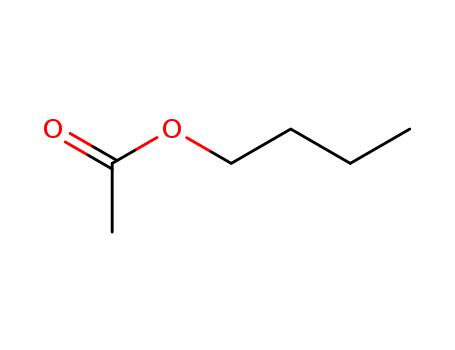
Chemical Property of Butyl acetate
Chemical Property:
- Appearance/Colour:colourless liquid with fruity odor
- Vapor Pressure:15 mm Hg ( 25 °C)
- Melting Point:-74 °C (199 K, -101°F)
- Refractive Index:1.394
- Boiling Point:126 °C (399 K, 256°F)
- Flash Point:24 °C (297 K)
- PSA:26.30000
- Density:0.88 g/cm3
- LogP:1.34960
- Storage Temp.:Flammables area
- Solubility.:5.3g/l
- Water Solubility.:0.7 g/100 mL (20 ºC)
- XLogP3:1.8
- Hydrogen Bond Donor Count:0
- Hydrogen Bond Acceptor Count:2
- Rotatable Bond Count:4
- Exact Mass:116.083729621
- Heavy Atom Count:8
- Complexity:68.9
- Transport DOT Label:Flammable Liquid
- Purity/Quality:
-
99% *data from raw suppliers
Butyl Acetate *data from reagent suppliers
Safty Information:
- Pictogram(s):
R10:;
R66:;
R67:;
- Hazard Codes:R10:;
R66:;
R67:;
- Statements:
10-66-67-R67-R66-R10
- Safety Statements:
25-S25
- MSDS Files:
-
SDS file from LookChem
Useful:
- Chemical Classes:Solvents -> Esters (
- Canonical SMILES:CCCCOC(=O)C
- Inhalation Risk:A harmful contamination of the air will be reached rather slowly on evaporation of this substance at 20 °C.
- Effects of Short Term Exposure:The substance is irritating to the eyes and respiratory tract. The substance may cause effects on the central nervous system. Exposure far above the OEL could cause lowering of consciousness.
- Effects of Long Term Exposure:The substance defats the skin, which may cause dryness or cracking.
-
Industrial Application and Production
Butyl acetate (BuAc) is widely utilized as a solvent in various industries including manufacturing, pharmaceuticals, cosmetics, and food. It is a key component in the production of adhesives, lacquers, coatings, paints, and fruit flavors. Industrial-scale production involves the esterification of n-butanol with acetic acid using strong acids as catalysts, typically solid-acidic catalysts like ion exchange resins.
-
Health and Safety Concerns
Butyl acetate is known to be an irritating, flammable, and potentially explosive toxic gas. High concentrations of inhaled butyl acetate can lead to cardiovascular and neurological diseases. Therefore, developing semiconductor sensors with high sensitivity and selectivity for detecting butyl acetate is crucial for preventing accidents and protecting health in industrial settings.
-
Production Challenges and Alternative Methods
Traditional production methods suffer from low equilibrium conversion rates and high energy consumption during product separation and purification. Transesterification processes offer higher economic performance compared to esterification. Enzymatic approaches, although more environmentally friendly, incur higher costs due to lipase production. Alternatively, metabolic engineering techniques can be employed for in vivo biosynthesis of n-butyl acetate from biomass, offering a promising alternative route.
-
Environmental Impact and Waste Management
Butyl acetate is commonly used as a solvent for drug extraction in pharmaceutical production processes, resulting in wastewater solutions containing high concentrations of BA. Discharging these chemical waste liquids without separation and recovery not only leads to underutilization of resources but also causes serious environmental pollution and economic losses for enterprises. Therefore, efficient separation and recovery methods are essential for mitigating environmental impact and maximizing resource utilization.