Welcome to LookChem.com Sign In|Join Free
  • or

Encyclopedia

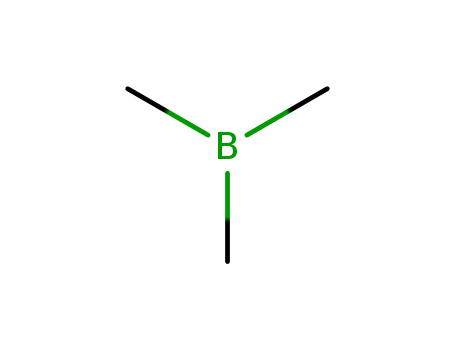
Trimethylborane

Base Information
  • Chemical Name:Trimethylborane
  • CAS No.:593-90-8
  • Molecular Formula:C3H9 B
  • Molecular Weight:55.9155
  • Hs Code.:
  • European Community (EC) Number:209-816-3
  • DSSTox Substance ID:DTXSID90208038
  • Nikkaji Number:J2.700F
  • Wikipedia:Trimethylborane
  • Wikidata:Q7842211
  • Mol file:593-90-8.mol
Trimethylborane

Synonyms:Trimethylborane;Trimethylboron;593-90-8;Borane, trimethyl-;EINECS 209-816-3;MFCD00058727;Trimethyl boron;Trimethylboron, elec. gr.;C3H9B;(CH3)3B;C3-H9-B;DTXSID90208038;AKOS025295508;Trimethylboron, electronic grade, >=98.35%;Q7842211

Suppliers and Price of Trimethylborane
Supply Marketing:
Business phase:
The product has achieved commercial mass production*data from LookChem market partment
Manufacturers and distributors:
  • Manufacture/Brand
  • Chemicals and raw materials
  • Packaging
  • price
  • American Custom Chemicals Corporation
  • TRIMETHYLBORON 95.00%
  • 10G
  • $ 2862.09
Total 6 raw suppliers
Chemical Property of Trimethylborane
Chemical Property:
  • Appearance/Colour:colorless gas 
  • Vapor Pressure:907mmHg at 25°C 
  • Melting Point:-161,5°C 
  • Boiling Point:20 °C at 760 mmHg 
  • Flash Point:°C 
  • PSA:0.00000 
  • Density:0.559 g/cm3 
  • LogP:1.37060 
  • Hydrogen Bond Donor Count:0
  • Hydrogen Bond Acceptor Count:0
  • Rotatable Bond Count:0
  • Exact Mass:56.0797305
  • Heavy Atom Count:4
  • Complexity:8
Purity/Quality:

98%min *data from raw suppliers

TRIMETHYLBORON 95.00% *data from reagent suppliers

Safty Information:
  • Pictogram(s): F,C 
  • Hazard Codes:F,C 
  • Statements: 11-17-34 
  • Safety Statements: 9-16-23-45-43-36/37/39-26-7 
MSDS Files:

SDS file from LookChem

Total 1 MSDS from other Authors

Useful:
  • Chemical Classes:Metals -> Metalloid Compounds (Boron)
  • Canonical SMILES:B(C)(C)C
  • Uses Precursor to boron carbide thin films by chemical vapor deposition (CVD).1
Technology Process of Trimethylborane

There total 137 articles about Trimethylborane which guide to synthetic route it. The literature collected by LookChem mainly comes from the sharing of users and the free literature resources found by Internet computing technology. We keep the original model of the professional version of literature to make it easier and faster for users to retrieve and use. At the same time, we analyze and calculate the most feasible synthesis route with the highest yield for your reference as below:

synthetic route:
Guidance literature:
at 130.0°C, 74.1 Torr equilibrium;
DOI:10.1021/ja01231a039
Guidance literature:
With hydrogenchloride; In diethyl ether; byproducts: LiCl; 1 equiv of MeLi slowly adding to a soln. of the boronic ester at -78°C, stirring for 3 h at the same temp., 1 equiv of anhydrous HCl in Et2O adding, warming to room temp., stirring for 15 min; the content was detd. by (11)B NMR spectrum;
DOI:10.1021/om00129a019
Guidance literature:
at 111.3°C, 64.5 Torr equilibrium;
DOI:10.1021/ja01231a039
Refernces

ORGANOBORIERUNG VON ALKINYLSTANNANEN XVI. BOROL-SYNTHESE UEBER DIE ORGANOBORIERUNG VON BIS(ALKINYL)BORANEN

10.1016/0022-328X(86)80470-3

The research focuses on the organoboration of alkynylboranes, specifically diethylamino-bis(trimethylstannyl-ethynyl)borane. The purpose of this study was to synthesize new boron-containing compounds, namely 1-diethylamino-2,5-bis(trimethylstannyl)-3-diethylboryl-4-ethylborol and 1-diethylamino-2-diethylboryl-3,5-bis(trimethylstannyl)-4-ethylborol, through a stepwise reaction process monitored by NMR spectroscopy. The results were compared with those obtained from the organoboration of bis(diethylamino)-trimethylstannylethynylborane. Key chemicals used in the process included diethylamino-diethinylboran, trimethylstannyl-derivatives, triethylboran, and trimethylboran. The study concluded that the organoboration reactions proceeded with the formation of new heterocycles and that the NMR spectroscopy data provided valuable insights into the reaction progress, isomer formation, and the structural assignments of the synthesized compounds. The final product, borol 13, remained as the only reaction product after 7 days at 60°C in benzene, indicating its stability under the given conditions.

Post a RFQ

Enter 15 to 2000 letters.Word count: 0 letters

Attach files(File Format: Jpeg, Jpg, Gif, Png, PDF, PPT, Zip, Rar,Word or Excel Maximum File Size: 3MB)

1 Customer Service

What can I do for you?
Get Best Price

Get Best Price for 593-90-8