Products Categories
| CAS No.: | 110-63-4 |
|---|---|
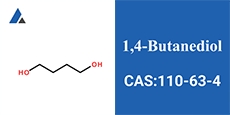
| Name: | 1,4-Butanediol |
| Article Data: | 395 |
| Molecular Structure: | |
|
|
|
| Formula: | C4H10O2 |
| Molecular Weight: | 90.1222 |
| Synonyms: | 1,4-Butyleneglycol;1,4-Dihydroxybutane;1,4-Tetramethylene glycol;DabcoDBO;Diol 14B;NSC 406696;Polycure D;Sucol B;Tetramethylene 1,4-diol;Tetramethylene glycol;Vibracure A 250;ZM 0025; |
| EINECS: | 203-786-5 |
| Density: | 1.006 g/cm3 |
| Melting Point: | 20 °C |
| Boiling Point: | 227.999 °C at 760 mmHg |
| Flash Point: | 105.909 °C |
| Solubility: | Miscible |
| Appearance: | viscous colourless liquid |
| Hazard Symbols: |
 Xn Xn
|
| Risk Codes: | 22 |
| Safety: | 36 |
| PSA: | 40.46000 |
| LogP: | -0.24880 |
- 144851-82-1METHYL2-AMINO-3-FLUOROBENZOATE
- 483366-12-7(2S,4R)-1-Boc-2-cyano-4-hydroxypyrrolidine
- 173606-50-3BOC-10-AMINODECANOIC ACID
- 361456-36-2METHYL (R)-(+)-ISOCYANATO-3-PHENYLPROPI&
- 5156-58-1N-(1-Benzyl-4-pipperidinyl)-N-phenylpropanamide HCl
- 81281-59-67-Benzylideneaminotheophylline
- 50288-62-5threo-Phenyl-2-piperidyl acetamide
- 82993-81-5D-threo-Ritalinic acid hydrochloride
- 47087-37-6Z-D-Glu-OMe
- 1219080-61-1IMIDAZOLE-2-BORONIC ACID

| Conditions | Yield |
|---|---|
| With C56H70Cl3N10Ru2(1+)*F6P(1-); potassium tert-butylate; hydrogen In tetrahydrofuran; dodecane at 70℃; under 37503.8 Torr; for 16h; Inert atmosphere; Glovebox; Autoclave; | 100% |
| With C30H34Cl2N2P2Ru; potassium methanolate; hydrogen In tetrahydrofuran at 100℃; under 38002.6 - 76005.1 Torr; for 15h; Glovebox; Autoclave; | 91% |
| With ethanol; sodium |
| Conditions | Yield |
|---|---|
| With sodium aluminum tetrahydride In tetrahydrofuran at 0℃; for 0.0833333h; | 100% |
| With C31H33ClN2O3RuS; potassium tert-butylate; hydrogen In isopropyl alcohol at 60℃; under 37503.8 Torr; for 48h; Inert atmosphere; | 100% |
| With C39H39N6ORu(1+)*Br(1-); potassium methanolate; hydrogen In tetrahydrofuran at 100℃; under 37503.8 Torr; for 16h; Reagent/catalyst; | 100% |
| Conditions | Yield |
|---|---|
| With sodium aluminum tetrahydride In tetrahydrofuran for 24h; Ambient temperature; | 100% |
| With hydrogen In water at 155℃; under 165017 Torr; Reagent/catalyst; | 95% |
| With sodium tetrahydroborate; C36H30F6N10Ni4O10(2+)*2C2F3O2(1-); zinc(II) chloride In tetrahydrofuran at 45℃; for 12h; | 78% |
| With [Ru(1,1,1-tris(diphenylphosphinomethyl)ethane)(trimethylenemethane)]; hydrogen In 1,4-dioxane at 195℃; under 37503.8 Torr; for 24h; Autoclave; Inert atmosphere; | |
| With C38H54Cl2N2P2Ru; hydrogen; sodium hydride In toluene at 160 - 190℃; under 60006 Torr; for 23h; Autoclave; Sealed tube; | 98 %Spectr. |
| Conditions | Yield |
|---|---|
| With hydrogen In water | 100% |
| With hydrogen In water | 100% |
| With hydrogen In water | 100% |
| Conditions | Yield |
|---|---|
| With hydrogen cation In tetrahydrofuran shaken for 10 min at room temp.; centrifuged, decanted, soln. contains naphthalene, pptn. hydrolysed in THF: butanediol detd. by GLC in the organic layer and a pptn. (Yb(OH)3); | A 83% B 100% C 75% |
| Conditions | Yield |
|---|---|
| With hydrogen; copper-palladium; silica gel In ethanol at 25℃; under 760 Torr; Kinetics; | A n/a B 99% |
| With LaNi5 hydride In tetrahydrofuran; methanol at 0℃; for 6h; | A 10% B 67% |
- 1033736-93-4
4-hydroxybutyl (4-oxo-3-phenyl-4H-thiochromen-2-yl)methylcarbonate

A
- 110-63-4
Butane-1,4-diol

B
- 124-38-9
carbon dioxide
C
- 1033736-87-6
C16H10O3S
| Conditions | Yield |
|---|---|
| In d(4)-methanol at 20℃; for 1h; Conversion of starting material; light irradiation; | A 99% B n/a C 85% |
- 110-16-7
maleic acid
A
- 109-99-9
tetrahydrofuran
B
- 96-48-0
4-butanolide
C
- 110-63-4
Butane-1,4-diol
D
- 110-15-6
succinic acid
E
- 64-19-7
acetic acid
| Conditions | Yield |
|---|---|
| With hydrogen; 0.5 percent Pd on Rutile TiO2 at 110℃; Product distribution / selectivity; | A 0.37% B 0.28% C 0.37% D 98.89% E 0.08% |
- 110-16-7
maleic acid
A
- 109-99-9
tetrahydrofuran
B
- 96-48-0
4-butanolide
C
- 67-56-1
methanol
D
- 110-63-4
Butane-1,4-diol
E
- 617-48-1
malic acid
F
- 110-15-6
succinic acid
G
- 64-19-7
acetic acid
H
- 71-36-3
butan-1-ol
| Conditions | Yield |
|---|---|
| With hydrogen; 0.5percent Pd on Rutile TiO2 at 110℃; Product distribution / selectivity; | A 0.45% B 0.06% C 0% D 0.21% E 0.36% F 98.73% G 0.04% H 0.08% |
| Conditions | Yield |
|---|---|
| With hydrogen; Ni catalyst as described in example 1 of U.S. Pat. No. 5,068,468 at 140℃; under 150015 Torr; for 336h; Conversion of starting material; | 98.3% |
| With hydrogen; Ni catalyst as described in example 1 of U.S. Pat. No. 5,068,468 In water at 140℃; under 150015 Torr; for 24 - 336h; Product distribution / selectivity; | 98.3% |
| With hydrogen In water at 100 - 135℃; under 60006 Torr; for 6h; Reagent/catalyst; Temperature; Pressure; | 90% |
- 27176-87-0Dodecyl benzene sulfonic acid
- 67-48-1Choline chloride
- 2058-46-0Oxytetracycline hydrochloride
- 8009-03-8Petrolatum
- 108-46-3Resorcinol
- 9003-01-42-Propenoic acid, homopolymer
- 109-77-3Malononitrile
- 72909-34-31H-Pyrrolo[2,3-f]quinoline-2,7,9-tricarboxylicacid, 4,5-dihydro-4,5-dioxo-
- 104987-11-3Tacrolimus
- 141-53-7Sodium formate
- 8001-54-5Quaternary ammonium compounds, alkylbenzyldimethyl, chlorides
- 9003-39-8Povidone
- 10161-34-9Trenbolone acetate
- 402957-28-2Telaprevir
- 68-19-9Cyanocobalamin

What can I do for you?
Get Best Price


History
Other early preparations were by reduction of succinaldehyde or succinic esters and by saponification of the diacetate prepared from 1,4-dihalobutanes. Catalytic hydrogenation of butynediol, now the principal commercial route, was first described in 1910.
Analytical Methods
Specification
The IUPAC name of this chemical is butane-1,4-diol. With the CAS registry number 110-63-4 and EINECS registry number 203-786-5, it is also named as 1,4-Butanediol. In addition, the molecular formula is C4H10O2 and the molecular weight is 90.121. It is odorless colorless liquid or solid (depending upon temperature).This colorless viscous liquid is derived from butane by placement of alcohol groups at each end of the chain. It is one of four stable isomers of butanediol. What's more, it is incompatible with strong oxidizing agents, mineral acids, acid chlorides, acid anhydrides. It should be stored in a cool, ventilated and dry place. The storage place must stay away from oxidant and water.
Physical properties about this chemical are: (1)# of Rule of 5 Violations: 0 ; (2)ACD/BCF (pH 5.5): 1; (3)ACD/BCF (pH 7.4): 1; (4)ACD/KOC (pH 5.5): 9.112; (5)ACD/KOC (pH 7.4): 9.112; (6)#H bond acceptors: 2; (7)#H bond donors: 2; (8)#Freely Rotating Bonds: 5; (9)Polar Surface Area: 40.46 Å2; (10)Index of Refraction: 1.441; (11)Molar Refractivity: 23.65 cm3; (12)Molar Volume: 89.574 cm3; (13)Polarizability: 9.376 10-24cm3; (14)Surface Tension: 39.637 dyne/cm; (15)Density: 1.006 g/cm3; (16)Flash Point: 105.909 °C; (17)Enthalpy of Vaporization: 54.011 kJ/mol; (18)Boiling Point: 227.999 °C at 760 mmHg; (19)Vapour Pressure: 0.015 mmHg at 25°C.
Preparation of 1,4-Butanediol: it can be prepared by 1,4-dichlorobutene. Through the hydrolysis and hydrogenation, you can get 1,4-Butanediol.

Uses of 1,4-Butanediol: it can be used in the production of THF, γ-butyllactone and butanediol polyp-phthalate. It also can be used as chain extender and raw materials of polyester to produce polyurethane elastomer and soft polyurethane foam plastics. It has good absorbency and increased flexibility, can make gelatin softener and SAP. In addition, it can prepare derivative of N-methyl pyrrole, N-vinyl pyrrole and other pyrrole, also can be used in preparation of vitamin B6, pesticides and herbicides. What's more, it can react with butylamine to get 1-butyl-pyrrolidine. This reaction will need catalyst RuCl3. The reaction time is 5 hours at reaction temperature of 220 °C. The yield is about 36%.

When you are using this chemical, please be cautious about it as the following:
It is harmful if swallowed. You should wear suitable protective clothing during using it.
You can still convert the following datas into molecular structure:
(1)SMILES: C(CCO)CO
(2)InChI: InChI=1/C4H10O2/c5-3-1-2-4-6/h5-6H,1-4H2
(3)InChIKey: WERYXYBDKMZEQL-UHFFFAOYAD
The toxicity data is as follows:
| Organism | Test Type | Route | Reported Dose (Normalized Dose) | Effect | Source |
|---|---|---|---|---|---|
| guinea pig | LD50 | oral | 1200mg/kg (1200mg/kg) | BEHAVIORAL: ALTERED SLEEP TIME (INCLUDING CHANGE IN RIGHTING REFLEX) BEHAVIORAL: SOMNOLENCE (GENERAL DEPRESSED ACTIVITY) BLOOD: OTHER CHANGES | Hygiene and Sanitation Vol. 33(1-3), Pg. 41, 1968. |
| man | LDLo | rectal | 429mg/kg (429mg/kg) | Pharmazie. Vol. 3, Pg. 110, 1948. | |
| mouse | LD50 | intraperitoneal | 1650mg/kg (1650mg/kg) | Toxicology and Applied Pharmacology. Vol. 49, Pg. 385, 1979. | |
| mouse | LD50 | oral | 2062mg/kg (2062mg/kg) | BEHAVIORAL: ALTERED SLEEP TIME (INCLUDING CHANGE IN RIGHTING REFLEX) BEHAVIORAL: SOMNOLENCE (GENERAL DEPRESSED ACTIVITY) BLOOD: OTHER CHANGES | Hygiene and Sanitation Vol. 33(1-3), Pg. 41, 1968. |
| rabbit | LD50 | oral | 2531mg/kg (2531mg/kg) | BEHAVIORAL: ALTERED SLEEP TIME (INCLUDING CHANGE IN RIGHTING REFLEX) BLOOD: OTHER CHANGES BEHAVIORAL: SOMNOLENCE (GENERAL DEPRESSED ACTIVITY) | Hygiene and Sanitation Vol. 33(1-3), Pg. 41, 1968. |
| rat | LCLo | inhalation | 15gm/m3/4H (15000mg/m3) | SENSE ORGANS AND SPECIAL SENSES: OTHER CHANGES: OLFACTION LUNGS, THORAX, OR RESPIRATION: OTHER CHANGES | Inhalation Toxicology. Vol. 3, Pg. 379, 1991. |
| rat | LD50 | intraperitoneal | 1070mg/kg (1070mg/kg) | Journal of Pharmacy and Pharmacology. Vol. 26, Pg. 597, 1974. | |
| rat | LD50 | oral | 1525mg/kg (1525mg/kg) | BEHAVIORAL: ALTERED SLEEP TIME (INCLUDING CHANGE IN RIGHTING REFLEX) BEHAVIORAL: SOMNOLENCE (GENERAL DEPRESSED ACTIVITY) BLOOD: OTHER CHANGES | Hygiene and Sanitation Vol. 33(1-3), Pg. 41, 1968. |
| women | LDLo | unreported | 300mg/kg (300mg/kg) | BEHAVIORAL: ALTERED SLEEP TIME (INCLUDING CHANGE IN RIGHTING REFLEX) | Pharmazie. Vol. 3, Pg. 110, 1948. |
-
Premium Related Products