N. d’Alessandro, M. Di Deo, M. Bonetti, L. Tonucci, A. Morvillo, M. Bressan
FULL PAPER
than those reported with other ruthenium catalysts.[10,13] for 24 h; the reaction mixtures were analyzed as above; (iii) 1,1-
diphenyl-2-propyn-1-ol (400 m) and RuPc (10 m) in a water-
saturated toluene solution were stirred at 80 °C for 24 h and di-
rectly analyzed by NMR spectroscopy and GC.
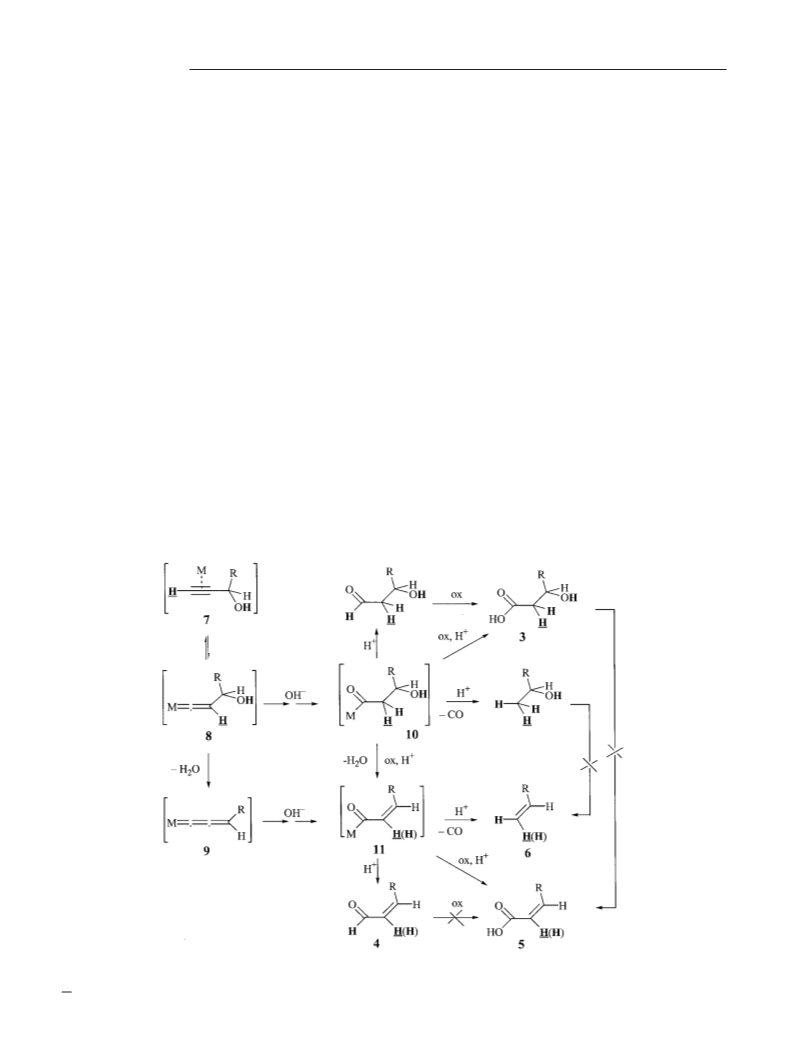
We have no data to support a real participation of the OH
group in the π-adduct/vinylidene species equilibrium, but
the fact that definite evidence of a metalϪligand interaction
was obtained only for the catalytically inactive NiPcS spec-
ies, suggests that the driving force of the RuPcS hydrations pyn-1-ol (400 m) and RuPcS (10 m) or RuHAP (13.9 mg,
O (D Ն 99.9 %) were reacted for 24 h at 80 °C.
2
Hydration Reactions with D O: 2-Propyn-1-ol or 1-phenyl-2-pro-
is essentially kinetic. The other important findings deal with 0.010 mmol) in D
2
the observed smooth decarbonylation of the propargylic al- Hydroxyacetone, acrylic acid, 1-hydroxy-1-phenylacetone, cinnam-
aldehyde and styrene were detected by GC, GC-MS and NMR
cohols to corresponding C(nϪ1) alkenes, which represents, to
spectroscopy, either directly or, when necessary, after extraction
with CDCl from the reaction mixture; 3-hydroxypropanoic was
3
directly analyzed only by NMR spectroscopy.
the best of our knowledge, the first catalytic decar-
bonylation process of terminal alkynes.
Detection of CO, Ethene and Propene: CO was captured by bub-
Experimental Section
bling the evolved reaction gas through a CH
RuCl(dppp) ]PF ; the amount of formed mono-carbonyl adduct
[RuCl(CO)(dppp) ]PF was measured both by UV/Vis and IR
2 2
Cl solution of
[
2
6
[
21]
Materials: Ruthenium tetrasulfophthalocyanine (RuPcS), cobalt
2
6
(CoPcS),[
29]
analysis, by following the disappearance of the 460 nm band of the
original complex or the appearance of the distinctive ν absorp-
tetrasulfophthalocyanine
2 4
cis-[RuCl (DMSO) ]
[
30]
39] (RuPW)[31] and ruthenium
(RuDMS),
K
5
[Ru(H
2
O)PW11
O
CO
Ϫ1
[32]
tion at 1930 cm of the carbonyl adduct.
Although both UV
hydroxyapatite (RuHAP; Ru 17 %, corresponding to 1.6 mmol/
[
23]
and IR measurements might allow, in principle, the quantitation of
the carbonyl adduct, and hence of the carbon monoxide produced,
the quantitative results were erratic, probably due to the long reac-
tion times required for the formation of the product. Ethene and
g) were prepared by published procedures. Ruthenium phthalo-
cyanine (RuPc) was prepared by the procedure of Weber and
[
29]
Bush,
starting from ruthenium trichloride, phthalic acid and
urea. Other metal complexes, organic substrates, chromatographic
and spectroscopic standards were purchased from Aldrich. D O (D
2
Ն 99 %) was obtained from Isotec Inc.
2 2
propene were captured in a CH Cl solution containing an excess
of Br ; the resulting 1,2-bromoalkane solutions were analyzed by
2
GC, GC-MS and NMR spectroscopy, by comparing the results
with those of the two commercial compounds (1,2-dibromoethane
and 1,2-dibromopropane). Further qualitative data on the pro-
duction of propene were obtained by headspace GC-MS analysis
of the final reaction mixtures.
Apparatus: Organic analyses by GC were performed on aliquots
withdrawn with a microsyringe from the aqueous reaction mixtures
and diluted 1:20 with diethyl ether, on a HP 6890 GLC instrument
equipped with FID, using a 30-m HP-5 (0.32 mm i.d.; 0.25 µm
film thickness) or a 30 m HP-Innowax (0.25 mm i.d.; 0.25 µm film
thickness) capillary column with the injection port kept at 250 °C
(carrier gas: He). The identity of each product was confirmed by
comparison of the fragmentation pattern in the mass spectrum ob-
Acknowledgments
The authors thank Mr. Antonio Ravazzolo, C.N.R., Padova, for
technical assistance.
tained with an MD 800 Fisons mass spectrometer operating in the
electron ionization mode at 70 eV. 1H NMR measurements were
performed on a Bruker Avance 300 MHz spectrometer equipped
2
with a BBO 5 mm probe, by adding small amount of D O to the
reaction mixtures (1:3); water suppression was carried out by a pre-
saturation sequence using a composite pulse (zgcppr Bruker se-
quence). A co-axial capillary tube containing a 30 m solution of
[1] [1a]
R. C. Laroci, W. W. Leong, in Comprehensive Organic Syn-
3
-(trimethylsilyl)propionic-2,2,3,3-d
4
acid sodium salt (TSP) in
thesis (Eds.: B. M. Trost, I. Fleming, M. F. Semmelhoci), Perga-
mon Press, Oxford, UK, 1991, vol. 4, 269. [ J. March, Ad-
vanced Organic Chemistry, John Wiley & Sons, New York, US,
1b]
water (D O) was used as reference. The identity of each product
2
and their quantitation were confirmed by comparison of the posi-
tion and intensity of suitable signals, by addition of measured
amounts of pure compounds to the reaction mixtures.
1
992, 762.
[
[
2]
3]
Y. Fukuda, I. Utimoto, J. Org. Chem. 1991, 56, 3729Ϫ3731.
J. Blum, H. Huminer, H. Alper, J. Mol. Catal. 1992, 75,
1
53Ϫ160.
J. W. Hartman, W. C. Hiscox, P. W. Jennings, J. Org. Chem.
993, 58, 7613Ϫ7614.
Typical Procedure for the Hydration Reactions: The progress of the
reactions was monitored by GC-MS and/or H NMR spec-
troscopy; conversions, yields and rates were reproducible to within
1
the hydration reaction: (i) 2-propyn-1-ol, 3-butyn-2-ol, 1-phenyl-2-
propyn-1-ol, 4-pentyn-1-ol, or 3-butyn-1-ol (equivalent to 400 m
of final solution) was added to an aqueous solution of RuPcS
[
4]
1
1
[5]
[6]
I. I. Meier, J. A. Marsella, J. Mol. Catal. 1993, 78, 31Ϫ42.
J. P. Damiano, M. Postel, J. Organomet. Chem. 1996, 522,
0Ϫ15 %. We describe three different experimental procedures for
303Ϫ305.
[
[
[
7]
8]
9]
W. Baidossi, M. Lahav, J. Blum, J. Org. Chem. 1997, 62,
669Ϫ672.
J. Halpern, B. R. James, A. L. W. Kemp, J. Am. Chem. Soc.
(10 m) in a 5 mL vial in air or under a nitrogen atmosphere. The
1
966, 88, 5142Ϫ5146.
T. M. M. Khan, S. B. Halligudi, S. Shuila, J. Mol. Catal. 1990,
8, 299Ϫ305.
mixture was stirred for 24 h at 80 °C and analyzed by GC-MS and/
or NMR spectroscopy. In the case of 1-phenyl-2-propyn-1-ol the
reaction mixture was also treated with CDCl (5 mL) and the ex-
3
tract analyzed by GC-MS and NMR spectroscopy; after the evap-
oration of the solvent, a polymeric film was obtained, which on the
basis of IR analysis was shown to contain also polystyrene and/or
styrene-based polymeric materials; (ii) the above substrates
5
[10]
M. Tokunaga, Y. Wakatsuki, Angew. Chem. Int. Ed. 1998, 37,
2867Ϫ2869.
[11]
T. Suzuki, M. Tokunaga, Y. Wakatsuki, Org. Lett. 2001, 3,
735Ϫ737.
[12]
M. Tokunaga, T. Suzuki, N. Koga, T. Fukushima, A. Horiuchi,
(400 m) and RuHAP (78 mg/mL) in water were stirred at 80 °C
Y. Wakatsuki, J. Am. Chem. Soc. 2001, 123, 11917Ϫ11924.
816
2004 Wiley-VCH Verlag GmbH & Co. KGaA, Weinheim
www.eurjic.org
Eur. J. Inorg. Chem. 2004, 810Ϫ817

 D'Alessandro, Nicola