May 2011
Luminescent Properties of A2ZnSi2O7: Eu3+(A5 Ca, Sr, Ba)
1481
Table III. Asymmetric Ratios of I [5D0-7F2]/I [5D0-7F1]
The results indicate that these hardystonite phosphors are very
suitable for color converter using UV lights as the primary light
source.
31
of A1.95ZnSi2O7:Eu
0.05
(A5 Sr, Ca, Ba)
Ã
Samples
Asymmetric ratio I [5D0-7F2]/I [5D0-7F1]
31
Sr1.95ZnSi2O7:Eu
0.05
870/808 5 1.08
906/815 5 1.11
964/820 5 1.18
References
31
Ca1.95ZnSi2O7:Eu
0.05
Ba1.95ZnSi2O7:Eu
1M. Dyble, N. Narendran, A. Bierman, and T. Klein, ‘‘Impact of Dimming
White LEDs: Chromaticity Shifts Due to Different Dimming Methods,’’ Proc.
SPIE, 5941, 291–9 (2005).
31
0.05
Ã
I [5D0-7F2] was calculated from photoluminescent intensities at 614 nm,
2H. A. Hoppe, ‘‘Recent Developments in the field of Inorganic Phosphors,’’
while [5D0-7F1] was calculated from intensities at 591 nm.
¨
Angew. Chem. Int. Ed., 48, 3572–82 (2009).
3C. Feldmann, T. Justel, C. R. Ronda, and P. J. Schmidt, ‘‘Inorganic Lumi-
¨
nescent Materials: 100 Years of Research and Application,’’ Adv. Funct. Mater.,
13, 511–6 (2003).
31
ratios of A1.95ZnSi2O7:Eu
0.05
(A5 Sr, Ca, Ba) particles were
4E. Danielson, M. Devenney, D. M. Giaquinta, J. H. Golden, R. C. Haushalter,
E. W. McFarland, D. M. Poojary, C. M. Reaves, W. H. Weinberg, and X. D. Wu,
‘‘A Rare-Earth Phosphor Containing One-Dimensional Chains Identified
Through Combinatorial Methods,’’ Science, 279, 837–9 (1998).
5E. Danielson, J. H. Golden, E. . W McFarland, C. M. Reaves, W. H. Wein-
berg, and X. D. Wu., ‘‘A Combinatorial Approach to the Discovery and Optimi-
zation of Luminescent Materials,’’ Nature, 389, 944–8 (1997).
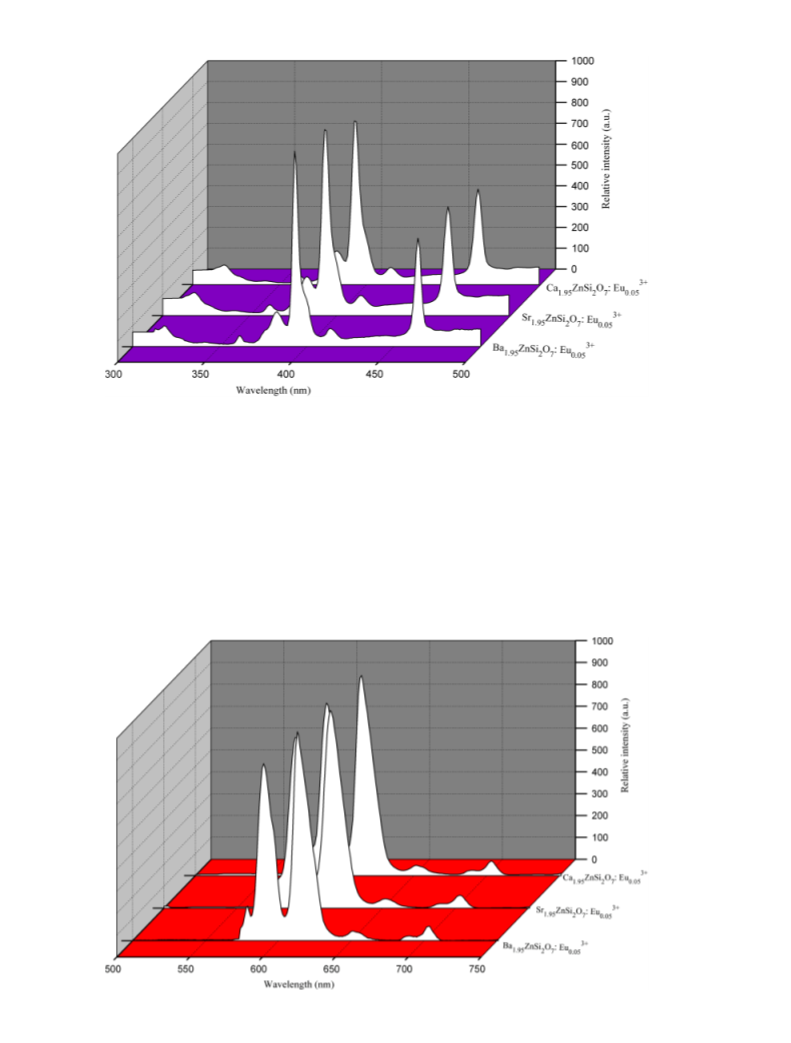
also calculated, and the results are shown in Table III . The re-
sults show that the asymmetric ratio increase slightly, which
confirms the decrease in local symmetry. The fluorescence in-
5
5
tensity ratio of D0-7F2 to D0-7F1 transitions of Eu31 in-
creases with increasing ionic radius in the order of SroCaoBa
31
for hardystonite.42–45 So, in the three hardystonite phosphors,
6J. Liu and Y. D. Li, ‘‘Synthesis and Self-Assembly of Luminescent Ln31
-
Doped LaVO4 Uniform Nanocrystals,’’ Adv. Mater., 19, 1118–22 (2007).
Ba1.95ZnSi2O7:Eu
has the strongest emission intensity.
Color purity can be visualized in the chromaticity diagram
0.05
7C. F. Guo, W. Zhang, L. Luan, T. Chen.H.Cheng, and D. X. Huang, ‘‘A
Promising Red-Emitting Phosphor for White Light Emitting Diodes Prepared by
Sol–Gel Method,’’ Sensor Actuat. B-Chem., 133, 33–9 (2008).
(Fig. 5), with the emission color coordinates of the luminescent
material. The CIE chromaticity diagram of A1.95ZnSi2O7:Eu
(A 5Ca, Sr, Ba) samples were obtained using a Spectra Lux
Software v.2.0 Beta.22 For any given color there is one setting for
each three numbers X, Y, and Z known as tristimulus values that
31
0.05
8J. K. Sheu, S. J. Chang, C. H. Kuo, Y. K. Su, K. W. Wu, Y. C. Lin, W. C. Lai,
J. M. Tsai, G. C. Chi, and R. K. Wu, ‘‘White-Light Emission from Near UV
InGaN–GaN LED Chip Precoated with Blue/Green/Red Phosphors,’’ IEEE Pho-
ton. Echnol. Lett., 15, 18–20 (2003).
9V. Sivakumar and U. V. Varadaraju, ‘‘Intense Red-Emitting Phosphor for
White Light Emitting Diodes,’’ J. Eelctrochem. Soc., 152, H168–171 (2005).
10R. T. Wegh, H. Donker, K. D. Oskam, and A., Meijerink, ‘‘Visible Quantum
Cutting in LiGdF4: Eu31 Thorough Downconversion,’’ Science, 283, 663–6 (1999).
11M. Yu, J. Lin, Z. Wang, J. Fu, S. Wang, H. J. Zhang, and Y. C. Han, ‘‘Fab-
will produce
A
a
match. Based on emission spectrum of
(A 5Ca, Sr, Ba) samples, the (x, y) color
31
1.95ZnSi2O7:Eu
0.05
coordinates were determined with the following values (x,
y)5(0.489, 0.355), (0.466, 0.353), and (0.576, 0.362), respectively.
rication, Patterning, and Optical Properties of Nanocrystalline YVO4:
A
(A5 Eu31, Dy31, Sm31, Er31) Phosphor Films via Sol–Gel Soft Lithograph,’’
Chem. Mater., 14, 2224–31 (2002).
12R. A. S. Ferreira, L. D. Carlos, R. R. Goncalves, S. J. L. Ribeiro, and V. D. Z.
IV. Conclusion
The A2ZnSi2O7:Eu31 (A5 Ca, Sr, Ba) red phosphors were pre-
pared by the combustion-assisted synthesis method. In the three
Bermudez, ‘‘Energy-Transfer Mechanisms and Emission Quantum Yields in Eu31
Based Siloxane-Poly(Oxyethylene) Nanohybrids,’’ Chem. Mater., 13, 2991–8
-
(2001).
13Z. G. Lu, J. W. Wang, Y. G. Tang, and Y. D. Li, ‘‘Synthesis and Photolu-
minescence of Eu31-Doped Y2Sn2O7 Nanocrystals,’’ J. Solid State. Chem., 177,
3075–9 (2004).
crystal structures, the doping ions of Eu31 will clearly substitute
31
the alkaline earth metal ions. Ba1.95ZnSi2O7:Eu
0.05
has the
14M. P. O. Wolbers, F. C. J. M. Veggel, B. H. M. S. Ruel, J. W. Hofstraat, F. A.
¨
strongest emission intensity by the lowest local symmetry.
The CIE of the Ca1.95ZnSi2O7:Eu , Sr1.95ZnSi2O7:Eu
J. Geurts, and D. N. Reinhoudt, ‘‘Novel Preorganized Hemispherands to Encap-
sulate Rare Earth Ions: Shielding and Ligand Deuteration for Prolonged Lifetimes
of Excited Eu31 Ions,’’ J. Am. Chem. Soc., 119, 138–44 (1997).
31
0.05
31
0.05
,
sanples were calculated (x, y) 5 (0.489,
31
and Ba1.95ZnSi2O7:Eu
0.05
¨
15O. Lehmann, K. Kompe, and M. Haase, ‘‘Synthesis of Eu31-Doped Core and
0.355), (0.466, 0.353), and (0.576, 0.362). These excitation spec-
tra couple well with the emission of UV-LED (350–410 nm).
Core/Shell Nanoparticles and Direct Spectroscopic Identification of Dopant Sites
at the Surface and in the Interior of the Particles,’’ J. Am. Chem. Soc., 126, 14935–
42 (2004).
16J. X. Wan, Z. H. Wang, X. Y. Chen, L. Mu, and Y. T. Qian, ‘‘Shape-Induced
Enhanced Luminescent Properties of Red Phosphors: Sr2MgSi2O7:Eu31 Nano-
tubes,’’ Eur. J. Inorg. Chem., 20, 4031–4 (2005).
17Z. G. Wei, L. D. Sun, X. C. Jiang, C. S. Liao, C. H. Yan, Y. Tao, J. Zhang, T.
D. Hu, and Y. N. Xie, ‘‘Correlation Between Size-Dependent Luminescent Prop-
erties and Local Structure Around Eu31 Ions in YBO3:Eu Nanocrystals: an XAFS
Study,’’ Chem. Mater., 15, 3011–7 (2003).
18R. Chakrabarti, M. Das, B. Karmakar, K. Annapurna, and S. Buddhudu,
‘‘Emission Analysis of Eu3: Cao–La2O3–B2O3 Glass,’’ J. Non-Cryst. Solids, 353,
1422–6 (2007).
19G. Tang, J. Q. Zhu, Y. M. Zhu, and C. Y. Bai, ‘‘The Study on Properties of
Eu31-Doped Fluorogallate Glasses,’’ J. Alloys Compd., 453, 487–92 (2008).
20C. J. Jia, L. D. Sun, F. Luo, X. C. Jiang, L. H. Wei, and C. H. Yan, ‘‘Struc-
tural Transformation Induced Improved Luminescent Properties for LaVO4: Eu
Nanocrystals,’’ Appl. Phys. Lett., 84, 5305–7 (2004).
21S. S. Yao, Y. Y. Li, L. H. Xue, and Y. W. Yan, ‘‘Synthesis and Luminescent
Properties of a Novel red-Emitting Phosphor Ba2ZnSi2O7:Eu31, B31 for Ultravi-
olet Light-Emitting Diodes,’’ Int. J. Appl. Ceram. Technol. DOI: 10.1111/j.1744-
7402.2009.02447.x. (2009).
22A. P. C. Satnta and S. F. Teles ‘‘Spectra Lux Software v.2.0 Beta, Photo.’’
Quaˆ nticao Nanodispositivos, Renami, 2003.
23M. Kimata, ‘‘Four-Coordinated Co21 Cation in Ca2CoSi2O7,’’ Z. Kristallogr.,
69, 40–1 (1982).
24Y. Ochi, ‘‘Crystal Structure of Sr–Akermanite Glass–Ceramics,’’ Mater. Res.
Bull., 41, 1825–34 (2006).
25Y. Hao and Y. H. Wang, ‘‘Synthesis and Photoluminescence of New Phos-
phors M2(Mg, Zn)Si2O7: Mn21 (M5 Ca, Sr, Ba),’’ Mater. Res. Bull., 42, 2219–23
(2007).
26J. W. Kaiser and W. Jeistchko, ‘‘Crystal Structure of the New Barium Zinc
Silicates Ba2ZnSi2O7,’’ Z. Krist-New Cryst. Struct., 217, 25–6 (2002).
27Y. A. Malinovskii, ‘‘The Crystal Structure of Ba2CuSi2O7,’’ Dokl.Akad. Nauk.
SSSR, 278, 616–9 (1984).
28T. Joseph and M. T. Sebastian, ‘‘Microwave Dielectric Properties of
(Sr1ꢁxAx)2(Zn1ꢁxBx)Si2O7 Ceramics (A5 Ca, Ba and B 5 Co, Mg. Mn. Ni),’’
J. Am. Ceram. Soc., 93, 147–54 (2010).
31
Fig. 5. CIE diagram of (a) Ca1.95ZnSi2O7:Eu , (b) Sr1.95ZnSi2O7:
0.05
31
0.05
Eu301.05, and (c) Ba1.95ZnSi2O7:Eu
ceramic phosphors (lex 5394 nm).

 Yao, Shanshan