W. Noh, G.S. Girolami / Polyhedron 26 (2007) 3865–3870
3869
erbium atoms were deduced by direct-methods from an E-
map. Subsequent least-squares refinement and difference
Fourier calculations revealed the positions of the remaining
non-hydrogen atoms. Non-hydrogen atoms were refined
with independent anisotropic displacement parameters.
Hydrogen atoms were fixed in ‘‘idealized’’ positions and
their displacement parameters were tied to those of the
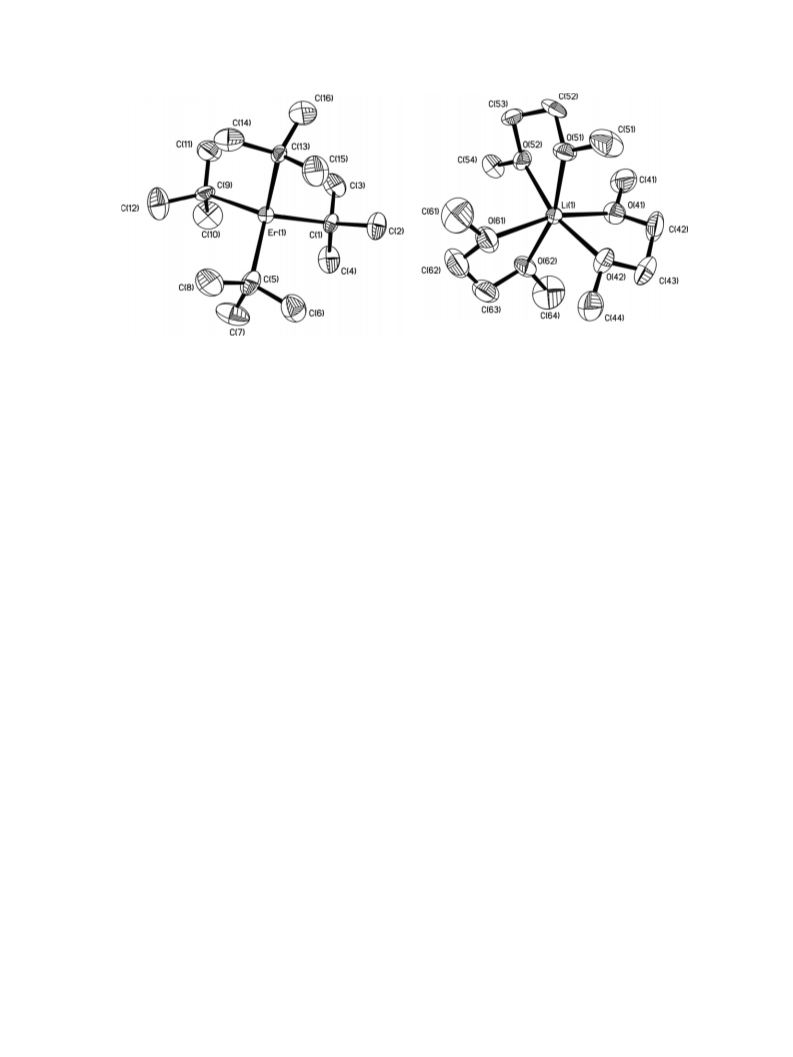
attached non-hydrogen atom. The Li(DME)3 cation cen-
tered on Li(3) was disordered about the two-fold axis.
The disorder involved overlapping atoms, and was mod-
eled in terms of three complete DME molecules, the atoms
of which were assigned site occupancy factors of exactly
0.5. In addition, two of the tert-butyl groups on Er(2) were
disordered over two rotameric conformations. The site
occupancy factors for these groups were initially refined,
but later set equal to exactly 0.5.
not modeled well; otherwise, there were no systematic
errors.
4. Supplementary material
CCDC 635390 contains the supplementary crystallo-
graphic data for this paper. These data can be obtained free
html, or from the Cambridge Crystallographic Data
Centre, 12 Union Road, Cambridge CB2 1EZ, UK; fax:
(+44) 1223-336-033; or e-mail: deposit@ccdc.cam.ac.uk.
Acknowledgments
We thank the National Science Foundation for support
of this research under Grant Nos. DMR03-54060 and
DMR04-20768, and Scott R. Wilson and Teresa Prussak-
Wieckowska for collecting the X-ray crystallographic data.
At this point, it became clear that several classes of
reflections were affected by the twinning. Reflections with
|l| = 0, 1, 11, 12, 13, 14, 24, 25, and 26 were systematically
more intense than calculated. For reflections with these
References
values of l, the calculated intensity was set equal to the for-
0
0
0 0
[1] F.T. Edelmann, in: E.W. Abel, F.G.A. Stone, G. Wilkinson, M.F.
Lappert (Eds.), Comprehensive Organometallic Chemistry II, vol. 4,
Pergamon, New York, 1995, pp. 11–212.
[2] R. Anwander, in: S. Kobayashi (Ed.), Topics in Organometallic
Chemistry, vol. 2, Springer, Berlin, 1999, pp. 1–62.
mula Icalc = xIhkl + (1 ꢀ x)Ih k l , where h = ꢀh ꢀ rnd(l/6),
k0 = ꢀk, and l0 = l, and x is the volume fraction of the
major twin individual; ‘‘rnd’’ indicates that the quotient
l/6 was rounded to the nearest integer. About 100 of the
reflections with |l| = 1, 11, and 14 were not modeled well
by this function (F2 > 4.5F2), evidently because the two
reciprocal lattices were sometimes distinguishable and only
one reflection had been measured; such reflections were
either reassigned calculated intensities based solely on the
major twin, or deleted from the reflection file. The intensi-
ties of symmetry-equivalent reflections were not averaged,
and 72825 unique reflections were used in the least-squares
refinement. The twin ratio refined to 0.682(1) for the major
twin individual.
[3] J-C.G. Bunzli, Acc. Chem. Res. 39 (2006) 53.
¨
[4] P. Dorenbos, Chem. Mater. 17 (2005) 6452.
[5] Y.M. Kiselev, Y.D. Tret’yakov, Russ. Chem. Rev. 68 (1999) 365.
[6] M.N. Bochkarev, Coord. Chem. Rev. 248 (2004) 835.
[7] W.J. Evans, J. Organomet. Chem. 647 (2002) 2.
[8] S. Cotton, in: J.A. McCleverty, T.J. Meyer (Eds.), Comprehensive
Coordination Chemistry II, vol. 3, Pergamon, New York, 2003, pp.
93–187.
[9] P.B. Hitchcock, M.F. Lappert, A.V. Protchenko, Chem. Commun.
(2006) 3546.
[10] Z.W. Hu, G. Kaindl, B.G. Muller, J. Alloys Comp. 246 (1997) 177.
[11] M. Josse, M. Dubois, M. El-Ghozz, J. Cellier, D. Avignant, Acta
Crystallogr., Sect. B 61 (2005) 1.
Similarity constraints were imposed on the Li–O, C–O,
and C–C distances of the disordered DME ligands attached
to Li(3), on the C–C distances in the disordered tert-butyl
groups on Er(2), and on the displacement parameters of
adjacent atoms. In the final cycle of least squares, aniso-
tropic displacement factors were refined for all erbium
and for all ordered oxygen carbon atoms; isotropic dis-
placement parameters were refined for the lithium atoms
and all disordered oxygen and carbon atoms. Hydrogen
atoms were placed in idealized positions (for methyl pro-
tons, they were placed in positions staggered with respect
to the substituents on the vicinal atom). The displacement
parameters for methylene hydrogens were set equal to 1.2
times Ueq for the attached carbon; those for methyl hydro-
gens were set to 1.5 times Ueq. Successful convergence was
indicated by the maximum shift/error of ꢀ0.009 for the last
cycle. Final refinement parameters are given in Table 1.
The largest peak in the final Fourier difference map
[12] D. Avignant, E. Largeau, V. Gaumet, P. Dugat, M. El-Ghozzi, J.
Alloys Comp. 277 (1998) 1.
[13] Y. Hinatsu, Y. Doi, J. Alloys Comp. 418 (2006) 155.
[14] W.J. Liu, M. Dolg, P. Fulde, Inorg. Chem. 37 (1998) 1067.
[15] F.T. Edelmann, D.M.M. Freckmann, H. Schumann, Chem. Rev. 102
(2002) 1851.
[16] A. Streitwieser, S.A. Kinsley, C.H. Jenson, J.T. Rigsbee, Organo-
metallics 23 (2004) 5169.
[17] H.D. Amberger, H. Reddmann, F.T. Edelmann, J. Organomet.
Chem. 690 (2005) 2238.
[18] H. Schumann, W. Genthe, E. Hahn, J. Pickardt, J. Organomet.
Chem. 306 (1986) 215.
[19] A.L. Wayda, W.J. Evans, J. Am. Chem. Soc. 100 (1978) 7119.
[20] H. Schumann, J. Muller, N. Bruncks, H. Lauke, J. Pickardt, H.
Schwarz, K. Eckart, Organometallics 3 (1984) 69.
[21] J.L. Atwood, W.E. Hunter, R.D. Rogers, J. Holton, J. McMeeking,
R. Pearce, M.F. Lappert, J. Chem. Soc., Chem. Commun. (1978) 140.
[22] H. Schumann, J. Mu¨ller, J. Organomet. Chem. 169 (1979) C1.
[23] F.A. Hart, A.G. Massey, M.S. Saran, J. Organomet. Chem. 21 (1970)
147.
[24] S.A. Cotton, F.A. Hart, M.B. Hursthouse, A.J. Welch, J. Chem. Soc.,
Chem. Commun. (1972) 1225.
[25] W.J. Evans, A.L. Wayda, J. Organomet. Chem. 202 (1980) C6.
[26] G.S. Girolami, C.G. Howard, G. Wilkinson, J. Chem. Soc., Dalton
Trans. (1985) 921.
ꢀ3
˚
˚
(2.69 e A ) was located 1.2 A from Er(2). A final analysis
of variance between observed and calculated structure fac-
tors showed that the intensities of many of the reflections
with |l| = 1, 11, and 14 (and some with |l| = 2) were still

 Noh, Wontae