10.1002/anie.201802090
Angewandte Chemie International Edition
COMMUNICATION
as the singlet, confirming that the diradical mechanism is the
most probable. (see experimental SI)
16
(
)
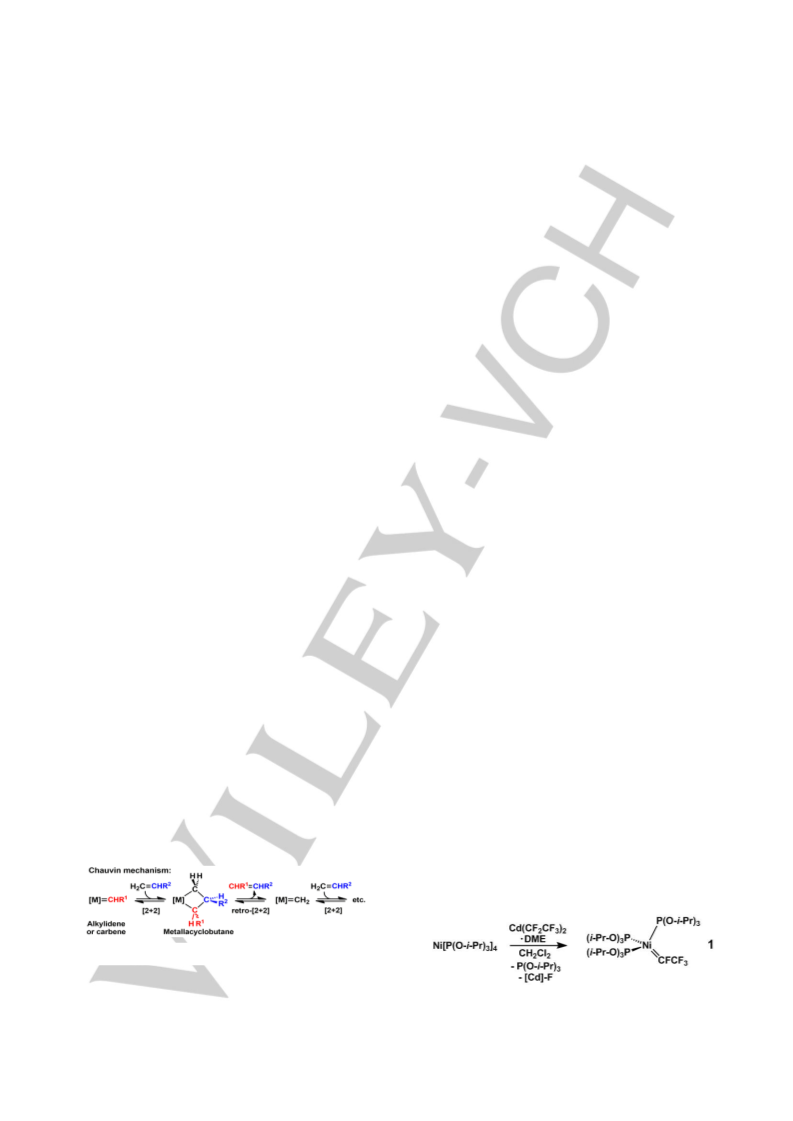
The [Ni]=CFCF3 sub-structure was confirmed by synthesizing
Ni(P3)(=CFCF3), 7 [P3 = MeC(CH2PPh2)3] from 1, by phosphite-substitution, to
To summarize, we have demonstrated the first examples of
metal fluorocarbene metathesis with fluoroalkenes, through a
novel variant of the Chauvin mechanism enabled by the
disparate four-coordinate transition states. These results extend
our understanding of metathesis mechanisms beyond the
original Chauvin postulate, in which the metallacycle is an
intermediate en route to metathesis products.1
Despite the important advances described herein, conside-
rable challenges still face metal-mediated polyfluoroalkene
metathesis. First, a more general source of nucleophilic metal
carbenes is needed.31 Second, ground state energy differences
between the Ni=CF2 and Ni=CFCF3 carbene complexes
introduce additional barriers to efficient metal-catalyzed
fluoroalkene metathesis that will require careful selection of the
carbene/fluoroalkene partners. Ongoing experimental and
computational efforts are focused on finding more systems that
favor the metathesis pathway.
obtain a crystalline derivative suitable for X-ray structural determination (see
SI).
(
17) G. R. Clark, S. V. Hoskins, T. C. Jones, W. R. Roper, J. Chem. Soc.,
Chem. Commun. 1983, 719-721.
(
18) M. Reisch, Chem. Eng. News 2010, 88, 23.
(
(
19) Complex 3 does not react with excess HFP (24 h, 50 oC).
20) J. Clayden, N. Greeves, S. Warren, P. Wothers. Radical stability. In
Organic Chemistry; Oxford: New York, 2004; pp. 1026-1028.
(
(
21) D. O’Hagan, Chem. Soc. Rev. 2008, 37, 308-319.
22) W. J. van Rensburg, P. J. Steynberg, W.H. Meyer, M. M. Kirk, G.S.
Forman, J. Am. Chem. Soc. 2004, 126, 14332-14333.
(
23) DFT calculations for the stability of the metallacyclobutanes/-propanes
formed from reactions of 1 with TFE and VDF are shown in the computational
SI.
(
24) (a) R. P. Hughes, R. B. Laritchev, J. Yuan, J. A. Golen, A. N. Rucker, A. L.
Rheingold, J. Am. Chem. Soc. 2005, 127, 15020-15021. (b) C. J. Bourgeois,
R. P. Hughes, J. Yuan, A. G. DiPasquale, A. L. Rheingold, Organometallics
2006, 25, 2908-2910. (c) J. Yuan, R. P. Hughes, A. L. Rheingold, Eur. J. Inorg.
Chem. 2007, 4723-4725.
(
25) (a) The density functional theory (DFT) calculations were performed with
the Gaussian 09 Suite of programs: Gaussian 09, revision D. 01, M. J. Frisch,
et al. Gaussian, Inc.: Wallingford, CT. 2013 (see SI for full reference). (b) The
M06 functional (see ref. 26) was employed with the 6-311+G* basis set for the
C, H, O, F, and P atoms, and the Stuttgart quasi-relativistic basis set and
effective core potential (see ref. 29) for Ni. Each species was optimized in the
gas phase on an ultrafine grid. Analytical frequency calculations were
performed on all optimized structures to ensure that either a minimum or a
first-order saddle point was achieved, and to obtain the thermal Gibbs free
energy corrections. Further single point calculations were carried out on the
basis of the optimized geometries with the continuum solvation model SMD
(see ref. 28) at the same level of theory to account for solvent effects, where
THF (tetrahydrofuran) was employed as the solvent. The reported energies
(ΔG) in this work include the electronic energy, DFT-D3 empirical dispersion
corrections proposed by Grimme et al. (see ref. 29), the gas-phase thermal
correction for the Gibbs free energy and SMD solvation corrections. The bond
energy of the ancillary ligand L (L = P(O-i-Pr)3) from the nickel carbene
complex was calculated from the following equation: NiL3(=CFCF3)
NiL2(=CFCF3) + L.
Acknowledgements
We thank the NSERC and the Canada Research Chairs
program for generous financial support and the University of
Ottawa, Canada Foundation for Innovation and Ontario Ministry
of Economic Development and Innovation for essential
infrastructure. MBH thanks The Welch Foundation (A-0648) and
the National Science Foundation (CHE-1300787) for their
support. ALD thanks NSERC for a CGS-D scholarship.
Keywords: keyword
(fluoroalkenes)• keyword
1
(Alkene metathesis)
(nickel-carbene)
•
keyword
2
4
3
• keyword
(Chauvin Mechanism) • keyword 5 (metallacyclobutanes)
(1) (a) Olefin Metathesis: Theory and Practice; Grela, K., Ed.; John Wiley &
Sons: Hoboken, NJ, 2014. (b) Handbook of Metathesis; R. H. Grubbs, Ed.;
Wiley-VCH: Weinheim, Germany, 2003.
(
(
26) Y. Zhao, D. G. Truhlar, Theor. Chem. Acc. 2008, 120, 215-241.
27) (a) M. Dolg, U. Wedig, H. Stoll, H. Preuss, J. Chem. Phys. 1987, 86, 866-
(2) (a) S. F. Y. Motta, E. D. V. Bercerra, M. W. Spatz, Analysis of LGWP
Alternatives for Small Refrigeration (Plug-in) Applications; International
Refrigeration and Air Conditioning Conference; Purdue University: West
Lafayette, IN, 2010; Paper 1149. (b) A. Mota-babiloni, P. Makhnatch, R.
Khodabandeh, Intl. J. Refrig. 2017, 82, 288-301.
872. (b) J. M. L. Martin, A. Sundermann, J. Chem. Phys. 2001, 114, 3408-
3420.
(
28) A. V. Marenich, C. J. Cramer, D. G. Truhlar, J. Phys. Chem. B 2009, 113,
6378-6396.
29) S. Grimme, J. Antony, S. Ehrlich, H. Krieg, J. Chem. Phys. 2010, 132,
154104-1-154104-19.
30) That the prior dissociation energy of a phosphine adds to this reaction
(
(3) (a) S. Fomine, M. A. Tlenkopatchev, Appl. Catal., A. 2009, 355, 148-155.
(b) M. Vasiliu, A. J. Arduengo, III, D. A. Dixon, J. Phys.Chem. C 2014, 118,
13563-13577.
(
barrier is confirmed through treatment of complex 7 with TFE which shows
little reactivity until the solution is heated to 60 oC (more details in SI).
(4) T. M. Trnka, M. W. Day, R. H. Grubbs, Angew. Chem. Int. Ed. 2001, 40,
3441-3444.
(
31) G. M. Lee, D. J. Harrison, I. Korobkov, R. T. Baker. Chem. Commun.,
2014, 50, 1128.
(5) Y. Takahira, Y. Morizawa, J. Am. Chem. Soc. 2015, 137, 7031-7034.
(6) (a) M. J. Koh, T. T. Nguyen, H. Zhang, R. R. Schrock, A. H. Hoveyda,
Nature 2016, 531, 459-465. (b) T. T. Nguyen, M. J. Koh, X. Shen, F. Romiti,
R. R. Schrock, A. H. Hoveyda, Science 2016, 352, 569-574. (c) M. J. Koh, T.
T. Nguyen, J. K. Lam, S. Torker, J. Hyvl, R. R. Schrock, A. H. Hoveyda,
Nature. 2017, 542, 80-86.
(7) D. J. Harrison, G. M. Lee, M. C. Leclerc, I. Korobkov, R. T. Baker, J. Am.
Chem. Soc. 2013, 135, 18296-18299.
(8) D. J. Harrison, S. I. Gorelsky, G. M. Lee, I. Korobkov, R. T. Baker,
Organometallics, 2013, 32, 12-15.
(9) D. J. Harrison, A. L. Daniels, I. Korobkov, R. T. Baker, Organometallics
2015, 34, 5683−5686.
(
10) L. F. Halle, P. B. Armentrout, J. L. Beauchamp, Organometallics. 1983, 2,
1829-1833.
(
11) For a unique example of apparent Ni-mediated alkene metathesis see: F.
G. N. Cloke, P. B. Hitchcock, M. F. Lappert, C. MacBeath, G. O. Mepsted, J.
Chem. Soc., Chem. Commun., 1995, 87-88.
(
12) J. T. Fuller, D. J. Harrison, M. C. Leclerc, R. T. Baker, D. H. Ess, R. P.
Hughes, Organometallics 2015, 34, 5210-5213.
(
(
(
13) S. D. Ittel, Inorg. Synth. 1990, 28, 98-104.
14) H. Lange, D. Naumann, J. Fluorine Chem. 1984, 26, 1-18.
15) Complex 1 was obtained in ~95% purity with the only NMR-visible
contaminant being the starting material, Ni[P(O-i-Pr)3]4. Sublimation gave
marginally improved purity but significantly diminished yield. See Supporting
Information.
4
This article is protected by copyright. All rights reserved.

 Harrison, Daniel J.