J. Agric. Food Chem. 1996, 44, 3379
−3382
3379
P h ototr a n sfor m a tion of Ch lor im u r on -eth yl in Aqu eou s Solu tion
Partha P. Choudhury and Prem Dureja*
Division of Agricultural Chemicals, Indian Agricultural Research Institute, New Delhi 110012, India
Chlorimuron-ethyl is relatively stable in water buffered to pH 7.0 and 9.0, but hydrolyzes readily
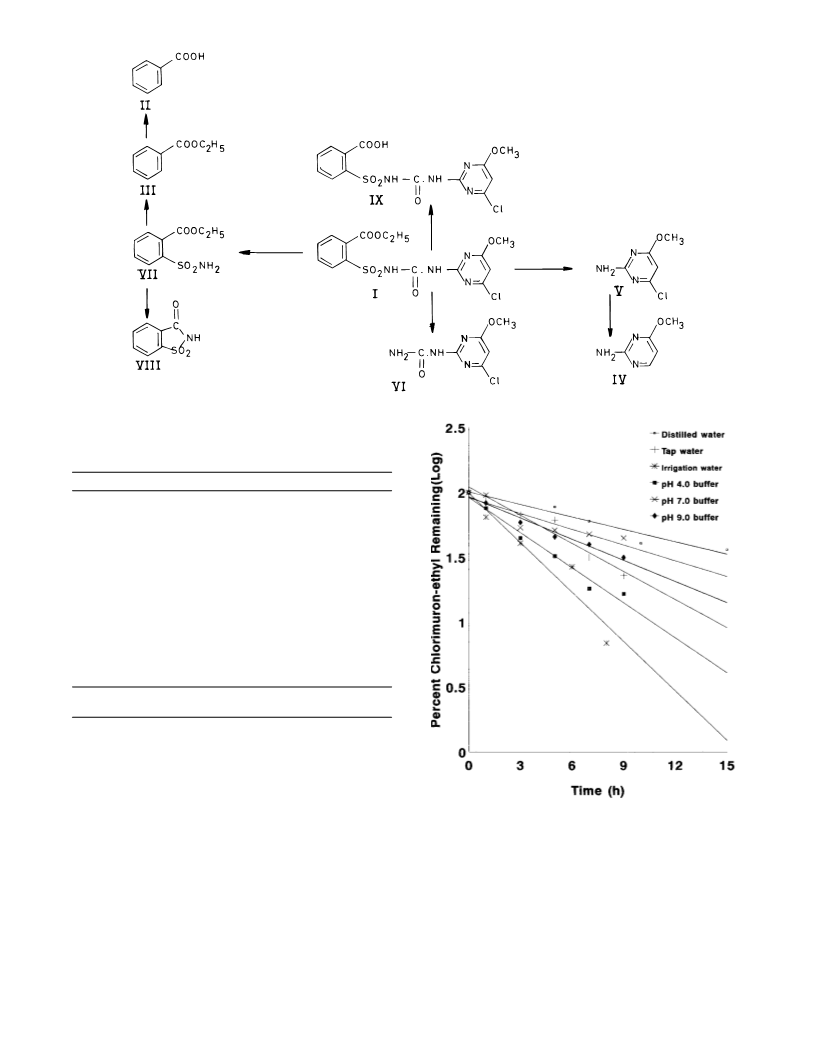
(half-life, 14 d) in water buffered to pH 4.0. In addition, chlorimuron-ethyl photodegrades rapidly
and extensively in aqueous solution. The predominant photoproducts are 4-methoxy-6-chloro-2-
aminopyrimidine, ethyl 2-aminosulfonylbenzoate, N-(4-methoxy-6-chloropyrimidin-2-yl)methyl urea,
and o-benzoic sulfimide (saccharin). A minor deesterified product (chlorimuron) was evident. The
decrease in chlorimuron-ethyl concentration in aqueous solutions followed first-order kinetics. The
rate of degradation in different types of water followed the order irrigation water > tap water >
distilled water. Chlorimuron-ethyl photodegraded in pH 4, 7, and 9 buffer solutions under both
UV and sunlight. A faster degradation rate in pH 4.0 buffer solution was observed.
Keyw or d s: Chlorimuron-ethyl; aqueous solution; photolysis
INTRODUCTION
Ta ble 1. p H a n d EC of Differ en t Typ es of Wa ter
distilled water
tap water
irrigation water
Chlorimuron-ethyl (ethyl 2-[[[[(4-chloro-6-methoxy-2-
pyrimidinyl)amino]carbonyl]amino]sulfonyl]benzoate) is
degraded in the agricultural environment primarily via
pH- and temperature-dependent chemical hydrolysis
and is not readily susceptible to other modes of degra-
dation (Beyer et al., 1988). Earlier studies have shown
that selective nonionic surfactants altered the photolysis
rates of chlorimuron-ethyl in aqueous solution and on
glass slides exposed to sunlight (Thomas and Harrison,
pH
EC (dS/m)
7.00
0.02
8.44
1.92
8.70
2.01
P r ep a r a tion of Aqu eou s Solu tion of Ch lor im u r on -
eth yl. An analytical sample of chlorimuron-ethyl (1 g) was
added to 1 L of double-distilled water in a conical flask and
stirred for 24 h at room temperature. The stirred aqueous
solution of chlorimuron-ethyl was filtered through Whatman
No. 42 filter paper. Similarly, solutions of chlorimuron-ethyl
were prepared in tap water and irrigation water. The con-
centration of chlorimuron-ethyl was adjusted to 10 ppm by
further dilution with the respective types of water.
1
990a,b). Following eight days of exposure, there was
a 30% loss of aqueous chlorimuron-ethyl in control
solutions with no surfactants, compared with a 97% loss
of chlorimuron-ethyl in aqueous solution containing
Bu ffer . The buffer solutions used during the photolysis rate
study to maintain pH values of 4.0, 7.0, and 9.0 were prepared
according to the system established by Clark and Lubs (Lange,
1961). The buffered solutions at pH 4.0 and 7.0 were prepared
by addition of appropriate amounts of 0.2 M disodium hydro-
gen phosphate to 0.1 M citric acid, and the buffered solution
at pH 9.0 was prepared by adding 0.05 M sodium tetraborate
to 0.1 M boric acid.
0
.1% (v/v) octoxynol. The presence of p-coumaric acid
delayed chlorimuron-ethyl photolysis, whereas ribofla-
vin sensitized its photolysis (Thomas and Harrison,
1
990a; Venkatesh et al., 1993). However, no informa-
tion on the identities of the degradation products has
been reported.
The present study was undertaken to determine the
kinetics of sunlight and ultraviolet (UV) light photo-
degradation of chlorimuron-ethyl in water, the products
of photodegradation, and the effect on photodegradation
rate of various solutes including dissolved organic
matter.
Aqu eou s Sta bility. The aqueous stability of chlorimuron-
ethyl was characterized prior to photochemical degradation
experiments. The stability of chlorimuron-ethyl (10 ppm) was
tested in natural water buffered to pH 4.0, 7.0, and 9.0 (by
the addition of appropriate buffer). The test solutions were
maintained in the dark at 28 °C for 20 days. One 2-mL aliquot
was taken from each buffer solution after 6 h and 1, 2, 3, 5, 7,
1
0, 12, 15, and 20 days. All experiments were done in
MATERIALS AND METHODS
duplicate and analyzed by HPLC-UV.
Ir r a d ia tion a n d P h otop r od u cts. An aqueous solution of
chlorimuron-ethyl (50 ppm) was irradiated for 2 h with a
medium-pressure Hg lamp (125 W, Philips) jacketed with a
water cooled quartz filter. After irradiation, the aqueous
solution was extracted with methylene chloride (100 mL × 3).
To produce enough of the photoproduct for structural analysis,
a solution of 500 mg of chlorimuron-ethyl in 5 L of distilled
water was irradiated in five batches (100 mg in 1000 mL) for
Ch em ica ls. A technical sample of chlorimuron-ethyl (95%
purity) was supplied by DuPont Far East Inc., New Delhi,
India, and was purified further by repeated crystallization
from benzene and hexane until a constant mp of 185 °C was
achieved. Laboratory grade reagents and solvents were
procured locally. All the solvents were dried and distilled
before use.
Wa ter . The types of water used in the experiments were
distilled water (double distilled from systronic model distilled
water plant), tap water (collected from New Delhi Municipal
Corporation water supply), and irrigation water (collected from
an irrigation well on Research Farm, Indian Agricultural
Research Institute, New Delhi, India). The properties of the
water are described in Table 1.
2
h through a quartz filter. The irradiated solutions were
combined and extracted with methylene chloride (100 mL ×
). After drying with anhydrous Na SO , the organic phase
9
2
4
was concentrated under reduced pressure. A brown residue
was obtained. A dark control experiment was performed by
covering the flask with aluminum foil to ensure that a given
product was derived by photochemical reactions.
P h otolysis Kin etics. Aqueous solutions of chlorimuron-
ethyl (distilled water, tap water, and irrigation water; 10 ppm)
were irradiated in both quartz and Pyrex tubes under both
*
Author to whom correspondence should be ad-
dressed (fax 011-5740722/5752006).
S0021-8561(95)00556-5 CCC: $12.00
© 1996 American Chemical Society

 Choudhury, Partha P.