
Journal of Physical Chemistry B p. 7260 - 7269 (1999)
Update date:2022-08-28
Topics:
 Barker, Anna L.
Unwin, Patrick R.
Amemiya, Shigeru
Zhou, Jungfen
Bard, Allen J.
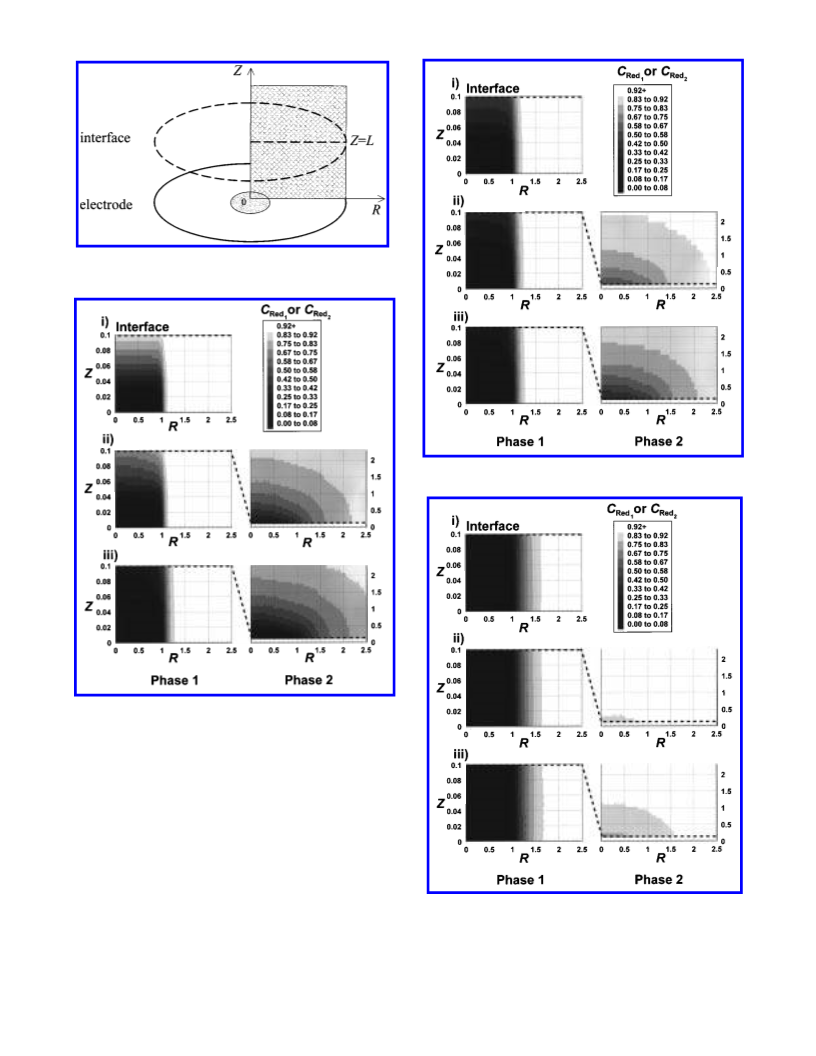
A numerical model is developed for the SECM feedback mode for the case of irreversible electron transfer (ET) processes at the interface between two immiscible electrolyte solutions (ITIES). In this application, a redox-active species is electrogenerated by the reduction/oxidation of the oxidized/reduced form of a couple at an ultramicroelectrode (UME) tip located in one liquid (phase 1). The tip is positioned close to the interface with a second immiscible liquid (phase 2), that contains the oxidized/reduced half of another redox couple. If ET occurs between the tip-generated species in phase 1 and the redox-active species in phase 2, then the original species in phase 1 is regenerated at the interface and undergoes positive feedback at the tip, enhancing the steady-state current. The feedback current, for a given separation between the tip and the interface, is shown to depend on the ratio of the concentrations of the redox-active species in the two phases, their relative diffusion coefficients, and the rate constant for the redox reaction. The results of the model are used to identify the conditions under which (i) diffusion in phase 2 has to be considered and; (ii) a simpler limiting (constant composition) model for phase 2, employed to analyze earlier SECM experiments, can be used. In addition to diversifying the range of conditions under which redox reactions at ITIES can be studied, the results of the model demonstrate that there are considerable advantages to lifting the constant composition restriction on phase 2 for the accurate characterization of rapid redox reactions. The theoretical predictions are examined through experimental studies of electron transfer between the electrogenerated, oxidized form of zinc-21H, 23H-tetraphenylporphine (ZnPor) in benzene or benzonitrile and the reductants Fe(CN)64-, Ru(CN)64-, Mo(CN)84-, or FeEDTA2- (where EDTA denotes ethylenediaminetetraacetic acid) in an aqueous solution. Bimolecular rate constants for each of these systems are reported, with the potential across the ITIES biased with either perchlorate or tetrafluoroborate ions in each phase.





website:http://www.vanzpharm.com/en/index.html
Contact:86-27-84492310
Address:FANHU INDUSTRY PARK
shanghai jiuling chemical co.,ltd.
Contact:+86-21-50387295
Address:Zaozhuang Road, Pudong, Shanghai City. China
Beijing Green Guardee Technology CO,.LTD
Contact:+86-10-69706062
Address:F2 BLdj,5 No.37 Chaoqian Road
Jiande City Silibase Silicone New Material Manufacture Co., Ltd.
Contact:15967177856
Address:Genglou Industrial Development Area
Contact:+86-13914766747
Address:Floors 21&22, Jin Cheng Tower, No. 216 Middle Longpan Road, Nanjing
Doi:10.1021/ja409527u
(2014)Doi:10.1016/j.bmcl.2020.127681
(2021)Doi:10.1016/j.bmc.2013.02.049
(2013)Doi:10.1021/ja072909o
(2007)Doi:10.1002/cphc.201000438
(2010)Doi:10.1002/anie.201915646
()
