Angewandte Chemie International Edition
10.1002/anie.202003481
COMMUNICATION
From K−O to K−Air Batteries: Realizing Superoxide Batteries on
2
the Basis of Dry Ambient Air
Lei Qin, Neng Xiao, Songwei Zhang, Xiaojuan Chen, and Yiying Wu*
[*]
Dr. L. Qin, Dr. N. Xiao, S. Zhang, X. Chen, Prof. Y. Wu
Department of Chemistry and Biochemistry
The Ohio State University
100 West 18th Avenue, Columbus, OH 43210 (USA)
E-mail: wu@chemistry.ohio-state.edu
Supporting information for this article is given via a link at the end of the document.
Abstract: Superoxide-based potassium-oxygen (K−O
2
) batteries
atmosphere with a large round-trip overpotential (1.3~1.62 V).[6]
have demonstrated enormous potential to realize high-energy-density
battery chemistry with low round-trip overpotentials. Although using
air cathode is the ultimate goal to unlock the full potential of
Lately, similar studies have been brought to sodium (Na)−air
electrochemistry. Sun et al. discovered that CO
dramatically alter the electrochemical pathway of Na−air batteries
·2H O,
.[7] The continuous accumulation of peroxide
2
and moisture
superoxide batteries, prior studies were limited to pure oxygen. Herein, and promotes side products formation, including Na
we report the first K−air (dry) battery based on reversible superoxide
2
O
2
2
NaOH, and Na
and carbonate largely limits the battery cyclability. Since the
demonstration of potassium (K)−O battery by our group in 2013,
2 3
CO
[
8]
electrochemistry. Spectroscopic and gas chromatography analyses
are applied to evaluate the reactivity of KO
that KO reacts with water vapor and CO to form KHCO
to be highly stable in dry air. With this knowledge, rechargeable K−air
dry) batteries were successfully demonstrated by employing dry air
2
in ambient air. Despite
2
2
2
3
, it is found
great progress has been made, including anode stability
improvement, electrolyte formula optimization, and cathode
design.[ One major advantage is that KO
9]
is the only product in
(
2
battery without the interference of peroxide species.[
1b]
cathode. We further prove that the reduced partial pressure of oxygen
plays a critical role in boosting the battery lifespan. With a more stable
environment for K anode, a K−air (dry) battery delivers over 100
cycles (> 500 hours) with low round-trip overpotentials and high
a K−O
Moreover, pure KO
to quantitatively investigate its reactions with moisture/CO
2
2
is commercially available. This facilitates us
and
2
understand the role of these reactions in a K−air (dry) battery.
coulombic efficiencies as opposed to traditional K−O
2
battery that fails
Herein, our work explores for the first time the highly reversible
at an early stage. This work sheds light on the benefits and restrictions
of employing air cathode in superoxide-based batteries, and will be of
use for the development of practical metal-air batteries.
2
KO electrochemistry under dry ambient air. The K−air (dry)
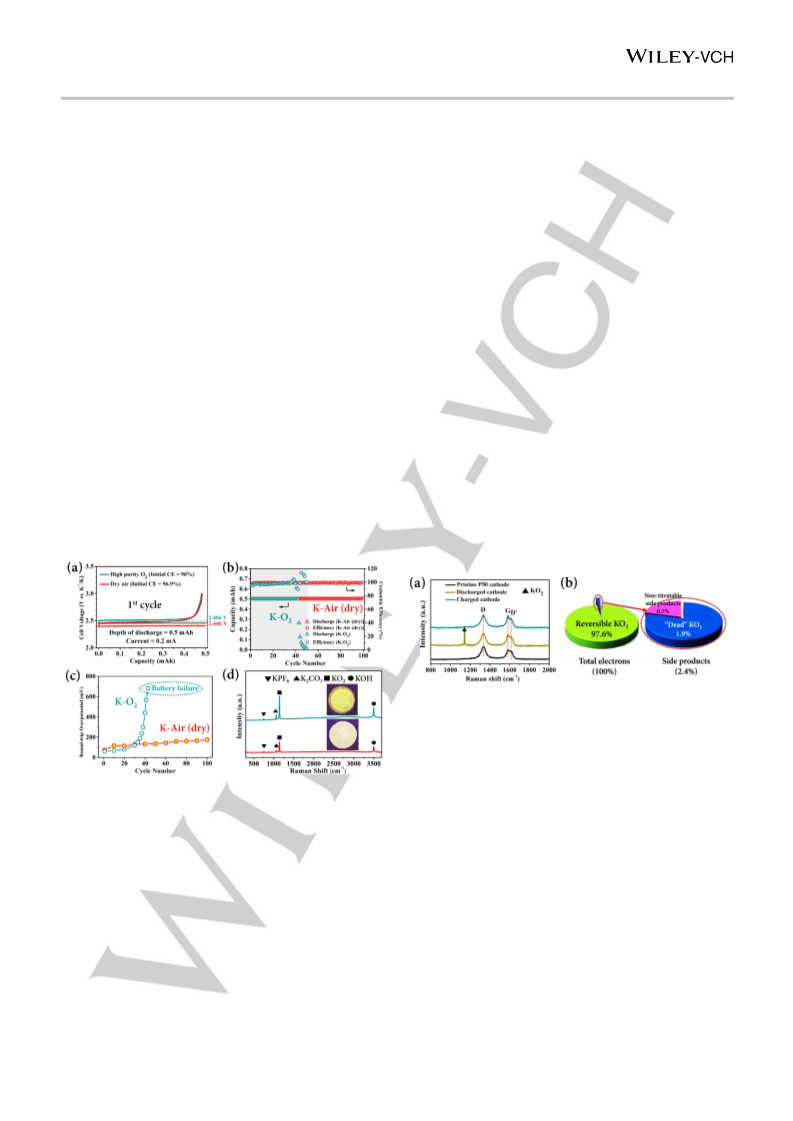
battery delivers a small round-trip overpotential of 74 mV and
+
offers a flat discharge voltage output at 2.40 V (vs. K /K). Based
on chemical quantifications and spectroscopic characterizations,
the superoxide chemistry is identified as the reaction mechanism
and such reaction route is barely affected by air components
Non-aqueous alkali metal-air batteries are deemed as energy
storage alternatives to the current lithium-ion batteries due to their
large energy densities and low costs.[1] To date, these gas-open
systems have been largely limited to pure oxygen (O ) conditions
2
due to the cell contamination and degradation caused by
unwanted atmospheric components, including nitrogen, carbon
(
especially CO
cycles (above 500 hours) with a high coulombic efficiency (CE) of
9.0% have been achieved. In the light of the feasibility of utilizing
2
) in the absence of moisture. As a result, over 100
9
dry ambient air and the realization of superb reaction kinetics with
an impressive battery lifespan, the “open” K−air (dry) battery
demonstrated here motivates the development of superoxide
batteries as a promising high-energy-density alternative to current
lithium-ion batteries technology.
dioxide (CO
for the air purification device and O
2
), and moisture. In order to eliminate additional needs
cylinder, it is crucial to design
2
a practical metal-air battery operating in ambient air.
A few groups have investigated the chemistry of metal−O
2
To explore the effects of different gas components, the
batteries in an air-like atmosphere. Note that CO
contaminant in metal-air batteries, which adversely affects the O
electrochemistry. Takechi et al. noticed that O -
can be captured
by CO to form a series of intermediates (e.g., peroxycarbonate
and peroxydicarbonate).[2] The final product of Li
CO results in a
2
is an inevitable
reactivity of KO
powder in air-tight vials filled with dry CO
saturated with water vapor), dry air, and dry O
2
was first examined by aging the commercial KO
2
2
2
, wet CO (namely CO
2
2
2
2
, respectively
Supporting Information, Figure S1a-c). The yellow KO powder
within 24 hours, while no obvious
2
(
2
2
3
turns to white only in wet CO
2
sluggish decomposition kinetics and requires electrocatalysts to
assist the removal of carbonate, leading to an intractable issue in
color change is observed in other vials. As shown in X-ray
diffraction (XRD) patterns, the white product is identified as
KHCO (JCPDS No. 12-0292) in wet CO , while the KO (JCPDS
3 2 2
No. 43-1020) does not change in other atmospheres (Supporting
Information, Figure S1d). Raman spectrum further confirms the
metal−CO
Li CO , by the reaction between LiO
Achilles’ heel of lithium (Li)−air batteries. Zhou et al. applied
2
batteries.[3] Peng et al. revealed that the build-up of
intermediate and CO , is the
2
3
2
2
[4]
ionic liquid (IL)-based gel to prevent electrolyte degradation when
-
1
dominant KO
while only KHCO
Figure S1e). Therefore, the presence of water vapor is critical for
CO to react with KO . It is also revealed that the KO powder is
highly sensitive to the moisture in ambient air (relative humidity of
2
(1142 cm ) in dry CO
2
(same as dry O
2
and dry air),
operating in ambient air.[5] Nevertheless, Li
CO
and undermines the reversibility of Li−O
still accumulates
electrochemistry.
2
3
3
is present in wet CO
2
(Supporting Information,
2
Curtiss and Salehi-Khojin et al. reported a long-life Li−O
2
battery
2
2
2
based on IL−dimethyl sulfoxide electrolyte in an air-like
1
This article is protected by copyright. All rights reserved.

 Chen, Xiaojuan