M.A. Leontiadou et al. / Chemical Physics 469-470 (2016) 25–30
27
h
mp;th ¼ Egð2 þ meeff =mehff
Þ
ð1Þ
For CdHgTe, meeff =mehff ꢃ 0:13 [28], and thus the MEG threshold
occurs at hmp,th ꢃ 2.1Eg. Taking the PL peak as a measure of Eg, this
relation yields hmp,th = 2.5 eV for the samples studied, which corre-
sponds to a pump wavelength of ꢁ500 nm. The MEG process can
result in more than one additional exciton but this would only
occur for an additional increase hmp above Eg of at least the same
size [20], i.e. a value of at least 3.2Eg for CdHgTe QDs. However,
the largest hmp value used in this study is equivalent to 2.8Eg, and
so under these conditions MEG can create only one extra exciton,
forming a biexciton.
Biexcitons are also formed when a QD absorbs two photons per
pump pulse, the probability of which is determined by the pump
fluence and the absorption cross-section at the pump wavelength
[29]. Recent work has shown that surface states can trap hot carri-
ers significantly, so that absorbed photons produce band edge exci-
tons with a sample-specific efficiency [30]. However, it is not
necessary to know this efficiency, since the band edge occupation,
F, can be determined directly from the peak fractional transmit-
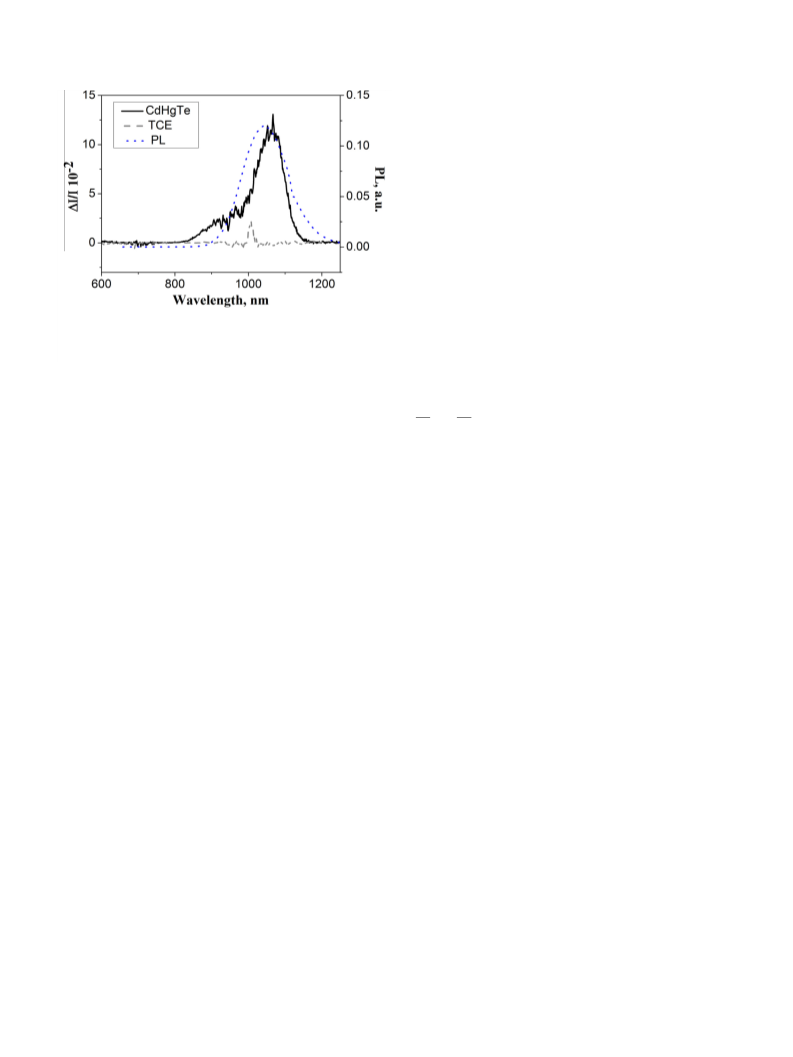
Figure 2. Pump-induced intensity change,
D
I/I spectra taken for CdxHg(1ꢀx)Te alloy
QDs (solid line) and TCE (dash line). Pumping was at a wavelength of 500 nm with a
spot size of 4 mm and a fluence of 16
intensity (dotted line).2
l
J/cm2. Also shown for comparison is the PL
tance change observed,
[20]:
DT/T|pk,, using the following expression
undergoing second-order diffraction from the grating therein. The
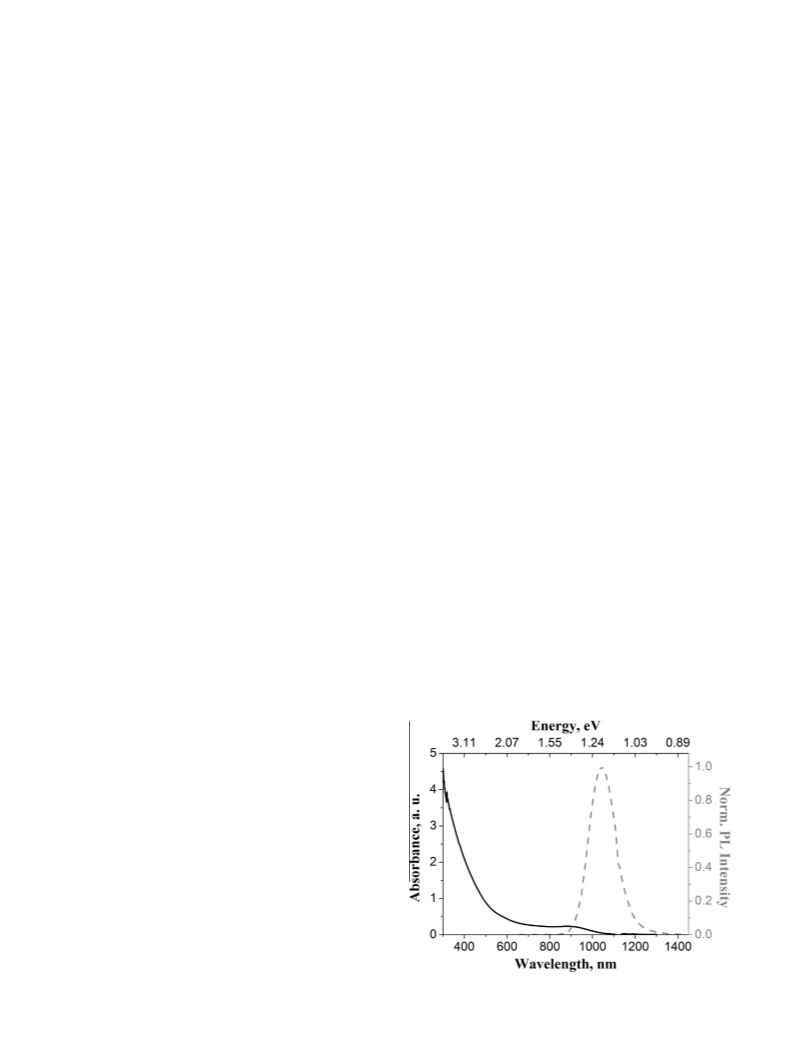
first peak in the QD spectrum is at the same spectral position as the
absorption edge, and is attributed solely to the bleach caused by
state-filling by photo-generated charges, whilst the second is at
the position that corresponds to the PL peak shown in Fig. 1 (and
reproduced in Fig. 2 to allow direct comparison) and will have con-
tributions from both bleaching and emissive processes. Direct sur-
face-trapping of photogenerated charges has been shown to result
in characteristic photo-induced absorption (PIA) features in the
vicinity of the band-edge [14,25,26]. However, the pump-induced
intensity change spectrum shown in Fig. 2 shows no signs of any
such PIA consistent with no significant surface-trapping occurring
on this time-scale. The first peak lies outside the PL band and so
does not correspond to a transition involving both the valence
band maximum (VBM) and the conductance band minimum
(CBM) simultaneously. Rather, it must correspond to transitions
involving either the VBM or the CBM and another state, with the
bleach produced by state-filling of whichever of the band edge
states is involved. Similar behaviour has been reported previously
for HgTe QDs, and was supported by detailed electronic structure
calculations [21]. In contrast the PL band corresponds to a CBM
to VBM transition, and here both PL and emission stimulated by
the probe beam, as well as bleaching, can result in an increased
intensity at the detector. However, the PL intensity is independent
of the time-delay between the pump and probe pulses and so
appears as a constant background in intensity change transients.
Figure S2a in the SI compares transients obtained for probe wave-
lengths of 920 nm and 1064 nm i.e. outside and within the PL band.
A significant background is observed for the latter but none for the
former, confirming this interpretation. Thus, in order to simplify
the analysis, a probe wavelength of 920 nm was used for the stud-
ies described from hereon since that yields an absorption bleach
only, and allows the pump-induced response of the CQDs to be
expressed in terms of the fractional change in transmittance pro-
duced by the bleach.
ꢀ
ꢀ
ꢀ
ꢀ
D
T
T
Apr
A
¼
Fð1 ꢀ eꢀA
Þ
ð2Þ
pk
where Apr and A are the sample absorbance at the probe and the
pump wavelengths, respectively. Thus F is used as a measure of
band edge excitation in this study.
Regardless of how they are produced, biexcitons decay into
single excitons with a lifetime that is typically several tens of
picoseconds; for instance, the lifetime reported for HgTe QDs was
49 2 ps [16]. This is observed in transient absorption data as a
sub-nanosecond decay of the bleach feature from its peak value,
which is due to state-filling by both biexcitons and single excitons,
to a smaller value corresponding to state-filling just by the single
excitons that remain. Single excitons have a much longer lifetime,
typically several nanoseconds or more, and so the bleach compo-
nent due to single excitons is observed on the time-scale of the
experiment as a constant or a nearly constant plateau [20]. The
ratio of the peak to the plateau bleach value, R, is given by [27]:
R ¼ dQYhNi½1 ꢀ expðꢀhNiÞꢄꢀ1
ð3Þ
where QY corresponds to the average number of excitons generated
per absorbed photon, hNi is the number of photons absorbed per QD
per pump pulse and is proportional to F, and d is a factor that takes
into account the decay of the single exciton over the duration of the
transient. At sufficiently low pump fluences, where hNi is negligible,
R/d ꢃ QY, which will be greater than unity if MEG is significant.
Figure 3 shows the transmittance transients,
DT(t)/T for the
CdHgTe QDs induced by pumping at a wavelength of 400 nm and
at range of excitation levels. The maximum value of the pump-
induced bleach varies linearly with pump fluence, as shown in
the SI (see Fig. S2b). The decay from this bleach peak is well-
described by a mono-exponential decay for F = 1.2, 3.1 and 6.9%,
and a global fit to these transients yields a time constant of
sB = 91 1 ps. Similar decay components have been reported previ-
ously for other QDs and attributed to the accumulation of charges
trapped on the surface [31–33]. Such surface trapped charges leads
to the formation of trions an electron–hole pair is photo-generated
whilst the geminate partner of the trapped charge remains in the
QD [34]. However, this effect is ameliorated by rapidly stirring or
flowing the sample and using only moderate pump fluences. A
comparison of the transients obtained for stirred and static sam-
ples of the CdHgTe QDs for moderate pump fluence is shown in
the SI (see Fig. S3). No significant difference is evident between
3.2. Ultrafast exciton dynamics
The quantum yield, QY, of MEG can be determined by studying
how the dynamics of the bleach peak depend on pump photon
energy, hmp. The onset of MEG occurs at a threshold value of hmp,th
that is determined by both the size-dependent band gap, Eg, and
the ratio of the effective masses of the electron and hole,
meeff =mehff [27]:

 Bourosh, Paulina N.