JOURNAL OF SOLID STATE CHEMISTRY 121, 105–110 (1996)
ARTICLE NO. 0015
PVP Protective Mechanism of Ultrafine Silver Powder Synthesized
by Chemical Reduction Processes
Zongtao Zhang, Bin Zhao, and Liming Hu
Technical Institute of Chemistry and Physics, East China University of Science and Technology, Shanghai 200237, P.R. China
Received January 3, 1995; in revised form August 14, 1995; accepted August 16, 1995
soluble silver salts was reacted with an appropriate reduc-
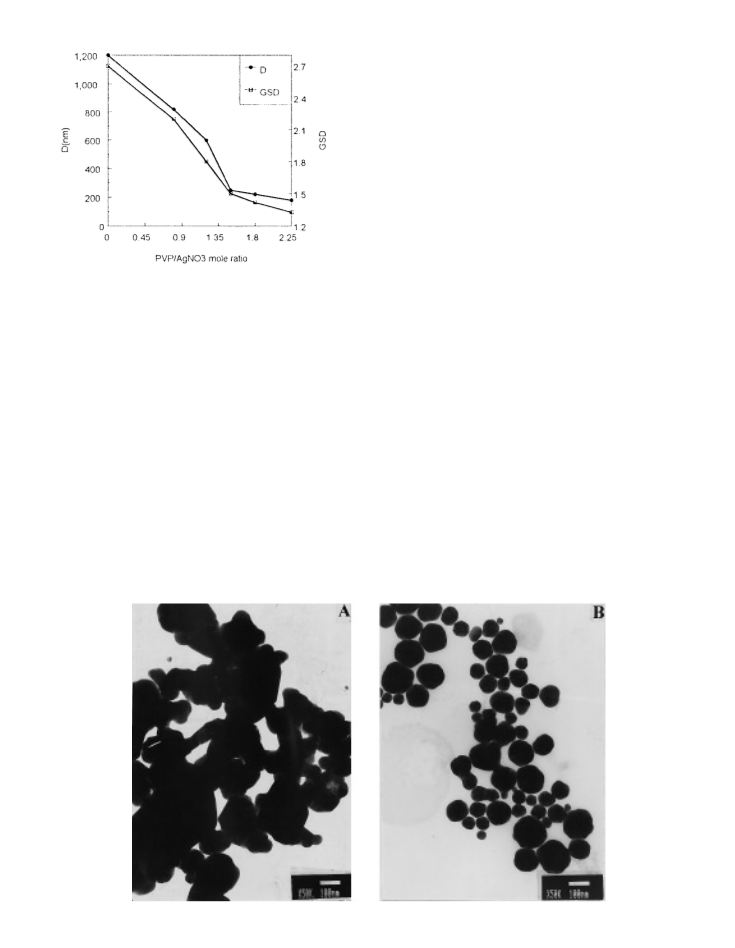
Polyvinyl pyrrolidone (PVP) as a protective agent plays a ing agent of both nonorganic and organic materials. How-
decisive part in controlling superfine silver particle size and
size distribution by reducing silver nitrate with hydrazine hy-
drate. The particle size and particle aggregation decrease with
the PVP/AgNO3 mole ratio. Mechanisms of PVP protection
were divided into three stages. First, PVP donates loan pair
electrons of oxygen and nitrogen atoms to sp orbitals of silver
ions, and thus the coordinative complex of Ag ions and PVP
forms in aqueous solution. Second, PVP promotes the nucle-
ation of the metallic silver because the Ag ions–PVP complex
is more easily reduced by hydrazine than the pure Ag ions
owing to Ag ions receiving more electronic clouds from PVP
ever, the conventional processes usually produce powders
with large size (sometimes more than 2 Ȑm), and irregular
shape and aggregation. This kind of powder was difficult
to use in thick-film and multilayer ceramic capacitors (1).
Fortunately, a newly developed chemical method,
known as the polymer protected reduction process, has
been used to prepare monodispersed silver powder with
submicrometer size and quasi-spherical shape (2–4). G.
Tosun and H. D. Glichsman (2) have reported a gelatin-
protected processing, in which silver nitrate was reduced by
than from H2O. Third, PVP prohibits silver particle aggregation alkylacid phosphate in aqueous solution and finely divided
and grain growth as a result of its steric effect. All of the
hypotheses were supported by ultraviolet spectra, infrared spec-
tra, and heterogeneous nucleation and grain growth by addition
silver particles with narrow particle size distribution and
with a mean particle size of about 0.1–1.0 Ȑm. They also
found that the gelatin played a key role in regulating the
silver particle size. F. Fievet et al. (3) and Ducamp-San-
guesa et al. (4) have employed polyvinyl pyrrolidone
(PVP) as a protective agent to synthesize ultrafine silver
powder with 300 nm diameter, by reducing silver nitrate
with hot polyol solution. We also prepared the superfine
of silver nuclei.
1996 Academic Press, Inc.
INTRODUCTION
Ultrafine silver powders have been widely used in the silver powders with spherical shape and about 100 nm
electronics industry for the manufacture of conductive diameter using a chemical reduction method protected by
thick film circuits and for the internal electrodes of PVP (5). However, the polymer protective mechanisms
multilayer ceramic capacitors. In recent years, with the have not been systematically studied.
small size and precision of electronic components, there
Polymer protective mechanisms originated from colloi-
are growing demands for a decrease in the thickness of dal chemistry. H. Hirai et al. (6) suggested that a complex of
conductive films to several micrometers and a further nar- the polymers and the metal ions was formed. According to
rowing of the width of printed circuits and the space be- chemical equilibrium, the effective metal ion concentration
tween these circuits (for instance, 100-Ȑm). It is thus re- decreased,sothepolymerhadimpairedthemetalionreduc-
quired that the conductive metal powder composing the tion, i.e., the nucleation of metal particles, the coordinative
paste should have small particle diameter and as close as bonds between the polymers and the ions being too strong.
possible to spherical shape with narrow particle size distri- On theother hand, the polymers usuallyhave the back bone
bution.
of polyvinyl as hydrophobic and hydrophilic groups. The
Many methods currently have been applied to prepare backbone of the vinyl polymer forms a hydrophobic do-
silver powder, such as physical processes of atomization main, which surround metal particles, whereas the hydro-
or milling, chemical methods of thermal decomposition, philic pendant groups of the polymer interact with water
and electrochemical processes. Silver powders used in elec- or polar solvent, i.e., the steric effect of the polymer in the
tronic applications are generally manufactured by chemical surface of metal particles prevents the particles from ag-
precipitation processes, in which an aqueous solution of glomeration. This hypothesis had, indeed, explained why
105
0022-4596/96 $12.00
Copyright 1996 by Academic Press, Inc.
All rights of reproduction in any form reserved.

 Zhang, Zongtao