I. Szyman´ska et al. / Polyhedron 26 (2007) 2440–2448
2441
stable in the gas phase until deposition on the substrate.
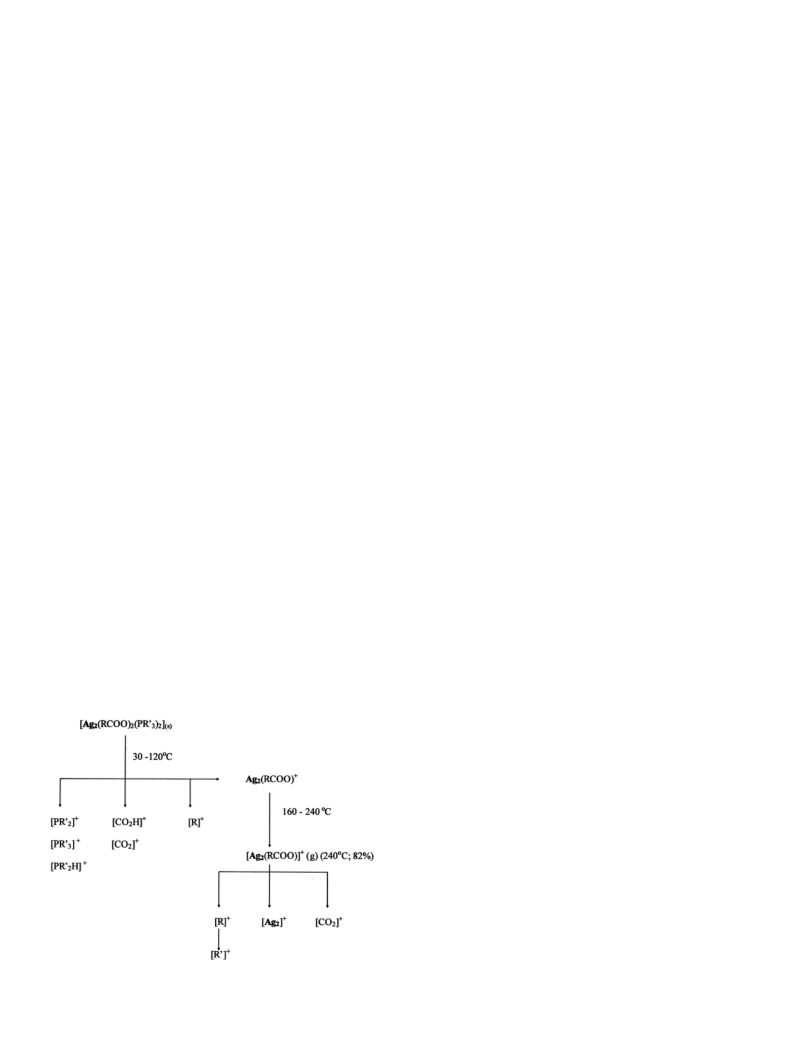
Therefore, temperature variable MS and TGA-IR spectra
of the gases evolved during the decomposition processes
will be described in the presented paper. Data from the lat-
ter studies will be use for elaboration of the fragmentation
schemes. Moreover, the fragmentation schemes of coordi-
nated ligands, should provide unique knowledge about
the chemistry of silver(I) complexes in the gas phase. The
article is also intended to describe a mechanism of carbox-
ylates thermal decomposition, therefore VT-IR spectra
were measured and discussed.
solution (1:1), heated to 40 °C and stirred 1 h, followed
by silver nitrate (3.5 mmol) addition (all manipulations
were carried out in the darkness). The obtained precipi-
tate was filtered, washed with water, ethanol and dried.
Anal. Calc. for C12H22Ag2O4: C, 32.2; H, 5.0; Ag, 48.3.
Found: C, 32.0; H, 5.2; Ag, 48.7%. IR: 1555, 1477,
1405, 1366, 1357, 1290 cmꢁ1
;
1H NMR (CD3CN):
0.83 ppm (3H, t, CH3), 1.10 ppm (6H, s, CH3),
1.49 ppm (2H, q, CH2); 13C NMR (CD3CN): 10.3 ppm
(CH3), 26.9 ppm (CH3)2, 35.5 ppm (CH2), 44.7 ppm (C),
183.9 ppm (COO).
2. Experimental
2.2.2. [Ag2(CH3CH2C(CH3)2COO)2(PMe3)2] (2) and
[Ag2(CH3CH2C(CH3)2COO)2(PEt3)2] (3)
2.1. Chemicals and instrumentation
Complexes were synthesized, in dried argon, using
Schlenk techniques, in the darkness. In a general proce-
dure: 1 (4 mmol) in C2H5OH (40 cm3) was mixed with
5 cm3 of TEOF and PR3 (4 mmol) (THF solution), where
R = Me, Et. The mixture was stirred at room temperature
for 4 h, filtered and solvents evaporated on a vacuum line.
[Ag2(CH3CH2C(CH3)2COO)2(PMe3)2] (2) was obtained as
white crystals, which were recrystallized from ethanol,
whereas [Ag2(CH3CH2C(CH3)2COO)2(PEt3)2] (3) was
obtained as a green–yellow oil and was analyzed directly
after evaporation. Anal. Calc. for C18H40Ag2O4P2 (2): C,
36.1; H, 6.7; P, 10.3; Ag, 36.1. Found: C, 36.3; H, 6.9; P,
10.2; Ag, 36.4%. IR: 1550, 1472, 1399, 1359, 1286,
CH3CH2C(CH3)2COOH (97%), trimethylphosphine
(PMe3) (1 M solution in THF), triethylphosphine (PEt3)
(1 M solution in THF), triethylorthoformate (TEOF) were
purchased from Aldrich, AgNO3, NaHCO3 and C2H5OH
were purchased from POCh (Poland), and all compounds
were used as received. Ethanol was dried by standard
methods.
Thermal studies (TG, DTG, DTA) were performed on a
SDT 2960 TA analyser. Decomposition processes were
studied in a dynamic atmosphere of dry nitrogen flowing
at 40 ml minꢁ1, heating rate 2.5 °C minꢁ1, heating range
up to 400 °C and sample mass 2–5 mg. Gaseous products
of thermal decomposition were detected by a FT IR Bio-
Rad Excalibur spectrophotometer equipped with a thermal
connector for gases evolved from a SDT 2960 TA analyser.
The thermal connector was heated to 200 °C. Powder
X-ray diffraction data for the thermal analysis residues
were obtained with a Philips X’PERT diffractometer using
Cu Ka radiation. Variable temperature mass spectra were
registered using a Finnigan MAT 95 spectrometer with
1
960 cmꢁ1. H NMR (CD3CN, ppm): 0.81 (3H, t, CH3),
1.03 (6H, s, CH3), 1.34 (9H, d, PCH3), 1.46 (2H, q,
CH2); 13C NMR (CD3CN, ppm): 9.7 (CH3), 14.8
P(CH3), 26.1 (CH3)2, 34.6 (CH2), 43.0 (C), 184.4 (COO);
31P NMR (CD3CN, ppm): ꢁ35.4.
Anal. Calc. for C24H52Ag2O4P2 (3): C, 42.2; H, 7.7; P,
9.1; Ag, 31.6. Found: C, 42.3; H, 7.4; P, 9.0; Ag, 31.1%.
IR: 1549, 1458, 1405, 1364, 1045, 764 cmꢁ1 1H NMR
.
(CD3CN, ppm): 0.84 (3H, t, CH3), 1.07 (6H, s, CH3),
1.18 (9H, t, PEt3), 1.47 (2H, q, CH2), 1.69 (2H, q, PEt3).
13C NMR (CD3CN, ppm): 9.19 (CH3), 10.5 P(CH2CH3),
16.9 P(CH2CH3), 26.8 (CH3)2, 35.0 (CH2), 43.6 (C), 185.8
(COO); 31P NMR (CD3CN, ppm): 28.2.
1
the EI technique (heating range 30–300 °C). H and 13C
NMR spectra in CD3CN or C6D6 were collected with a
Varian Gemini 200 MHz spectrometer using TMS as the
standard, and 85% H3PO4 for 31P NMR (80.96 MHz). IR
spectra were recorded using a Perkin–Elmer 2000 FT IR
spectrometer in the range 4000–400 cmꢁ1, in KBr discs.
Variable temperature IR (VT-IR) studies in the solid phase
were carried out with a SPECAC (Perkin–Elmer) tempera-
ture variable cell. The composition of vapors formed
during the thermolysis of the studied compounds was
determined by VT-IR spectroscopy. Spectra of vapors
transported with the carrier gas (Ar) were recorded using
the equipment as reported [21]. Silver was determined arg-
entometrically (after complex mineralization), whereas C,
H, P were determined by elemental microanalysis.
2.3. CVD experiments
The deposition experiments were carried out using hor-
izontal hot-wall CVD reactor as described [11]. Silver films
were deposited on Si(111) and steel substrates, under
2 mbar, and in the deposition temperature 200–280 °C.
The films were characterized by X-ray diffraction (XRD).
XRD data were collected with a Philips X’PERT diffrac-
tometer, in 30–80° 2H ranges, using CuKa irradiation
and sample spinning (step size – 0.1°, program. res. slit –
0.5, measuring time – 11 s per point). The silver films’ mor-
phology were studied by a scanning electron microscopy
(SEM – LEO 1460 V) and an atomic force microscopy
instrument (Veeco, Multimode, Nanoscope IIIa Controler,
Taping Mode AFM).
2.2. Synthesis
2.2.1. [Ag2(CH3CH2C(CH3)2COO)2] (1)
2,2-Dimethylbutyric acid (3.5 mmol) and potassium
nitrate (0.43 mmol) were suspended in a water–ethanol