Welcome to LookChem.com Sign In|Join Free
  • or

Encyclopedia

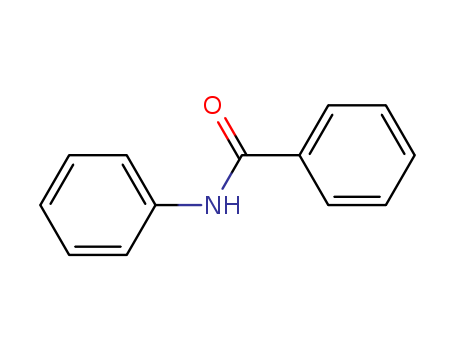
Benzanilide

Base Information
  • Chemical Name:Benzanilide
  • CAS No.:93-98-1
  • Deprecated CAS:100747-15-7
  • Molecular Formula:C13H11NO
  • Molecular Weight:197.236
  • Hs Code.:29242990
  • European Community (EC) Number:202-292-7
  • NSC Number:3131
  • UNII:AK1B12366O
  • DSSTox Substance ID:DTXSID9059096
  • Nikkaji Number:J95.755K
  • Wikipedia:Benzanilide
  • Wikidata:Q421501
  • ChEMBL ID:CHEMBL115523
  • Mol file:93-98-1.mol
Benzanilide

Synonyms:benzanilide

Suppliers and Price of Benzanilide
Supply Marketing:
Business phase:
The product has achieved commercial mass production*data from LookChem market partment
Manufacturers and distributors:
  • Manufacture/Brand
  • Chemicals and raw materials
  • Packaging
  • price
  • TCI Chemical
  • Benzanilide >98.0%(GC)
  • 500g
  • $ 96.00
  • TCI Chemical
  • Benzanilide >98.0%(GC)
  • 25g
  • $ 16.00
  • SynQuest Laboratories
  • N-Phenylbenzamide
  • 250 g
  • $ 120.00
  • SynQuest Laboratories
  • N-Phenylbenzamide
  • 25 g
  • $ 24.00
  • Sigma-Aldrich
  • Benzanilide 98%
  • 100g
  • $ 30.70
  • Sigma-Aldrich
  • Benzanilide 98%
  • 5g
  • $ 20.60
  • Matrix Scientific
  • N-Phenylbenzamide 95%+
  • 5g
  • $ 323.00
  • Matrix Scientific
  • N-Phenylbenzamide 95%+
  • 2.500g
  • $ 215.00
  • Matrix Scientific
  • N-Phenylbenzamide 95%+
  • 1g
  • $ 101.00
  • Crysdot
  • N-Phenylbenzamide 95+%
  • 100g
  • $ 50.00
Total 78 raw suppliers
Chemical Property of Benzanilide
Chemical Property:
  • Appearance/Colour:greyish to yellow-green powder 
  • Vapor Pressure:0.0261mmHg at 25°C 
  • Melting Point:161-163 °C(lit.) 
  • Refractive Index:1.642 
  • Boiling Point:247.165 °C at 760 mmHg 
  • PKA:13.52±0.70(Predicted) 
  • Flash Point:141.223 °C 
  • PSA:29.10000 
  • Density:1.172 g/cm3 
  • LogP:3.01190 
  • Storage Temp.:Store below +30°C. 
  • Solubility.:H2O: insoluble 
  • Water Solubility.:Insoluble 
  • XLogP3:2.6
  • Hydrogen Bond Donor Count:1
  • Hydrogen Bond Acceptor Count:1
  • Rotatable Bond Count:2
  • Exact Mass:197.084063974
  • Heavy Atom Count:15
  • Complexity:203
Purity/Quality:

99% *data from raw suppliers

Benzanilide >98.0%(GC) *data from reagent suppliers

Safty Information:
  • Pictogram(s): HarmfulXn 
  • Hazard Codes:Xn 
  • Statements: 20/21/22-36/37/38 
  • Safety Statements: 22-24/25-36-26 
MSDS Files:

SDS file from LookChem

Useful:
  • Chemical Classes:Nitrogen Compounds -> Other Aromatics (Nitrogen)
  • Canonical SMILES:C1=CC=C(C=C1)C(=O)NC2=CC=CC=C2
  • Uses manufacture of dyes and perfumes. Benzanilide is used to make dyes, active pharmaceutical ingredients and perfumes. It is also used to study the influence of beta-cyclodextrin on photorearrangement of acetanilide, benzanilide and ethyl phenyl carbonate. Further, it is used as an amide model compound to study the reaction between the amide and epoxy. In addition to this, it reacts with aryltriflates in the presence of palladium-based catalyst system to get N-(2,6-diarylbenzoyl)anilines.
Technology Process of Benzanilide

There total 1257 articles about Benzanilide which guide to synthetic route it. The literature collected by LookChem mainly comes from the sharing of users and the free literature resources found by Internet computing technology. We keep the original model of the professional version of literature to make it easier and faster for users to retrieve and use. At the same time, we analyze and calculate the most feasible synthesis route with the highest yield for your reference as below:

synthetic route:
Guidance literature:
aniline; With n-butyllithium; In tetrahydrofuran; hexane; at -78 - 20 ℃; Inert atmosphere;
benzaldehyde; With yttrium(III) chloride; In toluene; at 20 ℃; for 48h; Inert atmosphere;
With hydrogenchloride; In water; toluene; at 20 ℃; Inert atmosphere;
DOI:10.1016/j.tet.2009.09.101
Guidance literature:
With 1,10-Phenanthroline; copper(II) chloride dihydrate; oxygen; In acetonitrile; for 36h; under 760.051 Torr; Reagent/catalyst; Solvent; Temperature; Reflux;
DOI:10.1021/acs.joc.5b01670
Guidance literature:
tris(bis(trimethylsilyl)amido)lanthanum(III); In benzene-d6; at 25 ℃; for 24h;
DOI:10.1021/ol702788j
Refernces

Metalloporphyrin Core Size Resonance Raman Marker Bands Revisited: Implications for the Interpretation of Hemoglobin Photoproduct Raman Frequencies

10.1021/ja00247a009

The study explores the resonance Raman spectra of various metalloporphyrin derivatives, focusing on the correlation between core size and high-frequency skeletal mode frequencies. It was found that these correlations, which inversely relate core size to mode frequency, apply to Mn, Co, Zn, Fe, and Ni species, with slight revisions to previously determined coefficients. Deviations were noted for certain complexes, particularly low-valent five-coordinate adducts, which may be due to electronic effects such as porphyrin doming. The study also observed a core-size dependence for the "oxidation-state marker" v4, with low-valent Fe, Mn, and Co species showing negative deviations. Additionally, the research confirmed the core-size correlations for planar high-spin Fe" species and extended the analysis to metallo TPP's, noting differences in slopes and intercepts due to altered normal mode compositions. An unusual enhancement of anomalously polarized modes in ClMn"'TPP upon Soret band excitation was also reported, suggesting a mixing of charge transfer and T-T* transitions. The findings have implications for understanding the structural basis of heme proteins and their photoproducts.

N-(tert-butyldimethylsilyl)imidazole and related heterocycles: 13C nuclear magnetic resonance study and reaction with dimethylsulfoxide

10.1139/v80-010

The study investigates the preparation, characterization, and reactions of N-tert-butyldimethylsilyl derivatives of various heterocyclic compounds, including imidazole, 2-methylimidazole, 4-methylimidazole, benzimidazole, pyrazole, 1,2,4-triazole, and benzotriazole. These derivatives were synthesized using tert-butyldimethylsilyl chloride and the corresponding heterocyclic compounds. The products were identified and characterized using carbon and proton nuclear magnetic resonance (NMR), mass spectrometry, and elemental analysis. The study confirmed the absence of intermolecular silyl exchange at ambient temperature through carbon NMR spectra, but noted that such exchange occurred at elevated temperatures (130-160°C). The study also explored the reaction of these silyl derivatives with dimethylsulfoxide (DMSO), resulting in the formation of N-(methylthio)methyl derivatives of the heterocycles. The mechanism for this reaction involves a Pummerer rearrangement, and the products were characterized using various analytical techniques, providing insights into the stability and reactivity of these compounds under different conditions.


Post a RFQ

Enter 15 to 2000 letters.Word count: 0 letters

Attach files(File Format: Jpeg, Jpg, Gif, Png, PDF, PPT, Zip, Rar,Word or Excel Maximum File Size: 3MB)

1 Customer Service

What can I do for you?
Get Best Price

Get Best Price for 93-98-1