Welcome to LookChem.com Sign In|Join Free
  • or

Encyclopedia

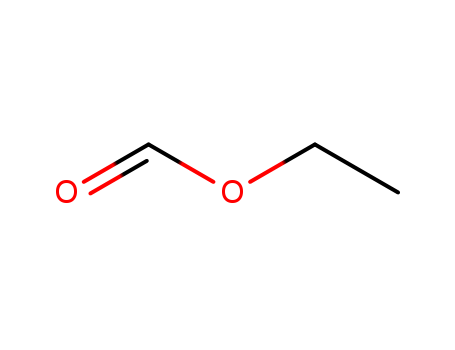
Ethyl formate

Base Information
  • Chemical Name:Ethyl formate
  • CAS No.:109-94-4
  • Molecular Formula:C3H6O2
  • Molecular Weight:74.0794
  • Hs Code.:29151300
  • European Community (EC) Number:203-721-0
  • ICSC Number:0623
  • NSC Number:406578,8828
  • UN Number:1190
  • UNII:0K3E2L5553
  • DSSTox Substance ID:DTXSID6040117
  • Nikkaji Number:J1.971B
  • Wikipedia:Ethyl formate
  • Wikidata:Q422777
  • Metabolomics Workbench ID:44766
  • ChEMBL ID:CHEMBL44215
  • Mol file:109-94-4.mol
Ethyl formate

Synonyms:ethyl formate

Suppliers and Price of Ethyl formate
Supply Marketing:
Business phase:
The product has achieved commercial mass production*data from LookChem market partment
Manufacturers and distributors:
  • Manufacture/Brand
  • Chemicals and raw materials
  • Packaging
  • price
  • TRC
  • Ethyl formate
  • 250g
  • $ 180.00
  • TRC
  • Ethyl formate
  • 1g
  • $ 45.00
  • TCI Chemical
  • Ethyl Formate >98.0%(GC)
  • 25mL
  • $ 16.00
  • TCI Chemical
  • Ethyl Formate >98.0%(GC)
  • 500mL
  • $ 36.00
  • TCI Chemical
  • Ethyl Formate [for Spectrophotometry] >98.0%(GC)
  • 100mL
  • $ 100.00
  • Sigma-Aldrich
  • Ethyl formate natural, ≥95%, FG
  • 5 kg
  • $ 2200.00
  • Sigma-Aldrich
  • Ethyl formate natural, ≥95%, FG
  • 5kg-k
  • $ 2200.00
  • Sigma-Aldrich
  • Ethyl formate natural, ≥95%, FG
  • 1 kg
  • $ 605.00
  • Sigma-Aldrich
  • Ethyl formate natural, ≥95%, FG
  • 1kg-k
  • $ 605.00
  • Sigma-Aldrich
  • Ethyl formate ≥97%, FCC, FG
  • 1kg-k
  • $ 605.00
Total 36 raw suppliers
Chemical Property of Ethyl formate
Chemical Property:
  • Appearance/Colour:colourless liquid with an aromatic odour 
  • Vapor Pressure:15.16 psi ( 55 °C) 
  • Melting Point:-80 °C(lit.) 
  • Refractive Index:n20/D 1.359(lit.)  
  • Boiling Point:54.7 °C at 760 mmHg 
  • Flash Point:7°F 
  • PSA:26.30000 
  • Density:0.906 g/cm3 
  • LogP:0.81520 
  • Storage Temp.:Flammables area 
  • Sensitive.:Moisture Sensitive 
  • Solubility.:Miscible with alcohol, benzene, and ether (Hawley, 1981) 
  • Water Solubility.:11 g/100 mL (18 ºC) 
  • XLogP3:0.5
  • Hydrogen Bond Donor Count:0
  • Hydrogen Bond Acceptor Count:2
  • Rotatable Bond Count:2
  • Exact Mass:74.036779430
  • Heavy Atom Count:5
  • Complexity:26.1
  • Transport DOT Label:Flammable Liquid
Purity/Quality:

99% *data from raw suppliers

Ethyl formate *data from reagent suppliers

Safty Information:
  • Pictogram(s): FlammableF,HarmfulXn 
  • Hazard Codes:F,Xn 
  • Statements: 11-20/22-36/37 
  • Safety Statements: 9-16-24-26-33 
MSDS Files:

SDS file from LookChem

Total 1 MSDS from other Authors

Useful:
  • Chemical Classes:Solvents -> Esters (
  • Canonical SMILES:CCOC=O
  • Inhalation Risk:A harmful contamination of the air can be reached rather quickly on evaporation of this substance at 20 °C.
  • Effects of Short Term Exposure:The substance is irritating to the eyes and respiratory tract. The substance may cause effects on the central nervous system. Exposure far above the OEL could cause lowering of consciousness.
  • Effects of Long Term Exposure:The substance defats the skin, which may cause dryness or cracking.
  • Description Ethyl formate is an ester formed when ethanol (an alcohol) reacts with formic acid (a carboxylic acid). It is also known as ethyl methanoate because formic acid is also known as methanoic acid. Ethyl formate has the characteristic smell of rum and is also partially responsible for the flavor of raspberries.
  • Physical properties Colorless and transparent liquid, volatile, with a pleasant, fruity odor. Miscible with ethanol and ether, soluble in acetone. The solubility in water is 11.8g/100ml.
  • Uses Ethyl Formate is a flavoring agent that occurs naturally in some plant oils, fruits, and juices but does not occur naturally in the ani- mal kingdom. it is used in food at a maximum level, as served, of 0.05% in baked goods; 0.04% in chewing gum, hard candy, and soft candy; 0.02% in frozen dairy desserts; 0.03% in gelatins, puddings, and fillings; and 0.01% in all other food categories.Ethyl formate is also used as a solvent for nitrocellulose; as fungicide and larvicide for tobacco, cereals, dried fruits, etc.; in organic synthesis.
Technology Process of Ethyl formate

There total 251 articles about Ethyl formate which guide to synthetic route it. The literature collected by LookChem mainly comes from the sharing of users and the free literature resources found by Internet computing technology. We keep the original model of the professional version of literature to make it easier and faster for users to retrieve and use. At the same time, we analyze and calculate the most feasible synthesis route with the highest yield for your reference as below:

synthetic route:
Guidance literature:
With chloro-trimethyl-silane; sodium bromide; for 2h; Product distribution; Heating; Me3SiBr generated in situ;
Guidance literature:
With ozone; at 24.85 ℃; for 0.416667h; under 100 Torr; Kinetics;
DOI:10.1039/b108364n
Guidance literature:
With ethanol; sodium hydroxide; at 82 - 96 ℃; for 4.5h; Reflux; elimination of ethyl formate;
Refernces

Facile preparation of aromatic esters from aromatic bromides with ethyl formate or DMF and molecular iodine via aryllithium

10.1016/j.tet.2012.04.016

The research focuses on the development of an efficient and environmentally friendly method for the preparation of aromatic esters from aromatic bromides and aromatics, which are important building blocks in the pharmaceutical and agrochemical industries. The study presents a novel one-pot conversion method that does not require transition metals or carbon monoxide, addressing the drawbacks of previous methods that involved expensive catalysts, toxic gases, and complex operational procedures. The process involves the treatment of aromatic bromides with n-BuLi, followed by reaction with either ethyl formate or DMF, and finally with molecular iodine in the presence of K2CO3 and an alcohol. The researchers found that this method could effectively convert various aromatic bromides into aromatic ethyl and methyl esters in good yields. The chemicals used in this process include aromatic bromides, n-BuLi, ethyl formate, DMF, molecular iodine, and K2CO3, along with different alcohols such as ethanol and methanol. The conclusions of the research emphasize the effectiveness of the new method in providing a transition-metal-free, carbon-monoxide-free route for the synthesis of aromatic esters.

Stereoselective synthesis of azepines through the conjugate addition of formamides to nitroalkenes and subsequent intramolecular nitrile oxide cycloaddition reaction

10.1016/j.tet.2008.09.070

The research aims to develop a concise and stereoselective method for synthesizing azepines, which are important heterocyclic compounds. The study employs the conjugate addition of formamides to nitroalkenes, followed by an intramolecular nitrile oxide cycloaddition (INOC) reaction to achieve this goal. Key chemicals used include formamides, nitroalkenes, tBuOK (potassium tert-butoxide), phenyl isocyanate, and ethyl formate. The researchers observed high cis-selectivity in the formation of azepines and successfully developed a one-pot procedure for the synthesis, achieving moderate yields. The formyl group in the synthesized compounds could be readily removed under acidic conditions without significant epimerization, yielding N–H azepines. The study concludes that this method provides a useful and stereoselective route for preparing azepines from readily available starting materials, with potential applications in the synthesis of aza-heterocyclic compounds.


Post a RFQ

Enter 15 to 2000 letters.Word count: 0 letters

Attach files(File Format: Jpeg, Jpg, Gif, Png, PDF, PPT, Zip, Rar,Word or Excel Maximum File Size: 3MB)

1 Customer Service

What can I do for you?
Get Best Price

Get Best Price for 109-94-4
  • ©2008 LookChem.com,License:ICP NO.:Zhejiang16009103 complaints:service@lookchem.com
  • [Hangzhou]86-0571-87562588,87562578,87562573 Our Legal adviser: Lawyer