nanoparticles having a quantum size region.{ The size control of
EuS by using thiourea should open the gates for the creation
of new opto-magnetic devices such as wavelength-adjustable
optical-isolators.
We would like to express our grateful acknowledgement to Prof.
Hirotaro Mori and Dr Takao Sakata, Research Center for Ultra-
High Voltage Electron Microscopy, Osaka University for the
TEM measurements. We would also like to express our grateful
acknowledgement to Prof. Kazuyuki Hirao and Prof. Koji Fujita,
Department of Material Chemistry, Graduate school of
Engineering, Kyoto University for the Faraday measurements.
This research was partly supported by NEDO, and a Grant-in Aid
for Scientific Research No. 17042015 from the ministry of
Education, Science, Sports and Culture. This work was also
supported by a Grant-in-Aid for Scientific Research on Priority
Areas (417, No. 17029038) from the Ministry of Education,
Culture, Sports, Science and Technology (MEXT) of the Japanese
Government and NEDO (New Energy Industrial Technology
Development Organization). This work was supported partly by a
Grant-in-Aid for Scientific Research (No. 15750155) and a Grant-
in-Aid for Scientific Research on Priority Area A of ‘‘Panoscopic
Assembling and High Ordered Functions for Rare Earth
Materials’’ from the Ministry of Education, Culture, Sports,
Science, and Technology, Japan.
Fig. 5 (a) Absorption spectrum (up) and Faraday rotation spectrum
(down) of EuS nanoparticles (size: 14 nm). (b) The particle-size
dependence of the peak top wavelength on Faraday rotation.
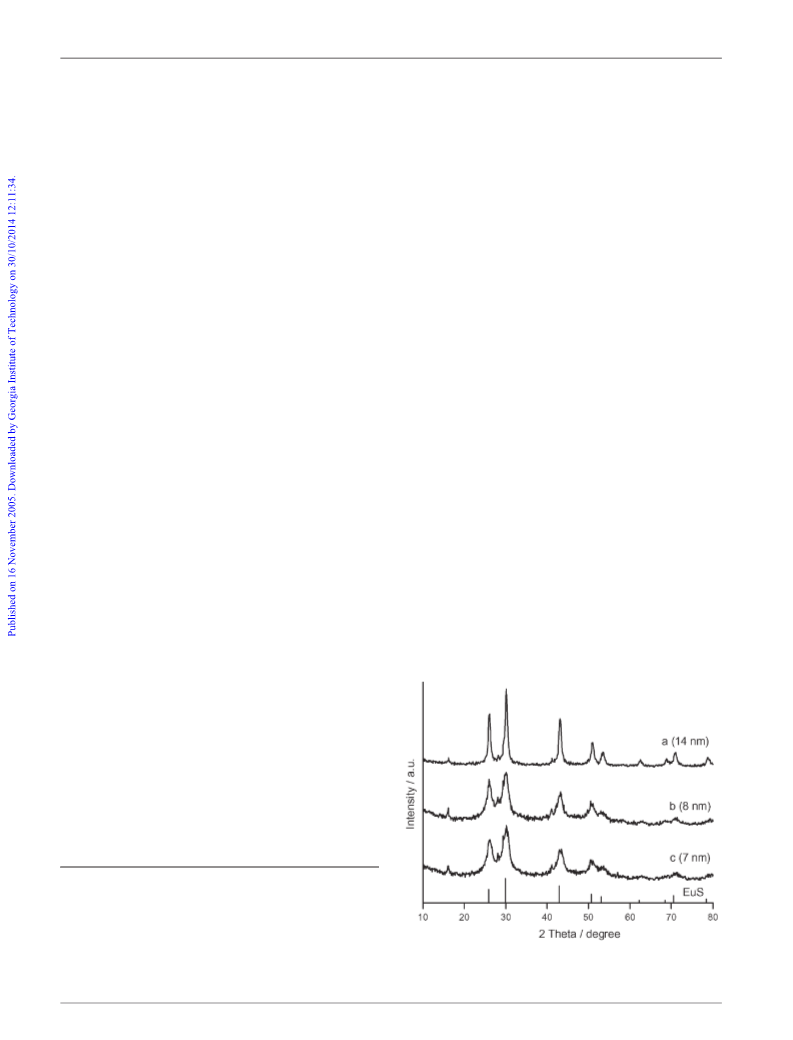
of a (14 nm), b (8 nm), and c (7 nm) were found to be 515, 520,
and 540 nm, respectively. The blue shift of the absorption bands
accompanied by the decrease of the particle size should be due to
the quantum size effect. This is the first observation of the
quantum size effect on the energy gap of EuS induced by the size
control. With these photophysical findings, we carried out Faraday
effect measurements of the EuS nanoparticles.{ Polymeric thin
films containing dispersed EuS nanoparticles were prepared for the
Faraday measurements according to the procedure described in
the literature.4 The UV-Vis absorption (Abs.) spectrum and the
Faraday rotation (FR) spectrum of the EuS sample (size = 14 nm)
are shown in Fig. 5(a). The peak of the Faraday rotation spectrum
of the EuS sample appeared at a little higher wavelength than that
of the absorption peak. The Verdet constants (V) of the EuS
samples calculated from the Faraday rotation angles4 were
calculated to be 1.4 6 1023 deg. cm21 Oe21 (a), 6.3 6 1024 (b),
and 1.6 6 1023 (c) respectively. V values of EuS nanoparticles
already reported in the literature4 were 8.9 6 1023 deg. cm21 Oe21
(the EuS size = 23 nm), 2.361023 (the EuS size = 28 nm), and
4.261023 (the EuS size = 31 nm). These values were of the same
order as those of the EuS nanoparticles prepared in the present
work. The particle-size dependence of the Faraday rotation peak
wavelength is also shown in Fig. 5(b). In order to compare the
wavelength values of the FR peak of the EuS nanoparticles
prepared in this work with that of large EuS particles, the FR peak
wavelength of the EuS nanoparticles (35 nm in diameter) was
added in Fig. 5(b). The particles were prepared by reaction of
europium metal and H2S according to the literature.5 The size was
determined by the Sherrer equation as well as the case of EuS
nanoparticles prepared in this work. The EuS sample of smaller
particle size showed a blue shift in the Faraday rotation because of
the increased energy gap. This physical relation between the
particle size and the peak wavelength of the Faraday rotation
should be understood from the quantum size effect. We have
successfully manipulated the peak wavelength of the Faraday
rotation by using size-controlled EuS nanoparticles.
Notes and references
{ Transmission Electron Microscopy (TEM) images were obtained with a
Hitachi H-9000 TEM equipment operating at 300 kV. The samples for
TEM measurements were prepared by dropping a dilute dispersion of EuS
sample in ethanol on a copper grid and drying at room temperature. FT-IR
measurements were performed at room temperature on a Perkin-Elmer
system 2000 FT-IR spectrometer. KBr pellets, which were used as a
measurement sample, were prepared by compressing a mixture of EuS
powder (2 mg) and KBr matrix (0.2 g). UV-Vis absorption spectra were
measured on a Hitachi U-3300 spectrophotometer at room temperature.
The measurement samples were the same as those for FT-IR measure-
ments. Faraday effect measurements were carried out using a measurement
system for Faraday and Kerr effects (JASCO, Model K-250). The external
magnetic field was fixed at 1.5 T. EuS nanoparticles-doped PMMA films
were prepared as below. EuS nanoparticles (0.06 g) were added to a
2-propanone solution of PMMA (1.5 g, 10 wt%) and dispersed under
ultrasonic treatment, to give a colloidal suspension. The glass substrate was
covered on two parallel edges with adhesive tape to control the thickness of
the film. The colloidal suspension was applied to one of the free edges of
the glass and distributed with a glass roll sliding over the tape-covered edges
to give PMMA films containing EuS.
{ Whereas EuS single crystal and Eu2+ doped glass have been reported,
control of the Faraday spectrum has never reported.
1 P. Wachter, Handbook on the Physics and Chemistry of Rare Earths, 2nd
Edn, North-Holland Publishing Company, 1979, pp. 189.
2 T. Kasuya and A. Yanase, Rev. Mod. Phys., 1968, 40, 684.
3 J. C. Suits, B. E. Argyle and M. J. Freiser, J. Appl. Phys., 1966, 37, 1391.
4 S. Thongchant, Y. Hasegawa, K. Tanaka, K. Fujita, K. Hirao, Y. Wada
and S. Yanagida, Jpn. J. Appl. Phys., 2003, 42, L876.
5 S. Thongchant, Y. Hasegawa, Y. Wada and S. Yanagida, J. Phys.
Chem. B, 2003, 107, 2193.
6 T. Mirkovic, M. A. Hines, P. S. Nair and G. D. Scholes, Chem. Mater.,
2005, 17, 3451.
7 Y. Hasegawa, M. Afzaal, P. O’Brien, Y. Wada and S. Yanagida, Chem.
Commun., 2005, 242.
8 N. Revaprasadu, M. A. Malik, P. O’Brien and G. Wakefield, Chem.
Commun., 1999, 1573.
9 P. C. Rieke and S. B. Bentjen, Chem. Mater., 1993, 5, 43.
10 S. Kim, B. Fisher, H. Eisler and M. Bawendi, J. Am. Chem. Soc., 2003,
125, 11466; A. P. Alivisatos, Science, 1996, 271, 933; A. Henglein, Chem.
Rev., 1989, 89, 1861.
In conclusion, the particle size of EuS has been successfully
controlled by using thiourea, resulting in the control of the
Faraday spectra. To the best of our knowledge, this is the first
report on manipulation of the Faraday spectra for EuS
6040 | Chem. Commun., 2005, 6038–6040
This journal is ß The Royal Society of Chemistry 2005

 Kataoka, Tomoharu