J. Chem. Phys., Vol. 115, No. 17, 1 November 2001
Electronic structure of chromium oxides
7943
TABLE IV. Fragmentation energies (De in eV͒ of CrOn and CrOϪn , com-
puted according to Eq. ͑4͒.
sored by Department of Energy’s Office of Biological and
Environmental Research and located at Pacific Northwest
National Laboratory, which is operated for the U.S. Depart-
ment of Energy by Battelle.
CrOn
CrOϪn
Channel
Channel
De
De
CrO→CrϩO
4.94a
CrOϪ→CrOϩe
→CrϩOϪ1
1.17
4.78
2.22
6.11
6.22
3.35
6.44
7.66
4.56
4.15
4.76
4.41
1.55
3.22
1 H. H. Kung, Transition Metal Oxides: Surface Chemistry and Catalysis
͑Elsevier, New York, 1989͒.
CrOϪ2 →CrO2ϩe
→CrOϪϩO
2 P. C. Thune, R. Linke, W. J. H. van Gennip, A. M. de Jong, and J. W.
Niemantsverdriet, J. Phys. Chem. B 105, 3073 ͑2001͒.
3 H. Brandle, D. Weller, S. S. Parkin et al., Phys. Rev. B 46, 13889 ͑1992͒.
4 M. A. Korotin, V. I. Anisimov, D. I. Khomskii, and G. A. Sawatzky, Phys.
Rev. Lett. 80, 4305 ͑1998͒.
CrO2→CrϩO2
→CrOϩO
5.11
5.98b
→CrϩOϪ2
CrOϪ3 →CrO3ϩe
→CrOϪ2 ϩO
CrO3→CrOϩO2
→CrO2ϩO
5.48
5.31
5 C. W. Walter, C. F. Hertzeler, P. Devynck, G. P. Smith, and J. R. Peterson,
J. Chem. Phys. 95, 824 ͑1991͒.
→CrOϪϩO2
CrOϪ4 →CrO4ϩe
→CrOϪ3 ϩO
CrO4→CrO2ϩO2
→CrO3ϩO
2.42
2.94
6 E. B. Rudnyi, O. M. Vovk, and E. A. Kaibicheva, J. Chem. Thermodyn.
21, 247 ͑1989͒.
→CrOϪ2 ϩO2
CrOϪ5 →CrO5ϩe
→CrOϪ3 ϩO2
→CrOϪ4 ϩO
7 H. Wu, S. R. Desai, and L. S. Wang, J. Chem. Phys. 103, 4363 ͑1995͒.
8 H. Wu, S. R. Desai, and L. S. Wang, J. Am. Chem. Soc. 118, 5296 ͑1996͒.
9 H. Wu, S. R. Desai, and L. S. Wang, J. Phys. Chem. 101, 2103 ͑1997͒.
10 H. Wu and L. S. Wang, J. Chem. Phys. 107, 16 ͑1997͒.
11 L. S. Wang, H. Wu, and S. R. Desai, Phys. Rev. Lett. 76, 4853 ͑1996͒.
12 L. S. Wang, H. Wu, S. R. Desai, J. Fan, and S. D. Colson, J. Phys. Chem.
100, 8697 ͑1996͒.
CrO5→CrO3ϩO2
→CrO4ϩO
0.49
3.37
aExperimental D0 value is 4.78Ϯ0.09, see Ref. 51.
bExperimental D0 value is 5.47ϩϪ00..635 , see Ref. 52.
13 L. S. Wang, Photodetachment Photoelectron Spectroscopy of Transition
Metal Oxide Species, in Advanced Series in Physical Chemistry, Photo-
ionization and Photodetachment, Vol. 10, edited by C. Y. Ng ͑World Sci-
entific, Singapore, 2000͒, p. 854.
ment with our computational results. Since Cr has a 4s13d5
electronic configuration, it has a formal valence of six. How-
ever, the Cr–O bond is stronger in CrO2 than that in CrO3 in
contrast to the anticipation based on the notion of maximum
saturation of formal vacancies. CrO4 is stable by about 55
kcal/mol while CrO3 is stable by only 10 kcal/mol toward
evolution of molecular oxygen.
14 G. L. Gutsev, B. K. Rao, P. Jena, X. Li, and L. S. Wang, J. Chem. Phys.
113, 1473 ͑2000͒.
15 P. G. Wenthold, R. F. Gunion, and W. C. Lineberger, Chem. Phys. Lett.
258, 101 ͑1996͒.
16 P. G. Wenthold, K.-L. Jonas, and W. C. Lineberger, J. Chem. Phys. 106,
9961 ͑1997͒.
17 P. C. Engelking and W. C. Lineberger, J. Chem. Phys. 66, 5054 ͑1977͒.
18 T. Andersen, K. R. Lykke, D. M. Neumark, and W. C. Lineberger, J.
Chem. Phys. 86, 1858 ͑1987͒.
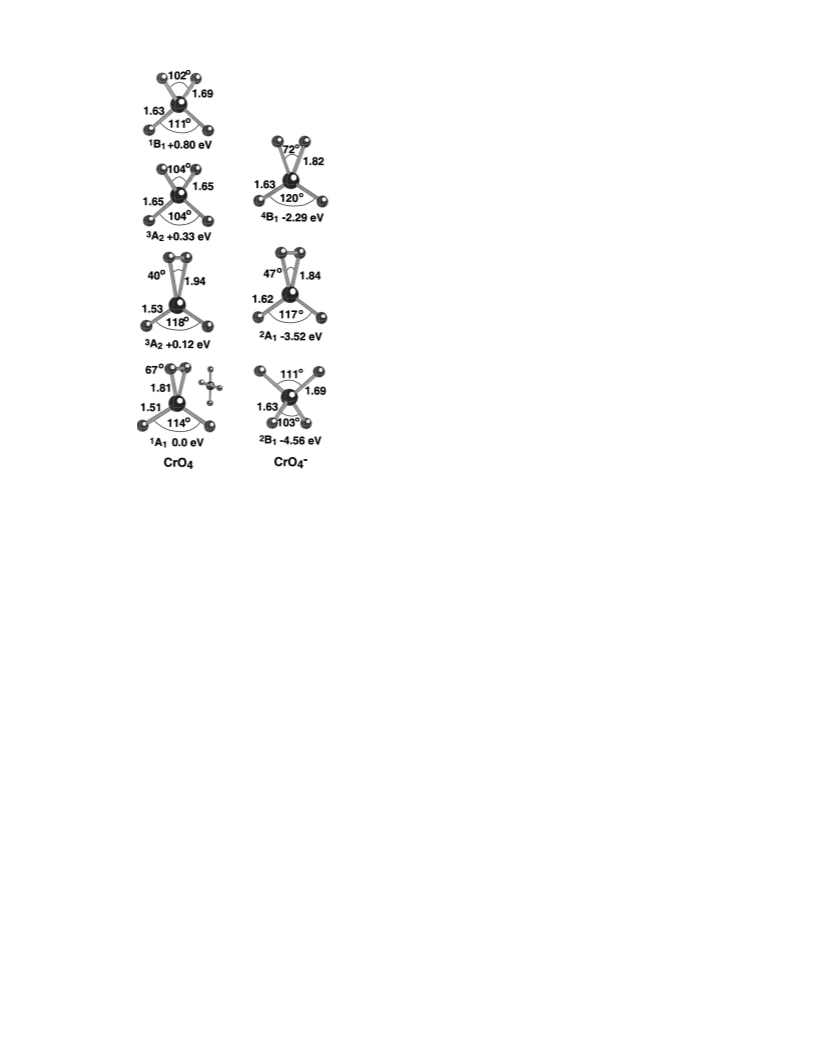
The low-energy decay channels of CrOϪn anion corre-
spond to detachment of an extra electron for nϭ1–3. CrO4Ϫ
is almost equally stable toward detachment of an extra elec-
tron or dissociation of atomic and molecular oxygen. While
CrOϪ3 is rather stable towards detachment of an extra elec-
tron and dissociation of an atomic oxygen, it is much less
stable toward evolution of molecular oxygen, as would be
expected due to the superoxo O2 bonding in CrOϪ5 .
19 R. F. Gunion, S. J. Dixon-Warren, W. C. Lineberger, and M. D. Morse, J.
Chem. Phys. 104, 1765 ͑1996͒.
20 C. W. Bauschlicher, Jr., M. Zhou, L. Andrews, J. R. T. Johnson, I. Panas,
A. Snis, and B. O. Roos, J. Phys. Chem. 103, 5463 ͑1999͒.
21 M. Rosi, C. W. Bauschlicher, Jr., G. V. Chertihin, and L. Andrews, Theor.
Chem. Acc. 99, 106 ͑1998͒.
22 G. V. Chertihin, L. Andrews, M. Rosi, and C. W. Bauschlicher, Jr., J. Phys.
Chem. 101, 9085 ͑1997͒.
23 M. B. Walsch, R. A. King, and H. F. Schaefer III, J. Chem. Phys. 110,
5224 ͑1999͒.
V. SUMMARY
24 S. F. Vyboishchikov and J. Sauer, J. Phys. Chem. A 104, 10913 ͑2000͒.
25 G. L. Gutsev, B. K. Rao, P. Jena, X. B. Wang, and L. S. Wang, Chem.
Phys. Lett. 312, 598 ͑1999͒.
We report a comprehensive theoretical and experimental
investigation of CrOϪn (nϭ1–5) and their corresponding
neutral species. Photodetachment photoelectron spectra were
obtained for the anions produced from a laser vaporization
cluster source at various photon energies. Calculated adia-
batic and vertical binding energies of CrOϪn are in good
agreement with the experimental values. We show that theo-
retical calculations are very helpful in interpretations of the
photoelectron spectra of the anions, in understanding the
electronic and geometrical structures of their ground and ex-
cited states, and chemical bonding for both the anions and
the neutral species.
26 G. L. Gutsev, B. K. Rao, and P. Jena, J. Phys. Chem. A 103, 10819 ͑1999͒.
27 G. L. Gutsev, S. N. Khanna, B. K. Rao, and P. Jena, Phys. Rev. A 59, 3681
͑1999͒.
28 G. L. Gutsev, S. N. Khanna, B. K. Rao, and P. Jena, J. Phys. Chem. 103,
5812 ͑1999͒.
29 G. L. Gutsev, B. K. Rao, and P. Jena, J. Phys. Chem. A 104, 5374 ͑2000͒.
30 G. L. Gutsev, B. K. Rao, and P. Jena, J. Phys. Chem. A 104, 11961 ͑2000͒.
31 A. D. Becke, Phys. Rev. A 38, 3098 ͑1988͒.
32 J. P. Perdew and Y. Wang, Phys. Rev. B 45, 13244 ͑1991͒.
33 C. Lee, W. Yang, and R. G. Parr, Phys. Rev. B 37, 785 ͑1988͒.
34 A. D. Becke, J. Chem. Phys. 98, 5648 ͑1993͒.
35 L. S. Wang, H. S. Cheng, and J. Fan, J. Chem. Phys. 102, 9480 ͑1995͒.
36 L. S. Wang and H. Wu, in Advances in Metal and Semiconductor Clusters.
IV. Cluster Materials, edited by M. A. Duncan ͑JAI, Greenwich, CT,
1998͒, p. 299.
37 M. J. Frisch, G. W. Trucks, H. P. Schlegel et al., GAUSSIAN 94, Revision
B.1, Pittsburgh, PA.
ACKNOWLEDGMENTS
38 A. J. H. Wachters, J. Chem. Phys. 52, 1033 ͑1970͒.
39 P. J. Hay, J. Chem. Phys. 66, 4377 ͑1977͒.
This work was supported in part by a grant to Virginia
Commonwealth University by the Department of Energy
͑Grant No. DE-FG02-96ER45579͒. The experimental work
was supported by NSF ͑L.S.W.͒ under grant CHE-9817811
and performed at the W. R. Wiley Environmental Molecular
Sciences Laboratory, a national scientific user facility spon-
40 W. Kohn and L. J. Sham, Phys. Rev. A 140, 1133 ͑1965͒.
41 O. Gunnarsson and B. I. Lundqvist, J. Chem. Phys. 13, 4274 ͑1976͒.
42 E. K. U. Gross, L. N. Oliveira, and W. Kohn, Phys. Rev. A 37, 2809
͑1988͒.
43 A. Gorling, S. B. Trickey, P. Gisdakis, and N. Rosh, Topics in Organome-
129.127.200.132 On: Wed, 10 Dec 2014 12:24:19

 Gutsev