1
036
Communications of the American Ceramic Society
Vol. 91, No. 3
Fig. 4. Tentative mechanism.
2
B. Xia, L. Duan, and Y. Xie, ‘‘ZrO
2
Nanopowders Prepared by Low-
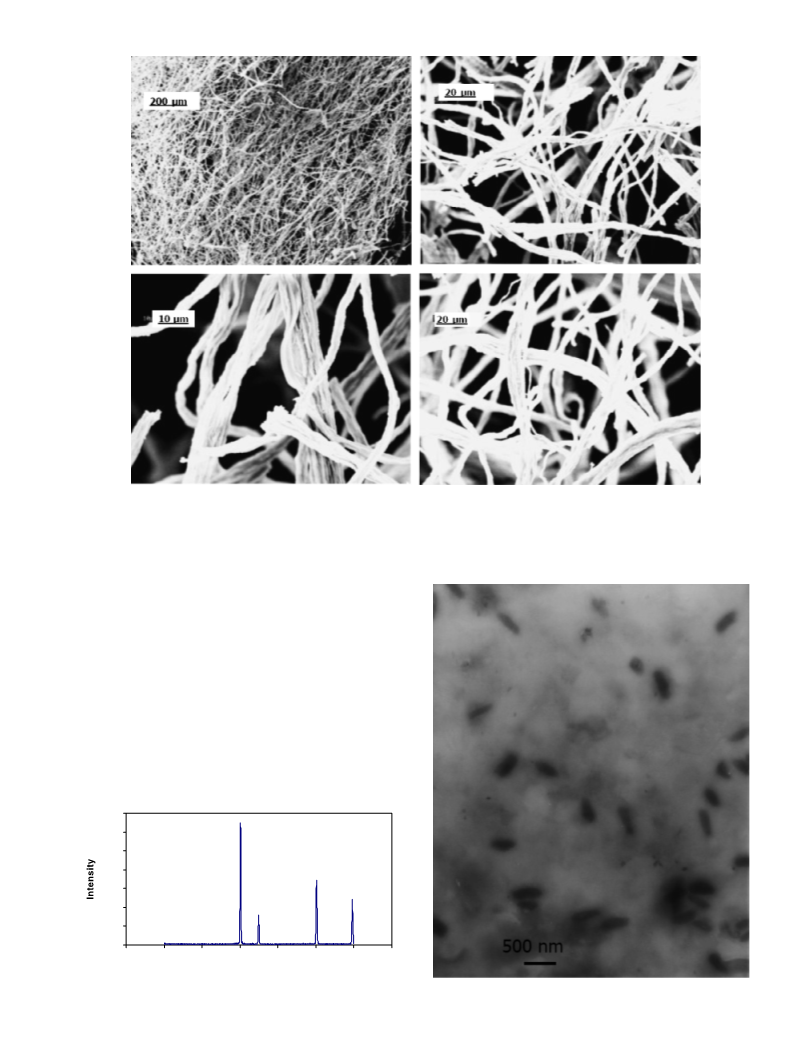
crystals was determined from X-ray line broadening studies.
˚
Temperature Vapor-Phase Hydrolysis,’’ J. Am. Ceram. Soc., 83 [5] 1077–80
2000).
Using Scherrer’s formula and with l 5 1.54 A, the crystallite
(
size, t is estimated to be around 30–35 nm. Figure 2 shows a
room temperature XRD plot of the heat-treated YSZ fibers.
The finer details of the fibers and their morphology into
polymer matrix were investigated using a Philips TEM. The
bright field electron micrograph of YSZ–epoxy composites is
shown in Fig. 3. It consists of small submicrometer fibers about
3
A. Benedetti, G. Fagherazzi, and P. Francesco, ‘‘Preparation and Structural
Characterization of Ultrafine Zirconia Powders,’’ J. Am. Ceram. Soc., 72 [3] 467–9
1989).
(
4
J. C. Ray, R. K. Pati, and P. Pramanik, ‘‘Chemical Synthesis of Nanocrystal-
line Zirconia by a Novel Polymer Matrix-Based Precursor Solution Method Using
Triethanolamine,’’ Mater. Lett., 48 [2] 74–80 (2001).
R. C. Garvie, R. H. Hannink, and R. T. Pascoe, ‘‘Ceramic Steel?,’’ Nature, 258,
5
7
03–4 (1975).
S. K. Saha and P. Pramanik, ‘‘Innovative Chemical Method for Preparation
300–500-nm long and around 100-nm wide uniformly distribut-
ed throughout the epoxy matrix.
6
Of Calcia Stabilized Zirconia Powders,’’ Br. Ceram. Trans., 94 [3] 123–7
1995).
Jute swells until the cell wall is saturated with water. Jute cell
wall polymers contain hydroxyl and other oxygen-containing
(
7
F. del Monte, W. Larsen, and J. D. Mackenzie, ‘‘Stabilization of Tetragonal
ZrO2 in ZrO2-SiO2 Binary Oxides,’’ J. Am. Ceram. Soc., 83 [3] 628–34
2000).
1
7
groups that attract water through hydrogen bonding. In our
case, we have used aqueous metal nitrate, PVA solution that can
easily interact with the jute cell wall either by hydrogen bonding
(
8
J. D. Lin and J. G. Duh, ‘‘Crystallite Size and Microstrain of Thermally Aged
Low-Ceria- and Low-Yttria-Doped Zirconia,’’ J. Am. Ceram. Soc., 81 [4] 853–60
(1998).
(
water and PVA) or by complex formation (zirconium, yttrium
9
Y.-H. Lee, C.-W. Kuo, and I-M Hung, ‘‘The Thermal Behavior of 8 mol%
Yttria-Stabilized Zirconia Nanocrystallites Prepared by a Sol–Gel Process,’’
ion). Treatment of ammonia slowly hydrolyzes Y and Zr ions
and precipitates yttrium zircoium hydroxide on the jute cells.
PVA not only reduces hydrolysis process but also acts as a
binder to stick zirconium hydroxide within the cell region. Heat
treatment of jute grows nanocrystalline YSZ from individual
cells and maintains the fiber’s structure. Figure 4 shows a ten-
tative mechanism for fiber formation.
J. Non-Cryst. Solids, 351 [49–51] 3709–15 (2005).
J. C. Ray, R. K. Pati, and P. Pramanik, ‘‘Chemical Synthesis and Structural
10
Characterization of Nanocrystalline Powders of Pure Zirconia and Yttria Stabi-
lized Zirconia (YSZ),’’ J. Eur. Ceram. Soc., 20 [9] 1289–95 (2000).
J. C. Ray, C. R. Saha, and P. Pramanik, ‘‘Stabilized Nanoparticles of Meta-
11
31
41
stable ZrO
the Study of the Thermal and Structural Properties,’’ J. Eur. Ceram. Soc., 22 [6]
51–62 (2002).
2
with Cr /Cr Cations: Preparation from a Polymer Precursor and
8
12
J. C. Ray, A. B. Panda, C. R. Saha, and P. Pramanik, ‘‘Synthesis of Niobi-
um(V)-Stabilized Tetragonal Zirconia Nanocrystalline Powders,’’ J. Am. Ceram.
Soc., 86 [3] 514–6 (2003).
IV. Conclusion
13
J. C. Ray, A. B. Panda, and P. Pramanik, ‘‘Chemical Synthesis of Nanocrys-
tals of Tantalum Ion-Doped Tetragonal Zirconia,’’ Mater. Lett., 53 [3] 145–50
2002).
In conclusion, YSZ fibers have been prepared from the thermal
decomposition of the dried PVA–metal hydroxide-coated jute
mass. In this paper, we introduced plant fibers to produce ce-
ramic fibers for the first time. This kind of YSZ fiber is expected
to play a key role in the future development of low cost, high-
(
14
J. C. Ray, C. R. Saha, and P. Pramanik, ‘‘Chemical Synthesis of Nanocrys-
talline Tin-Doped Cubic ZrO2 Powders,’’ Mater. Lett., 57 [13–14] 2140–4
2003).
(
15
1
8,19
M. Watanabe, H. Uchida, and M. Emori, ‘‘Analyses of Self-Humidification
and Suppression of Gas Crossover in Pt-Dispersed Polymer Electrolyte Mem-
branes for Fuel Cells,’’ J. Electrochem. Soc., 145 [4] 1137–41 (1998).
performance electrolyte membranes for SOFCs.
The current
work also demonstrates the dispersion of YSZ fibers into epoxy
matrix. TEM analysis of the composite shows uniform YSZ fi-
ber dispersion into polymer matrix. The synthetic strategy pre-
sented here may be extended to other metal oxide systems of Ti,
Nb, V, Si, Mn, W, Mo, etc.
16
M. Watanabe, H. Uchida, Y. Seki, and M. Emori, ‘‘Self-Humidifying Polymer
Electrolyte Membranes for Fuel Cells,’’ J. Electrochem. Soc., 143 [12] 3847–52
1996).
(
17
S. Das, A. K. Saha, P. K. Choudhory, R. K. Basak, B. C. Mitra, T. Todd,
S. Lang, and R. M. Rowell, ‘‘Effect of Steam Pretreatment of Jute Fiber on
Dimensional Stability of Jute Composite,’’ J. Appl. Pol. Sci., 76, 1652–61
(2000).
18
T. Okubo, T. Takahashi, B. N. Nair, M. Sadakata, and H. Nagamoto, ‘‘For-
mation Mechanism of Crack-Free Porous YSZ Membrane,’’ J. Membr. Sci., 125
[2] 311–7 (1997).
References
1
M. Z.-C. Hu, R. D. Hunt, E. A. Payzant, and C. R. Hubbard, ‘‘Nanocrystal-
lization and Phase Transformation in Monodispersed Ultrafine Zirconia Particles
from Various Homogeneous Precipitation Methods,’’ J. Am. Ceram. Soc., 82 [9]
2
19
X. Xin, Z. Lu
Electrolyte Membranes by a Modified Dry-Pressing Using Nanocrystalline Pow-
ders,’’ J. Mater. Chem., 17 [16] 1627–30 (2007).
¨
, Q. Zhu, X. Huang, and W. Su, ‘‘Fabrication of Dense YSZ
313–20 (1999).
&

 Das, Rabindra N.