Technical Note
Simple Modification To Obtain High Quality Fludarabine
Siddheshwar W. Kshirsagar, Mangesh S. Deshpande, Swapnil P. Sonawane,* Golak C. Maikap,
and Mukund K. Gurjar
API R & D Centre, Emcure Pharmaceuticals Ltd, I.TBT Park, Phase-II, M.IDC Hinjewadi, Pune-411057, India
ABSTRACT: A simple and improved debenzylation process is described to obtain fludarabine in greater than 99.8% purity and
90−95% yield.
INTRODUCTION
solvent. Further, debenzylation with palladium chloride/
charcoal produces fludarabine in 81% yield; however, the use
of hydrogen gas necessitates the utilization of a pressure reactor
■
Fludarabine is the fluorinated nucleotide analog of the antiviral
1
agent vidarabine used in the treatment of chronic lymphocytic
(
autoclave), which makes the reaction tedious and unfriendly
leukemia. Fludarabine is a purine analog and can be given both
2
,3
for commercial application. In addition to the above drawbacks,
the use of methoxyethanol as solvent is not recommended
because of its toxic effect on bone marrow and testicles; high
exposure causes granulocytopenia macrocytic anemia, oligo-
orally and intravenously. Being phosphorylated, fludarabine is
ionized at physiologic pH and is effectually trapped in blood.
This provides some level of specificity for blood cells, both
cancerous and healthy. This metabolite appears to act by
inhibiting DNA polymerase α, ribonucleotide reductase, and
4
7
spermia, and others.
DNA primase, thus inhibiting DNA synthesis.
We observed that all the prior art methods lack consistency
in getting the desired quality of debenzylated product, i.e.
fludarabine, on a large scale. Moreover, being an antineoplan-
stin, these products are very expensive, and the yields reported
by various researchers may not be acceptable for a commercial
process. Thus, there was a strong need to develop a method
which produces the desired quality and quantity of fludarabine
and its phosphate salt. Therefore, to overcome these issues, the
present authors have modified the debenzylation method by
replacing the catalytic hydrogenation−debenzylation with
RESULTS AND DISCUSSION
■
During the process development of fludarabine phosphate,
significant impurities were appearing in the drug substance, and
it was extremely difficult to remove these impurities without
significant loss in yield. Upon investigation it was observed that
the quality of fludarabine phosphate is dependent on its
precursor, fludarabine. A commonly adapted commercial
3
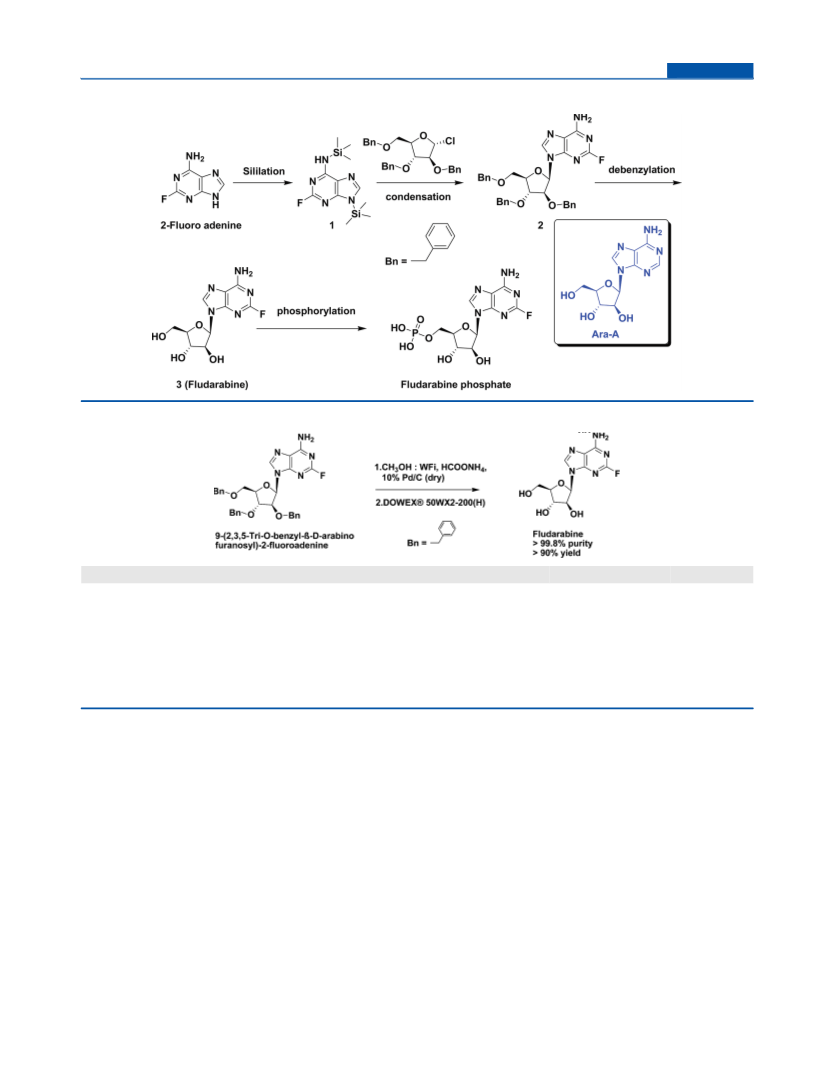
synthetic route is displayed in Scheme 1, in which several
8
researchers have attempted the debenzylation of 2 using various
cryogenic reaction conditions in less than 90% purity. The
potential impurity observed was Ara-A, which is not a part of
any pharmacopoeial specifications.
transfer hydrogenation, utilizing ammonium formate as an in
situ hydrogen donor. This process is reproducible, easily
implemented industrially, cost-effective, and environmental
friendly. With this simple modification reported in this Note,
the degradation impurities were reduced to an undetectable
level in greater than 90% yield (Table 1).
To decide which solvent system is suitable for debenzylation
so that catalyst can be easily separated from product, the
solubility of fludarabine in different solvents was carefully
studied, and we observed that it is highly soluble in a 70:30
3
Montgomery et al. disclose a debenzylation reaction by
employing palladium or palladised charcoal or sodium/liquid
ammonia, and a 34% yield was obtained. The use of catalytic
hydrogenation using hydrogen gas along with palladium/
carbon always results in defluorination and gives a mixture of
fludarabine and defluorinated fludarabine (Ara-A). Further, the
use of sodium/ammonia or catalytic hydrogenation using a
pressure reactor (autoclave) for a debenzylation reaction is
quite tedious and produces an unsatisfactory product with
respect to quality and yield.
methanol/water mixture. The choice of utilizing other
9,10
hydrogen donors such as hydrazinium monoformates
was
ruled out due to the safety concerns of hydrazine. After
studying various parameters such as dilution, ratio of methanol/
water, catalyst, and resin, the ratio of methanol/water and
dilution were found to be crucial parameters for debenzylation.
During reflux, mild sublimation of ammonium formate was
noticed at the edges of the condenser, which was easily
removed by water during reflux. The resin was used for
removing residual amines, as the last step involves reaction of
triethyl phosphate and phosphorus oxychloride; removal of the
amines also helped in improving the purity. Thus, Table 1
Debenzylation with boron trichloride in dichloromethane
5
was also disclosed by the same authors. Even though boron
trichloride produces a minimum of defluorinated product,
however, the method is limited to the laboratory scale, as the
reaction is performed at −80 °C and boron trichloride liberates
hydrochloric acid and boric acid in the presence of moisture or
alcoholic solvent and therefore requires stringent anhydrous
conditions for implementation on an industrial scale.
6
To overcome these issues, Blumbergs et al. disclosed a
process for preparation of 2,6-(2,3,5,-tri-O-benzyl-β-D-arabino-
furanosyl) purine, which is further treated with fluoroboric acid
and sodium nitrite in the presence of tetrahydrofuran as
Received: February 29, 2012
Published: April 2, 2012
©
2012 American Chemical Society
840
dx.doi.org/10.1021/op3000509 | Org. Process Res. Dev. 2012, 16, 840−842

 Kshirsagar, Siddheshwar W.