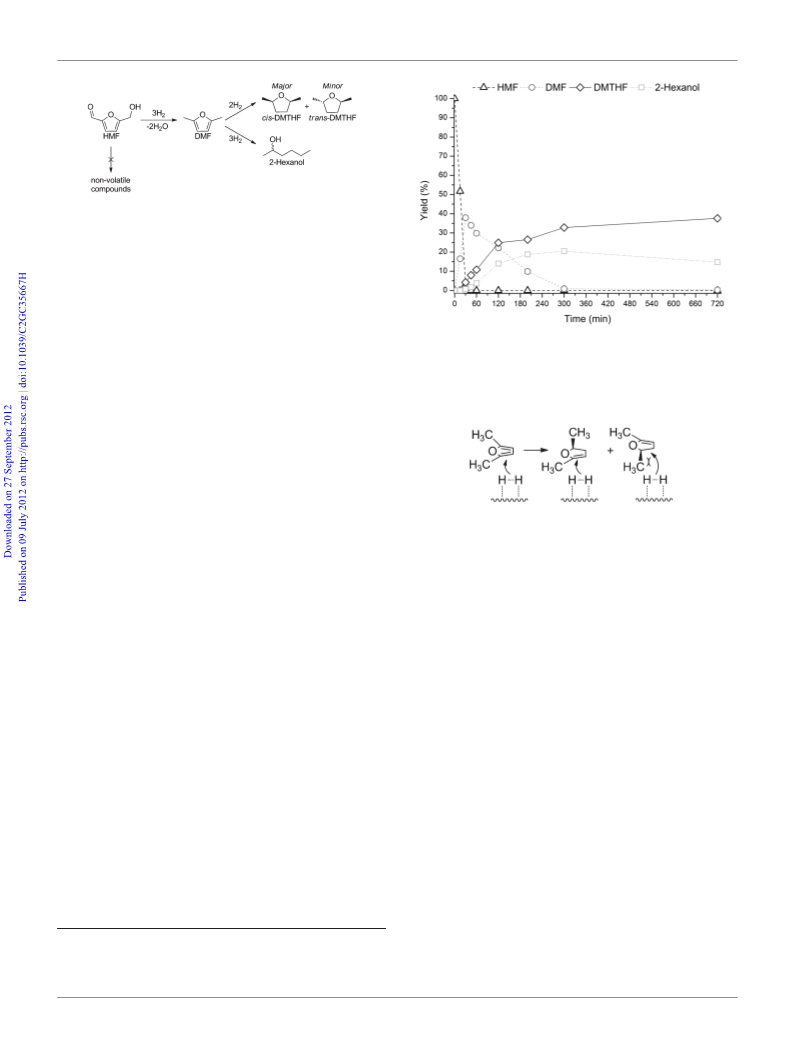
DMTHF longer reaction times might be needed for the latter
runs. In addition, our recent catalyst stability studies using
Cu–PMO in the conversion of lignocellulose and cellulose
revealed that no leaching occurs and that the catalyst is
Acknowledgements
This work was supported by the Danish National Advanced
Technology Foundation in collaboration with Novozymes A/S,
and the US Department of Agriculture.
sufficiently robust for
a variety of biomass conversion
reactions.21
Finally, we were interested in converting crude HMF syn-
thesized by dehydration of fructose as previously developed in
our laboratories.24 The reaction mixture was extracted with
MIBK (methyl-isobutyl ketone) as the only method of purifi-
cation, resulting in a brown sticky material after removal of the
solvent in vacuo. A slurry containing 0.5 g of this crude HMF
material in 3 mL MeOH was reacted for 5 h at 300 °C with
100 mg Cu–PMO. Impressively, the reaction proceeded and
resulted in DMF (12% yield) besides other volatile products
even though the conversion from fructose to HMF was not opti-
mized. Hence, with an optimized reaction process an even
higher DMF yield might be obtainable.
Notes and references
1 J. J. Bozell, Science, 2010, 329, 522–523.
2 B. Kamm, Angew. Chem., Int. Ed., 2007, 46, 5056–5058.
3 J. Q. Bond, D. A. Alonso, D. Wang, R. M. West and J. A. Dumesic,
Science, 2010, 327, 1110–1114.
4 J. J. Bozell and G. R. Petersen, Green Chem., 2010, 12, 539–554.
5 A. A. Rosatella, S. P. Simeonov, R. F. M. Fraude and C. A. M. Afonso,
Green Chem., 2011, 13, 754–793.
6 M. J. Climent, A. Corma and S. Iborra, Green Chem., 2011, 13, 520–
540.
7 A. Boisen, T. B. Christensen, W. Fu, Y. Y. Gorbanev, T. S. Hansen,
J. S. Jensen, S. K. Klitgaard, S. Pedersen, A. Riisager, T. Ståhlberg and
J. M. Woodley, Chem. Ing. Res. Des., 2009, 87, 1318–1327; T. Ståhlberg,
W. Fu, J. M. Woodley and A. Riisager, ChemSusChem, 2011, 4, 451–
458.
8 J. Ma, Z. Du, J. Xu, Q. Chu and Y. Pang, ChemSusChem, 2011, 4,
51–54.
Conclusions
9 E. Taarning, I. S. Nielsen, K. Egeblad, R. Madsen and C. H. Christensen,
ChemSusChem, 2008, 1, 75–78; S. Dutta, S. De and B. Saha, Chem-
PlusChem, 2012, 77, 259–272.
10 Y. Román-Leshkov, C. J. Barrett, Z. Y. Liu and J. A. Dumesic, Nature,
2007, 447, 982–986.
11 W. Yang and A. Sen, ChemSusChem, 2010, 3, 597–603.
12 F. M. A. Geilen, T. vom Stein, B. Engendahl, S. Winterle, M. A. Liauw,
J. Klankermayer and W. Leitner, Angew. Chem., Int. Ed., 2011, 50, 1–5.
13 F. Cavani, F. Trifiró and A. Vaccari, Catal. Today, 1991, 11, 173–301.
14 A. Dubey, S. Kannan, S. Velu and K. Suzuki, Appl. Catal., A, 2003, 238,
319–326.
15 A. Monzón, E. Romeo, C. Royo, R. Trujillano, F. M. Labajos and
V. Rives, Appl. Catal., A, 1999, 185, 53–63.
16 C. M. S. Polato, C. A. Henriques, A. C. C. Rodrigues and
J. L. F. Monteiro, Catal. Today, 2008, 133–135, 534–540.
17 M. A. Aramendía, V. Borau, C. Jiménez, J. M. Marinas, J. R. Ruiz and
F. Urbano, Appl. Catal., A, 2003, 249, 1–9.
18 J. E. Holladay, J. J. Bozell, J. F. White and D. Johnson, Top Value Added
Chemicals from Biomass. Volume II – Results of Screening for Potential
Candidates from Biorefinery Lignin, Pacific Northwest National Labora-
publications/external/technical_reports/PNNL-16983.pdf).
19 G. S. Macala, T. D. Matson, C. L. Johnson, R. L. Lewis, A. V. Iretskii
and P. C. Ford, ChemSusChem, 2009, 2, 215–217.
In this work, we have shown that a Cu-doped PMO catalyst
obtained by the calcination of a hydrotalcite-like precursor is
capable of converting HMF into valuable and interesting chemi-
cals in supercritical MeOH, thus paving a new direction toward a
renewable chemical industry. Complete conversion of HMF to
volatile compounds could be achieved in only 45 min, without
the formation of higher boiling side products. Reduction of
HMF at 300 °C for 2 h resulted in 61% total yield of three main
products: DMF, DMTHF and 2-hexanol. The reaction conditions
were tunable and offer a degree of flexibility to the process such
that either DMF or DMTHF and 2-hexanol could be obtained as
the major reaction product. At 240 °C DMF yield reached 41%
after 3 h, and at 260 °C 48%. A total yield for DMF and
DMTHF of 58% was achieved at 260 °C after 3 h. Further in-
depth studies of the catalyst structure and optimization of reac-
tion conditions are desired to improve activity, and selectivity
toward DMF and DMTHF.
Notably, both the fructose dehydration24 as well as the
catalytic HMF conversion method described in this study could
be performed utilizing inexpensive and environment-friendly
materials (boric acid and earth abundant metals). The combi-
nation of these two novel routes would enable a simple two-step
production of DMF or DMTHF and 2-hexanol directly from
fructose. The Cu–PMO catalyst system was even able to convert
a tar-like slurry containing HMF. This could ultimately eliminate
one of the major challenges in the chemical infrastructure based
on HMF, namely purification.
20 K. Barta, T. D. Matson, M. L. Fetting, S. L. Scott, A. V. Iretskii and
P. C. Ford, Green Chem., 2010, 12, 1640–1647.
21 T. D. Matson, K. Barta, A. V. Iretskii and P. C. Ford, J. Am. Chem. Soc.,
2011, 133, 14090–14097.
22 Reflection identification and assignment according to: R. Zăvoianu,
R. Ionescu, O. D. Pavel, R. Bîrjega and E. Angelescu, Appl. Clay Sci.,
2011, 52, 1–10.
23 M. L. J. Mihailović, R. I. Mamuzić, L. J. Žigić-Mamuzić, J. Bošnjak and
Ž. Čeković, Tetrahedron, 1967, 23, 215–226.
24 T. S. Hansen, J. Mielby and A. Riisager, Green Chem., 2011, 13,
109–114.
This journal is © The Royal Society of Chemistry 2012
Green Chem., 2012, 14, 2457–2461 | 2461

 Hansen, Thomas S.