2180 J. Am. Chem. Soc., Vol. 119, No. 9, 1997
Trentler et al.
semiconductor syntheses conducted in solution at low temper-
atures may now be similarly rationalized. The outcomes depend
on the success or failure of (1) molecular pathways for
elimination-condensation (possibly catalyzed) and (2) nonmo-
lecular pathways for assembling the covalent crystal lattices.
sample probe in a N
protective sleeve with an O-ring fitting. The probe was then inserted
into the microscope port through a N -filled glovebag. The analyses
were performed on a JEOL 2000 FX transmission electron microscope,
fitted with a Noran Voyager X-ray spectrometer for energy-dispersive
spectroscopic (EDS) elemental analyses.
2
-atmosphere glovebox and sealed by an air-tight
2
Formation of InP by Methanolysis of {t-Bu
1). Compound 1 (1.10 g, 1.35 mmol) was suspended in toluene (30
2
In[µ-P(SiMe
3 2 2
) ]}
Conclusion
(
Low-temperature, solution-based growth of crystalline InP
proceeds by the SLS pathway, which comprises an effective
substituent-elimination mechanism working in concert with an
effective crystallization mechanism. These are the necessary
and sufficient conditions for organometallic synthesis of crystal-
line covalent nonmolecular solids under any conditions (includ-
ing those for CVD). The key to reducing growth temperatures
is identifying novel crystal-growth pathways that function at
lower temperatures. Further developments in this area may
bring the synthesis of nonmolecular inorganic materials into the
regime of conventional, solution-phase organometallic chem-
istry.
mL), and MeOH (0.22 mL, 0.17 g, 5.4 mmol) was added at room
temperature, resulting in a clear colorless solution within 3-4 min.
Stirring was continued for 10 h whereupon the color changed to yellow
orange. The reaction mixture was then refluxed for 24 h in a heating
mantle. The color of the solution changed to dark orange within the
first 10 min at reflux, and then polycrystalline InP precipitated slowly
as a black solid. The mixture was allowed to cool, and the InP was
collected by filtration, washed with hexane (2 × 10 mL), and dried in
vacuo (yield 0.31 g, theoretical InP weight yield 0.40 g). Anal.
Found: C, 1.02; H, 0.08. EDS (atom %): calcd for InP, In, 50; P, 50;
found, In, 46; P, 49.
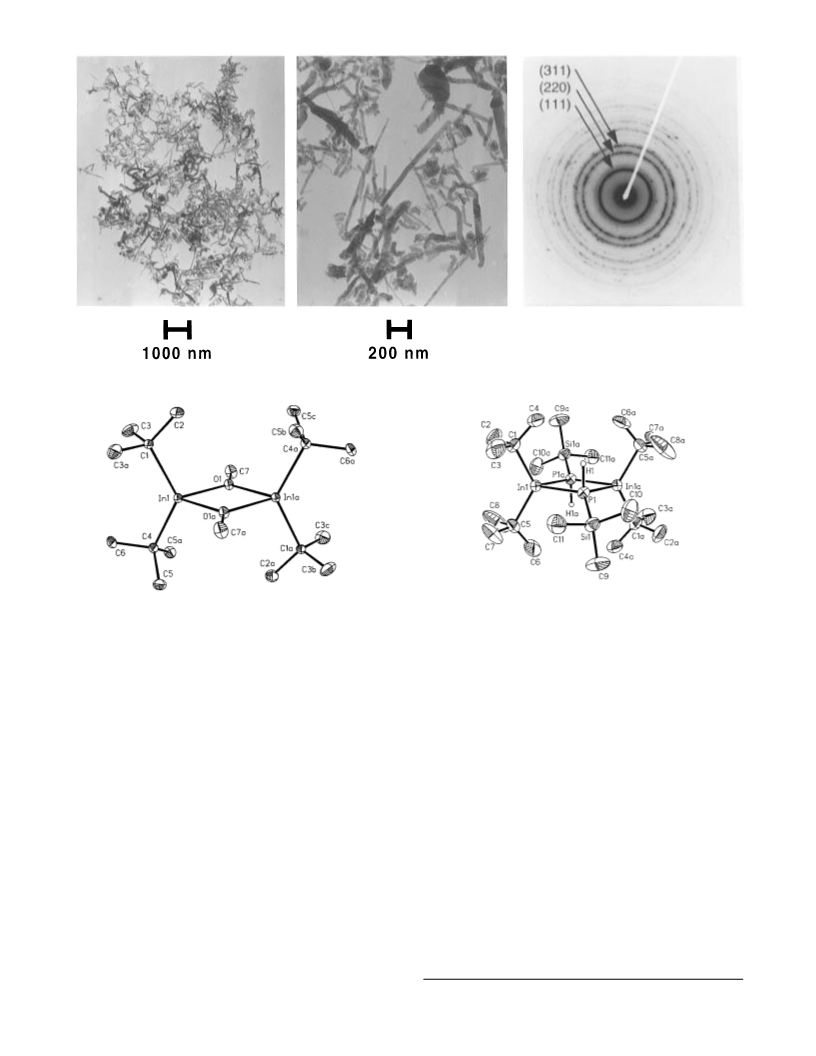
The XRD pattern of the black solid indicated an average InP
crystallite coherence length of ca. 11 nm (Figure 1a). A small amount
of indium metal was also detected. The coherence lengths of InP varied
from 9 to 16 nm and the In coherence lengths varied from 29 to 71 nm
with decreasing stirring time prior to refluxing.
Experimental Section
General Methods. All ambient-pressure procedures were carried
2 3
out under dry N using standard inert-atmosphere techniques. t-Bu -
Preparation of [t-Bu
2 2
In(µ-OMe)] (2) by Methanolysis of 1.
2
2
In,34 and (2,4,6-Me
35
In, (Me
2
EtC)
3
3
C
6
H
2
)
3
In were prepared by the
Compound 1 (0.66 g, 0.81 mmol) was suspended in hexane (5 mL).
MeOH (66 µL, 0.052 g, 1.62 mmol) was added at room temperature
with stirring, whereupon a homogeneous solution formed in 2 min.
The solution was stirred at room temperature for 2 min and then stored
at -75 °C for 10 h. Colorless crystals of 2 were deposited. The
supernatant was removed by cannula, and the crystals of 2 were dried
in vacuo (yield 0.25 g, 0.48 mmol, 59%). Mp: 121 -122 °C. Anal.
procedures of Bradley and Barron. Et
3
In was used as received from
Strem. {t-Bu
from t-Bu In and HP(SiMe
zene-d
was prepared similarly to the method of Steigerwald and co-workers.
PH was used as received from Matheson. Caution! Phosphine (PH
2
In[µ-P(SiMe
3
)
3
2
]}
2
6
(1) was prepared as a white precipitate
3
31
3
)
2
in hexane. P{H} NMR (ppm, ben-
3
7
6
): -189.3 (s). Mp: 152-3 °C dec. {Me
2
In[µ-P(SiMe
3
)
2
]}
2
10
3
3
)
is highly toxic and must be handled in accordance with proper safety
Calcd for C18
H
42
O
2
In
2
: C, 41.56; H, 8.14. Found: C, 41.03; H, 8.04.
): 3.46 (s, 6 H, OMe), 1.39 (s, 36 H, t-Bu). IR
3
8
measures. We used PH
3
from a lecture bottle by bubbling small
1
H NMR (δ, benzene-d
(
6
amounts through reaction solutions in a well-Ventilated hood, and by
-1
cm , KBr): 2945 s, 2925 s, 2829 vs, 2761 w, 2703 w, 1465 vs, 1360
passing the effluent gas from the reaction solutions through aqueous
m, 1248 w, 1191 w, 1158 m, 1051 s, 1012 m, 836 w, 808 s, 625 w,
39 s.
3 2
Preparation of [t-Bu In(µ-PHSiMe )] (3) by Methanolysis of 1.
38
sodium hypochlorite to destroy unreacted PH
Fisher), PhSH (Aldrich), Et NH (Fisher), and Et
as received. Indium metal shot and P (white phosphorus) were used
as received from Strem. Methanol and t-BuOH were dried over Mg
activated by I , and distilled. Hexane, toluene, mesitylene, and THF
were distilled from sodium-benzophenone ketyl. 1,3-Diisopropyl-
benzene was sequentially washed with concentrated H SO , deionized
O, dilute NaOH, and deionized H O, then sequentially dried over
CaH and KOH (s), and finally sparged with N . NMR solvents were
sparged with N and stored over type 4A sieves.
Melting points were measured under N . C, H, and N analyses were
3
.
The reagents PhCO
2
H
4
(
2
3
N (Aldrich) were used
2
4
Compound 1 (1.47 g, 1.81 mmol) was suspended in hexane (4 mL) at
room temperature. MeOH (147 µL, 0.116 g, 3.62 mmol) was added
at room temperature with stirring, whereupon a homogeneous solution
formed in 2 min. The solution was stirred at room temperature for 3
h and then stored at -23 °C for 5 h. Colorless crystals of 3 were
deposited. The supernatant liquid was removed by cannula, and the
crystals were dried under reduced pressure. A second crop of 3 was
obtained similarly after reducing the volume of the supernatant to 2
mL (total yield 0.97 g, 1.45 mmol, 80%). Dec pt: g110 °C (slow
2
2
4
H
2
2
2
2
2
2
performed by Oneida Research Services, Whitesboro, NY. NMR
decomposition). Anal. Calcd for C22
Found: C, 39.74; H, 8.53.
56 2 2 2
H P Si In : C, 39.53; H, 8.44.
1
spectra were recorded at a field corresponding to 300 MHz for H.
XRD patterns were recorded on a Rigaku DmaxA diffractometer using
Cu KR radiation (λ ) 1.541 845 Å) and Materials Data Inc. (MDI)
software. Experimental powder patterns were compared to the JCPDS
reference patterns for InP (32-0452) and In metal (05-0642). Coherence
lengths (crystalline-domain dimension) were estimated by the JADE
X-ray powder data processing program, which uses the Scherrer
formula. KR2 features and background counts were stripped from the
data, and fwhm values were determined by peak integration; a term
correcting for instrumental broadening was included. The reported
coherence lengths are averages of the values obtained from the three
major InP reflections, or the 100% reflection of In.
Compound 3 was soluble in THF and hydrocarbon solvents. 1H
1
NMR (δ, toluene-d
8
): 1.53 (d, JH-P ) 231 Hz, 0.50 × 2 H, PH of cis
1
or trans isomer), 1.45 (d, JH-P ) 234 Hz, 0.50 × 2 H, PH of trans or
cis isomer), 1.45 (s, 0.50 × 18 H, t-Bu of cis isomer), 1.41 (s, 0.50 ×
3
0
6 H, t-Bu of trans isomer), 1.37 (s, 0.50 × 18 H, t-Bu of cis isomer),
31
.30-0.27 (complex m, 36 H, SiMe
3
of trans and cis isomers).
P
1
3
NMR (ppm, toluene-d ): -237.0 (dd, JP-H ) 163 Hz, JP-H ) 71
8
1
Hz, PHSiMe
3
of cis or trans isomer), -239.5 (dd, JP-H ) 164 Hz,
3
-1
J
3
P-H ) 71 Hz, PHSiMe of trans or cis isomer). IR (cm , KBr):
2942 m, 2920 m, 2826 m, 2757 w, 2700 w, νP-H 2301 w, 1461 m,
1360 m, νSi-Me 1248 s, 1154 m, 1012 m, νSi-Me 839 vs, 807 s, 771 m,
700 w, 625 vs, 436 vs.
Specimens for TEM analyses were prepared from pyridine suspen-
sions of the product powders generated in an ultrasonic cleaning bath.
A few drops of the suspensions were applied to the TEM substrates
Preparation of [t-Bu
61 µL, 0.048 g, 1.5 mmol) was added to a toluene (2 mL) solution of
(0.50 g, 0.75 mmol) at room temperature. The reaction mixture was
2
In(µ-PH
2 3
)] (4) by Methanolysis of 3. MeOH
(
3
(placed on absorbent tissues). The substrates were holey, amorphous
carbon films on copper grids. Some specimens were loaded into the
stirred for 3 h at room temperature, and then stored at -23 °C
whereupon pale yellow crystals of 4 deposited in 15 h. The supernatant
was removed by cannula, and the crystals were dried (yield 0.21 g,
0.27 mmol, 53%). Dec pt: 115-120 °C. The thermal instability of 4
precluded elemental analysis.
(34) Stoll, S. L.; Bott, S. G.; Barron, A. R. J. Chem. Soc., Dalton Trans.,
in press.
(
(
(
(
35) Leman, J. T.; Barron, A. R. Organometallics 1989, 8, 2214.
36) B u¨ rger, H.; Goetze, U. J. Organomet. Chem. 1968, 12, 451.
37) Goel, S. C.; Cha, D.; Chiang, M. Y.; Buhro, W. E. To be published.
38) (a) Fluck, E. Fortschr. Chem. Forsch. 1973, 35, 1. (b) Braker, W.;
Compound 4 was soluble in hydrocarbons, but decomposition began
immediately in solutions prepared at room temperature as evidenced
Mossman, A. L. Effects of Exposure to Toxic Gases - First Aid and Medical
Treatment; Matheson Gas Products: East Rutherford, NJ, 1970; pp 37-
1
1
by H NMR. H NMR (δ, benzene-d
6
): 1.60 -1.30 (br m, 0.77 × 54
3
8, 86-96.
H, t-Bu), 1.34 (s, 0.23 × 54 H, t-Bu). Resonances for the PH
2
protons

 Trentler, Timothy J.