(e.g. thiourea) will yield a highly unstable sulfenic acid:12
Methods
Experiments were carried out at 25 ꢂ 1.0 ꢃC. The ionic strength
was maintained at 1.0 M (NaCl) in all experiments. Most of
the reactions were performed on a Hi-Tech Scientific SF-61
DX2 double mixing stopped flow spectrophotometer with an
M300 monochromator and a spectrascan diode array control
unit. The signal from the spectrophotometer was digitized
via an Omega Engineering DAS-50/1 16-bit A/D board inter-
faced to a computer for storage and data analysis. Reaction
progress was followed by monitoring the evolution of Br2 at
390 nm. The direct reactions between bromine and FDS were
also monitored by following the consumption of bromine at
390 nm on the stopped flow spectrophotometer using cells with
a 1 cm path length.
X2ðaqÞ þ ðH2NÞ2C
B
S þ H2O
! H2Nð
B
NHÞCSOH þ 2Hþ þ 2Xꢀ ðR1Þ
In this case X2 could be a halogen or any 2-electron oxidant.
The sulfenic acid being highly unstable, should, in the presence
of further oxidant, be rapidly oxidized to the sulfinic acid:
X2ðaqÞ þ H2Nð NHÞCSOH þ H2O
B
! H2Nð
B
NHÞCSO2 H þ 2Hþ þ 2Xꢀ ðR2Þ
In the absence of further oxidizing agent, however, the sulfenic
acid can disproportionate into a number of thiosulfinates,13
but the major pathway is towards dimerization:14
ðH2NÞ2C
B
S þ H2Nð
B
NHÞCSOH
NHÞCS SCð NHÞNH2 þ H2O ðR3Þ
! H2Nð
B
B
Stoichiometric determinations
Formamidine disulfide exists as a doubly-protonated cation
hydrochloride (with each positive charge delocalized over a
carbon center and two nitrogens) under the conditions used
because it is very unstable in alkaline conditions. However,
we will represent it as a neutral molecule. Reaction (R3), which
Stoichiometric determinations were performed by varying the
amount of bromate while keeping concentrations of FDS con-
stant. The required stoichiometry was determined as the point
just before the reaction solution produced bromine as a final
product.
=
produces the dimer of thiourea, H2N( NH)CS–SC( NH)-
=
Analyses for sulfate, bromate and bromine were also per-
formed: sulfate was analyzed gravimetrically as BaSO4 in
excess bromate conditions. The reactions were allowed to sit
for at least 24 h before addition of barium chloride. Subse-
quently the precipitate was allowed to sit for several hours in
a vacuum desiccator before weiꢀghing. In these gravimetric ana-
lysis experiments; excess BrO3 was first removed iodometri-
cally since it forms slightly insoluble Ba(BrO3)2 precipitate
with BaCl2 , thus distorting the precipitation results. Excess
bromate was acidified and mixed with excess iodide and the
liberated iodine was titrated against standard sodium thiosul-
fate with starch as indicator. Bromine was evaluated from its
absorbance at 390 nm (absorptivity coefficient 142 Mꢀ1 cmꢀ1).
=
NH2 (which is written as [(H2N(HN )CS–]2) is also dominant
in the presence of a weak oxidizing agent which might render
reaction (R2) slow (or unfeasible). In such situations, quantita-
tive formation of the dimeric species might be achieved. A
further slow reaction will then occur with the dimeric species
being oxidized further to the sulfinic and sulfonic acids. In
alkaline conditions, the dimer is very unstable but exists as
the doubly protonated cation in acidic medium. Oxidants such
as hydrogen peroxide and peracetic acid can quantitatively
oxidize thiourea to the dimer, formamidine disulfide, FDS,
in exact stoichiometric equivalents.15 However, with any oxi-
dant, and in any quantity, there will always be a competition
between reactions (R2) and (R3).
Our own research work on the mechanism of the oxidation
of thiourea by bromate had postulated a mechanism that
involved sulfenic, sulfinic and sulfonic acids without involving
FDS. Here we report on a comprehensive kinetics and
mechanistic study on the oxidation of FDS by acidic bromate.
The fact that it was overlooked as a possible intermediate in
the oxidation of thiourea could be explained if the FDS is
labile enough to be easily oxidized to two sulfenic acids:
Results
Stoichiometry
The reaction appeared to deliver two stoichiometries based on
the ratio of the initial concentrations of oxidant to reductant,
R. In excess bromate conditions, R > 3, yellow bromine is
formed as a final product, but in conditions of excess reduc-
tant, no formation of bromine is observed. From our previous
studies, it has been generally acknowledged that formation of
bromine is derived from the reaction of one of the products,
bromide, with excess bromate after all the reducing substrate
has been oxidatively saturated. Hence the true stoichiometry
of the reaction under study is one in which there is just enough
bromate to oxidize FDS with no bromate left to conduct the
bromate–bromide reaction and produce bromine. This ratio
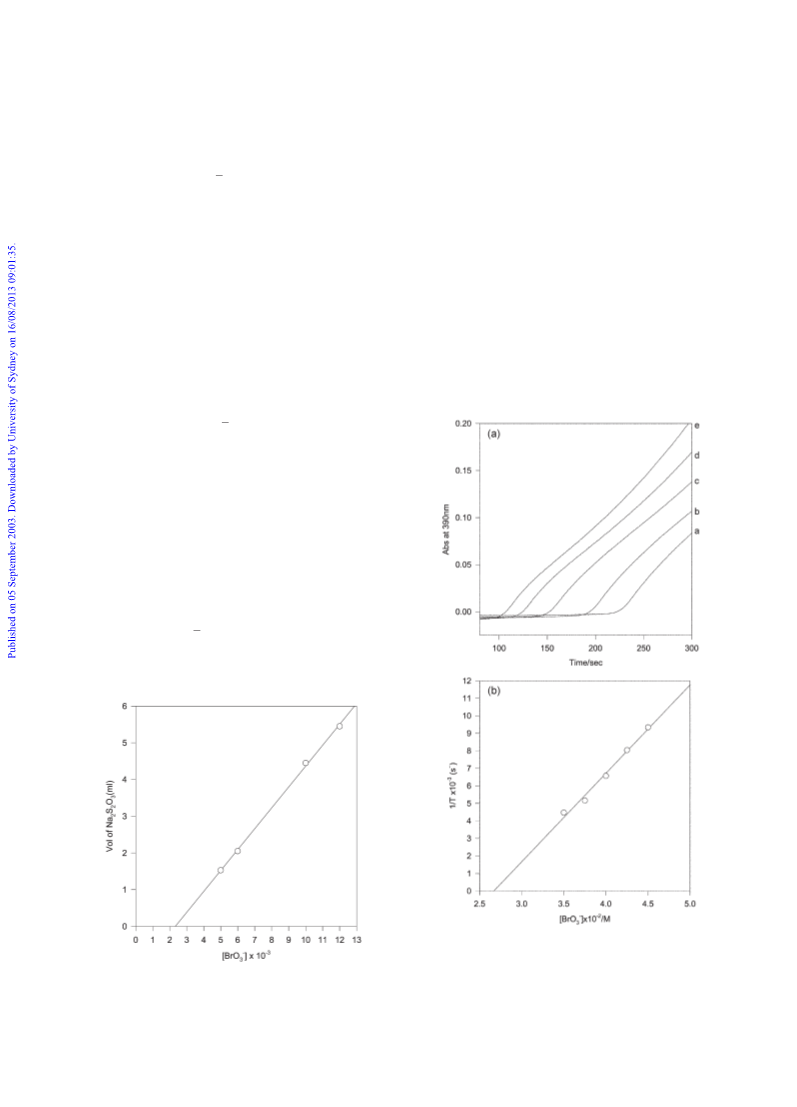
could be obtained by extrapolation: bromate was varied for
fixed set of acid and FDS concentrations for ratios that pro-
duce bromine (excess oxidant). At the end of the reaction the
excess oxidizing power was measured via an iodometric titra-
tion in which excess iodide was added and the liberated iodine
titrated with standard thiosulfate:
X2 þ ½ðH2NðHN ÞCS ꢁ2 þ 2H2O
B
! 2H2Nð
B
NHÞCSOH þ 2Hþ þ 2Xꢀ ðR4Þ
If reaction (R4) is rapid (or in overwhelming excess of X2),
it will be kinetically inconsequential with respect to the rate
of consumption of thiourea. However, this manuscript will
examine if FDS is a viable intermediate in the oxidation of
thiourea.
Experimental
Materials
The following reagents were used without further purification:
sodium bromate, formamidine disulfide dihydrochloride
(FDS), 97% (Aldrich), perchloric acid (70–72%), sodium bro-
mide, bromine, sodium chloride, sodium thiosulfate (Fisher).
All the major reactants were assumed to be of high enough
purity with no need for further standardization. FDS solutions
were prepared just before use and were not kept for more than
48 h. These solutions were stored in dark Winchester bottles
and further protected from light by covering them with alumi-
num foil. Reaction solutions were prepared using singly
distilled water.
BrO3ꢀ þ 9Iꢀ þ 6Hþ ! Brꢀ þ 3I3ꢀ þ 3H2O
ðR5Þ
ðR6Þ
I3ꢀ þ 2S2O3 ! S4O62ꢀ þ 3Iꢀ
2ꢀ
The bromate–bromide reaction will not alter the value of the
thiosulfate titer obtained since it will be merely a rearrange-
ment of oxidizing species. One can then plot the volume of titer
obtained against the amount of bromate used. This plot will
give a straight line. This line is extrapolated to the bromate
volume axis for a value for zero titer and this intercept is the
4150
Phys. Chem. Chem. Phys., 2003, 5, 4149–4156

 Madhiri, Nicholas