344
L. Leclercq et al. / European Journal of Pharmaceutical Sciences 46 (2012) 336–345
charges. For
a
-CD/[DiC10] mixture, the f-potential remains con-
leading to a loss of efficiency. The developed approach can be gen-
eralized to other types of amphiphilic or organic biocides. More-
over, due to the current interest in the development of new
biocidal formulations, work is currently underway in our labora-
tory to obtain more information on the self-assembly mechanism
of [DiC10] with CDs in the presence of surfactant mixtures such
as polyethoxylated alcohols.
stant due to the weak amount of free [DiC10] cations inserted in
the cell membrane.
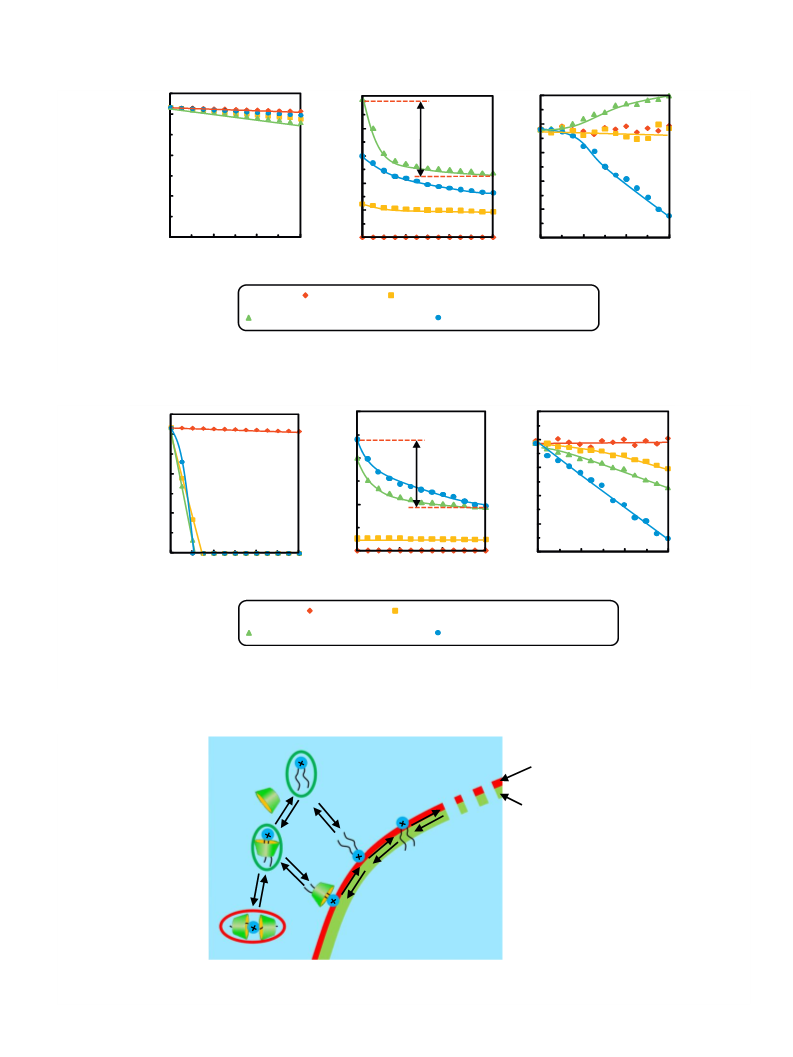
As depicted in Fig. 8, when the [DiC10][Cl] total concentrations
are higher than the MBC of the considered mixtures, cell lyses oc-
cur. For b- and
centrations (76 and 120
MBC of free [DiC10] cation (79
organism death) is due to a sufficient amount of free [DiC10] cat-
ions. However, the initial free [DiC10] concentration of -CD/
[DiC10] mixture is lower than the MBC of free [DiC10] cation (13
vs. 79 M). The observed antifungal activity is due to a progressive
release of [DiC10] cations by the complexes. This assumption is cor-
roborated by the loss of free ammonium cations: for -CD/[DiC10
mixture only 1 M is lost. Therefore, it is clear that the complexed
c
-CD/[DiC10] mixtures, the initial free [DiC10] con-
M, respectively) are higher than the
M): the biocidal activity (i.e. micro-
l
l
Acknowledgments
a
We are grateful to Université Lille 1 and to Fonds Européen de
Développement Régional (FEDER) for financial support. We are
grateful to Chrystèle Pluchart (Laboratoires Anios, Sainghin,
France) for antifungal experiments. b-CD was a generous gift from
Roquette Frères (Lestrem, France).
l
a
]
l
cations are released and directly incorporated in the cell mem-
brane. The same behavior can be invoked for b-CD/[DiC10] mixture:
References
the ammonium loss is only 53
the ammonium loss is around 72
cations). Therefore, the biocidal activity of
l
M. For the
c-CD/[DiC10] mixture,
Arun, R., Ashok, K.C.K., Sravanthi, V.V.N.S.S., 2008. Cyclodextrins as drug carrier
molecule: a review. Sci. Pharm. 76, 567–598.
Ashman, R.B., Blanden, R.V., Ninham, B.W., Evans, D.F., 1986. Interaction of
amphiphilic aggregates with cells of the immune system. Immunol. Today 7,
278–283.
Balgavy, P., Devinsky, F., 1996. Cut-off effects in biological activities of surfactants.
Adv. Colloid Int. Sci. 66, 23–63.
Cocera, M., Lopez, O., de la Maza, A., Parra, J.L., Esteerich, J., 1999. Electrokinetic
study of the sublytic interaction of alkyl sulfates with phosphatidylcholine
liposomes. Langmuir 15, 2230–2233.
lM (i.e. the MBC of free [DiC10
]
c
-CD/[DiC10] mixture
is only due to free [DiC10] cations. It is noteworthy that c-CD can
complex only one [DiC10] cation and that the association constant
is weaker than the two other 1:1 complex (see Table 1). The f-po-
tential behavior over time supports the proposed mechanisms. For
the
free ammonium available in the solution. In contrast, the f-poten-
tial decrease weaker for the -mixture and b-CD/[DiC10] mixtures
c-CD/[DiC10] mixture, the f-potential decrease is due to the
Collinet-Fressancourt, M., Leclercq, L., Baudoin, P., Aubry, J.-M., Nardello-Rataj, V.,
2011. Counter anion effect on the self-aggregation of dimethyl-di-n-
a
octylammonium cation:
a
dual behavior between hydrotropes and
because the free CDs remain in the vicinity of the cell membrane.
Indeed, when the total [DiC10] concentration is above the MBC of
the considered mixture, the amplitude of f-potential decrease is
surfactants. J. Phys. Chem. B 115, 11619–11630.
Cybulski, J., Wis´niewska, A., Kulig-Adamiak, A., Lewicka, L., Cieniecka-
Rosłonkiewicz, A., Kita, K., Fojutowski, A., Nawrot, J., Materna, K., Pernak, J.,
2008. Long-alkyl-chain quaternary ammonium lactate based ionic liquids.
Chem. Eur. J. 14, 9305–9311.
in the following order: free [DiC10] cations (ꢁ9.6 mV) >
c-CD/
[DiC10 (ꢁ3.2 mV) > -CD/[DiC10
]
(ꢁ6.8 mV) > b-CD/[DiC10
]
a
]
Debouzy, J.C., Fauvelle, F., Crouzy, S., Girault, L., Chapron, Y., Göschil, M., Gadelle, A.,
(ꢁ1.8 mV). The same behavior is observed when the total [DiC10
]
1998. Mechanism of a-cyclodextrin induced hemolysis 2. A study of the factors
controlling the association with serine-, ethanolamine-, and choline-
phospholipids. J. Pharm. Sci. 87, 59–66.
concentration is comprised between the MIC and the MBC of the
considered mixture. This observation can be used to explain the
D’Enfert, C., Hube, B. (Eds.), 2007. Candida: Comparative and Functional Genomics.
Caister Academic Press, Norfolk.
del Burgo, P., Aicart, E., Junquera, E., 2007. Mixed vesicles and mixed micelles of the
cationic–cationic surfactant system: didecyldimethylammonium bromide/
dodecylethyl dimethylammonium bromide/water. Colloids Surf. A 292, 165–
172.
cell growth inhibition observed principally with
(see the MIC values).
a- and b-CDs
4. Conclusion
Denyer, S.P., 1995. Mechanism of action antibacterial biocides. Int. Biodeter.
Biodegr. 36, 227–245.
Fauvelle, F., Debouzy, J.C., Crouzy, S., Göschl, M., Chapron, Y., 1997. Mechanism of
alpha-cyclodextrin-induced hemolysis. 1. The two-step extraction of
phosphatidylinositol from the membrane. J. Pharm. Sci. 86, 935–943.
Antifungal properties of the double-tailed quaternary ammo-
nium surfactant, di-n-decyldimethylammonium chloride, have
been estimated by the measurement of the minimum biocidal con-
centrations (MBC) and minimum inhibitory concentrations (MIC)
ˇ
Ferraz, R., Branco, L.C., Prudêncio1, C., Noronha, J.P., Petrovski, Z., 2011. Ionic liquids
as active pharmaceutical ingredients. ChemMedChem 6, 975–985.
Funasaki, N., Ishikawa, S., Neya, S., 2008. Advances in physical chemistry and
pharmaceutical applications of cyclodextrins. Pure Appl. Chem. 80, 1511–1524.
Funasaki, N., Neya, S., 2000. Multiple complexation of didecyldimethylammonium
bromide and cyclodextrins deduced from electromotive force measurements.
Langmuir 16, 5343–5346.
Gaillard, P., Carrupt, P.A., Testa, B., Boudon, A., 1994. Molecular lipophilicity
potential, a tool in 3D QSAR method and application. J. Comput. Aided Mol. Des.
8, 83–96.
with or without
a-, b- and c-CDs. The results demonstrate that
[DiC10] cations, encapsulated in the CD, can act as efficient anti-
fungal agents against C. albicans. The resulting activity is at least
comparable to that of the free [DiC10] depending on the CD choice.
Moreover, for b-CD/[DiC10] mixture, synergistic inhibition of cell
growth is observed due to the presence of cyclodextrin in the vicin-
ity of the cell membrane. The antifungal mechanism of free or
encapsulated [DiC10] biocide has been investigated from in silico
(molecular properties calculation and molecular dynamics) and
in vitro analyses (antifungal activity, potentiometry and zetame-
try). The proposed antimicrobial mechanism for CDꢃ[DiC10][Cl]
complexes is based on the mechanism of free [DiC10] cation with
four-steps: (i) the positively-charged complex diffuses through
the solution, (ii) it adsorbs onto the fungus membrane surface by
electrostatic interaction, (iii) then it dissociates and the ammo-
nium inserts into the microorganism membrane, and (iv) the
change of the cell surface charge induces cell lysis (Fig. 9).
Henriques, M., Azeredo, J., Oliveira, R., 2004. Adhesion of Candida Albicans and
Candida dubliniensis to acrylic and hydroxypatite. Colloids Surf. B 33, 235–241.
Hiramatsu, K., Kameyama, K., Ishiguro, R., Mori, M., Hayase, H., 2003. Properties of
dilute
aqueous
solutions
of
double-chain
surfactants,
alkyldodecyldimethylammonium bromides with a change in the length of the
alkyl chains. Bull. Chem. Soc. Jpn. 76, 1903–1910.
Hough, W.L., Smiglak, M., Rodríguez, H., Swatloski, R.P., Spear, S.K., Daly, D.T.,
Pernak, J., Grisel, J.E., Carliss, R.D., Soutullo, M.D., Davis, J.H., Rogers, R.D., 2007.
The third evolution of ionic liquids: active pharmaceutical ingredients. New J.
Chem. 31, 1429–1436.
Hough-Troutman, W.L., Smiglak, M., Griffin, S., Reichert, W.M., Mirska, I., Jodynis-
Liebert, J., Adamska, T., Nawrot, J., Stasiewicz, M., Rogers, R.D., Pernak, J., 2009.
Ionic liquids with dual biological function: sweet and anti-microbial,
hydrophobic quaternary ammonium-based salts. New J. Chem. 33, 26–33.
Jeulin, H., Grancher, N., Kedzierewicz, F., Finance, C., Le Faou, A.E., Venarda, V., 2008.
In vivo antiviral activity of ribavirin/a-cyclodextrin complex: evaluation on
Besides the fact that cyclodextrins are biocompatible, they can
be seen as reservoirs of the amphiphilic quaternary biocide avoid-
ing at the same time, its spontaneous self-aggregation with poly-
ethoxylated alcohols in detergent/disinfectant formulations
experimental measles virus encephalitis in mice. Int. J. Pharm. 357, 148–153.
Klamt, A., Schümann, G., 1993. COSMO: a new approach to dielectric screening in
solvents with explicit expressions for the screening energy and its gradient. J.
Chem. Soc. Perkin Transactions 2, 799–805.

 Leclercq, Lo?c